Artificial Intelligence in after-sales is no longer about flashy demos or generic chatbots. The real opportunity is operational: taking complex, high-stakes service workflows and making them faster, more accurate, and more profitable. Service organizations are under pressure to “do more with less” while keeping uptime high and customers loyal – as argued in my Service Trends 2025 piece. The most impactful AI projects are narrow, measurable, and tightly integrated into the end-to-end service journey – not point tools that create more handoffs and data friction.
In this article, we’ll explore real-world AI use cases in customer support, parts management, field service, and warranty – what challenges they address, what KPIs they improve, and the complexity involved in making them work. We’ll also discuss AI’s current limitations, precautions, and how to build a realistic AI roadmap.
The AI Opportunity Map for After-Sales
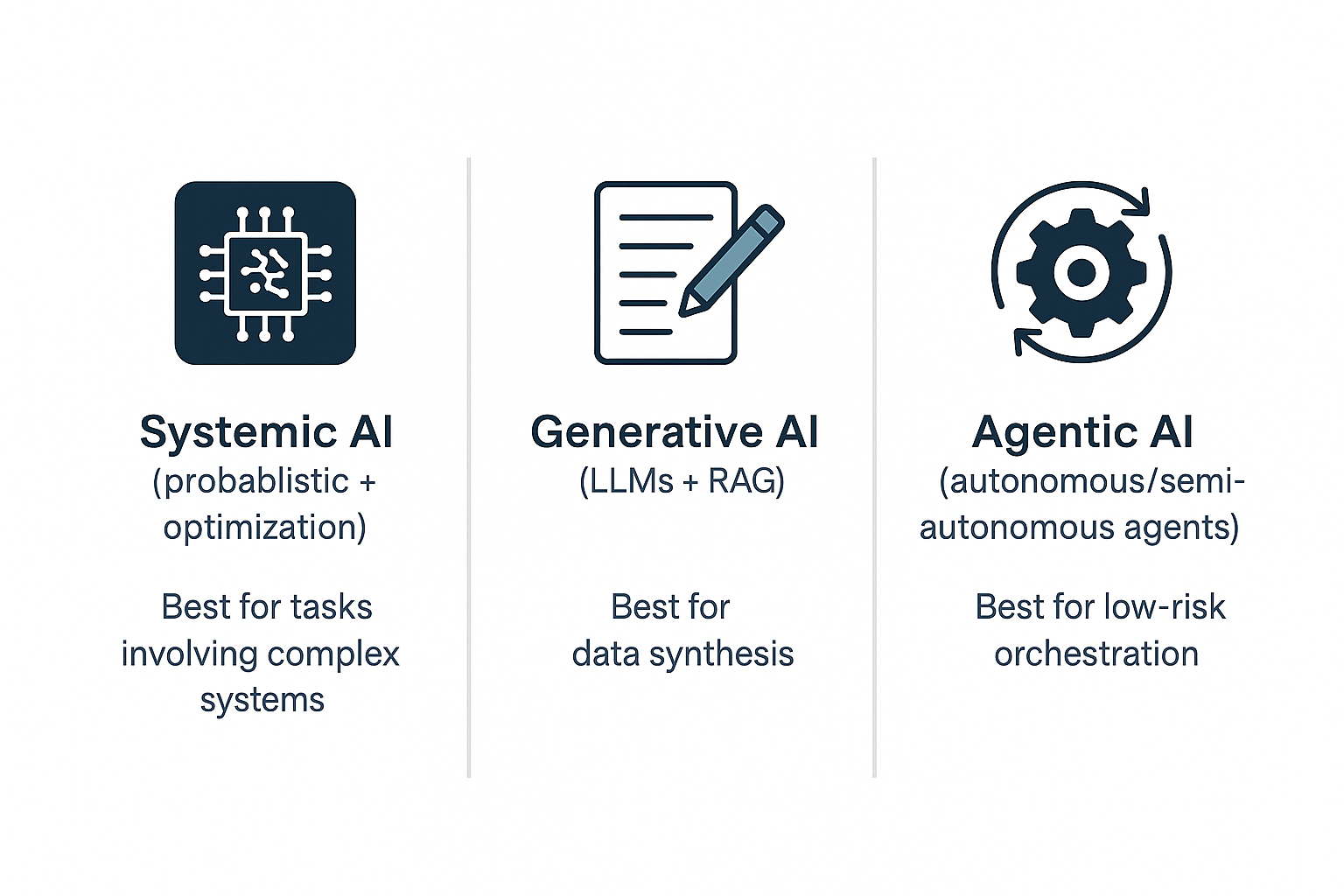
AI comes in different flavors – and the business question is: which flavor fits which problem?
- Systemic AI (probabilistic + optimization): Best for parts forecasting, multi-echelon inventory optimization and scheduling optimization.
- Generative AI (LLMs + RAG): Best for synthesizing manuals, generating repair playbooks, and producing customer-ready narratives.
- Agentic AI (autonomous/semi-autonomous agents): Best for low-risk orchestration – booking, reassigning, and chasing down predictable exceptions under policy rules.
Use a fit-for-purpose approach – map the AI type to the part of the journey you’re trying to improve, and always think end-to-end, not just touchpoint by touchpoint.
High-Impact Use Cases
Section Below are five composable, high-impact plays you can pilot and scale. Each is written as a mini business case, with maturity and pilot suggestions.
| Use Case | Primary Theme | Strategic Value |
|---|---|---|
| AI Repair Playbooks to Empower Frontline Support | Service Differentiation | Strategic Value |
| Probabilistic Multi-Echelon Parts Orchestrator | Cost Reduction | Reduced inventory, better parts availability |
| Autonomous Field-Operational Agents | Revenue Growth | Monetizes urgency, maximizes margins |
| Predictive Warranty Reserve & Product Health Modeling | Competitiveness | More accurate financials, pricing agility |
| Customer Companion: Persistent, Contract-Aware Bot | Cost Reduction + Differentiation | Lower support costs, unique technician experience |
Use Case A – AI Repair Playbooks to Empower Frontline Support
In industrial manufacturing, equipment often arrives at the customer site with unique configurations or retrofits that make generic manuals almost useless in troubleshooting. When a customer calls, support agents – especially those newer to the role – face a major challenge: identifying the root cause quickly enough to prevent costly downtime.
Without immediate, configuration-specific guidance, they either spend excessive time searching through scattered resources (manuals, PDFs, tribal knowledge) or escalate prematurely to field service, triggering delays and higher costs. This complexity compounds when historical service records, warranty terms, and IoT telemetry data are siloed across systems, leaving agents without a complete operational picture.
Possible AI interventions
- Contextual diagnosis: Grounded Generative AI (LLM + Retrieval-Augmented Generation) analyzes the customer’s asset data in real time to create a targeted repair playbook.
- Data fusion: Pulls from the asset’s serial number, live telemetry snapshot, historical work orders, warranty data, and OEM documentation.
- Actionable outputs: Generates annotated images, step-by-step triage instructions, likely failure points, required parts list, estimated resolution time, and safety protocols.
- Optimized routing: Suggests the correct field team or specialist if escalation is required, with pre-filled work order details to save time.
- Continuous learning: Uses feedback from completed support cases to refine the accuracy and relevance of future playbooks.
KPIs Impacted
- First-Time Fix Rate
- Mean Time To Repair
- Cost per visit
- Service attach/ upsell conversion
Use Case B – Probabilistic Multi-Echelon Parts Orchestrator
Parts planning for field service operates in a delicate balance between financial prudence and operational readiness. Service leaders must decide how much to stock at each tier – central warehouses, regional depots, and technician vans – without over-committing capital or risking stockouts. When forecasting is wrong, the costs are real: excessive carrying costs, emergency freight charges, extended downtime for critical equipment, and frustrated customers.
Siloed decision-making between inventory planners, service operations, and procurement further compounds inefficiencies. The complexity multiplies when factoring in telemetry signals, seasonal patterns, supplier lead times, and the variable criticality of parts.
Possible AI interventions
- Probabilistic SKU-level demand forecasting at each echelon (central → depot → van) that accounts for uncertainty, lead times, and service urgency probabilities.
- Multi-objective optimization engine that continuously balances carrying cost, SLA adherence, and expedite cost trade-offs to find the economically optimal stocking strategy.
- Telemetry-linked failure forecasting that dynamically updates stocking plans in anticipation of predicted breakdowns in the installed base.
- Automated nightly van inventory rebalancing to ensure technicians start their day fully prepared, with parts sourced from the nearest optimal location to minimize delays.
- Simulation sandbox to test the impact of supplier delays, demand spikes, or SLA changes before implementing stocking adjustments.
KPIs Impacted
- Inventory Carrying Cost
- Stockouts
- Expedite Spend
- Mean Time to Repair
Use Case C – Autonomous Field-Operational Agents
Field service scheduling isn’t just about finding an open slot – it’s a high-stakes puzzle where technician skill, parts availability, customer urgency, and travel time all intersect. During seasonal spikes, major outages, or post-product recalls, dispatchers face an overwhelming queue of incoming jobs. The pressure to act quickly often forces compromises: assigning a technician without the ideal skill set, routing inefficiently, or dispatching without confirming parts readiness.
These shortcuts erode first-time-fix rates, inflate travel costs, and frustrate customers. In multi-region operations, bottlenecks in one dispatch center can cascade into neighboring territories, causing systemic slowdowns. The current reliance on human schedulers for real-time decision-making limits responsiveness and consistency.
Possible AI interventions
- Causal triage models interpret fault data, job history, and contextual metadata to determine probable root cause, required skills, parts dependencies, and estimated repair duration before a job even enters the scheduling queue.
- Agentic AI orchestration autonomously manages low- to medium-risk tasks from start to finish: job creation, skill-based technician selection, real-time parts reservation, optimal routing, and automated customer notifications with live ETA updates.
- Dynamic conflict negotiation where the AI resolves overlapping job requests, SLA conflicts, or sudden priority changes within defined operational guardrails, only escalating exceptions or ambiguous cases to human planners.
- Self-learning optimization that adapts routing, assignment rules, and prioritization logic over time based on performance metrics like first-time-fix rate, travel efficiency, and SLA compliance.
KPIs Impacted
- Time to Dispatch
- Scheduling cost
- First time fix rate
- SLA compliance
Use Case D – Predictive Warranty Reserve & Product Health Modeling
Warranty accounting is both a financial control exercise and an early-warning system for product health – yet in many organizations, the two functions operate independently. Finance often calculates reserves using simple lag-based averages, overlooking emerging defect patterns that engineers might catch months later. This creates two risks: financial surprises when claims suddenly spike, and brand damage when systemic defects remain unresolved in the field.
The challenge lies in connecting disparate data sources – production lots, service tickets, telemetry, supplier quality reports – into a coherent risk picture at both the cohort and serial-number level. In regulated industries, late detection of systemic failures can also trigger compliance issues and costly recalls.
Possible AI interventions
- Integrated predictive modeling that blends telemetry, claims history, manufacturing data, supplier defect rates, and parts replacement costs to detect emerging risk patterns before they are visible in lagging metrics.
- Cohort and serial-level risk scoring to isolate specific production runs, geographies, or usage conditions associated with higher failure probability.
- Probabilistic reserve forecasting that feeds finance with forward-looking scenarios, allowing more accurate reserve allocation and fewer end-of-quarter adjustments.
- Closed-loop engineering alerts that trigger preemptive corrective actions such as supplier part redesigns or targeted maintenance campaigns before failures escalate.
KPIs Impacted
- Reserve Accuracy
- Reliability
- Warranty Spend
- Issue detection time
Use Case E – Customer Companion: Persistent, Contract-Aware Bot
For most customers, interacting with a service organization means navigating silos – a chatbot for basic queries, a separate portal for warranty claims, and phone calls for scheduling. Even when the same company is handling the request, each touchpoint often “forgets” prior interactions. This fragmented experience wastes time, erodes trust, and increases the likelihood of misaligned expectations (e.g., discovering mid-visit that a repair isn’t covered).
Enterprises with complex service contracts – tiered entitlements, conditional SLAs, or asset-specific coverage – struggle to give customers a single, coherent narrative across the service journey. The absence of a persistent, context-aware point of contact leaves customers feeling like they have to restart the conversation at every stage.
Possible AI interventions
- Persistent, contract-aware AI assistant that maintains full context of the customer, their assets, service history, and entitlements across every channel – web, mobile, phone, or email.
- Telemetry-driven proactive engagement, where the bot reaches out when anomalies suggest an impending issue, offering preemptive troubleshooting or scheduling.
- Adaptive self-service guidance for low-complexity fixes, with seamless escalation to human agents or technicians when required.
- Dynamic entitlement interpretation so customers receive accurate, real-time clarity on coverage before scheduling work, avoiding disputes and delays.
- Lifecycle engagement with personalized training tips, maintenance reminders, and usage insights tailored to each asset’s health and history.
KPIs Impacted
- Self-service deflection
- Time to resolution
- CSAT/ NPS
- Attach/ Renewal rates
Where AI Falls Short Today
Even the most advanced AI systems can stumble when deployed in complex, high-stakes environments like customer support for industrial equipment. Understanding where AI can fail, and proactively mitigating those risks, is critical to avoiding costly mistakes. Some of the key risks are:
- Governance & auditability: AI making financial or customer-impacting decisions needs traceability and rollback capability.
Mitigation: Maintain transparent audit logs with clear evidence for each automated decision. - Data fragmentation: Models underperform when they don’t have access to unified, canonical master data (assets, parts, contracts).
Mitigation: Establish a single source of truth with ongoing data quality checks. - Context limits & hallucinations: Generative models can produce plausible but incorrect steps if they lack proper grounding.
Mitigation: Require source links and human approval for warranty-affecting outputs. - Change & adoption: Without agent buy-in, automation can create resistance and increase workarounds.
Mitigation: Involve users early in co-design and training to drive adoption.
Building a Realistic AI Roadmap for After-Sales Service
Many AI initiatives fail not because the technology isn’t ready, but because the business tries to run before it can walk. In after-sales, the stakes are high – service downtime, customer trust, and revenue all hang in the balance. A realistic roadmap ensures that AI adoption moves from foundational readiness to measurable value, while avoiding “shiny object” traps.
The goal is to connect AI capabilities to real operational KPIs, phasing investments so each stage funds and informs the next. Here’s a phased approach to building an AI enabled service organization.

Final Thoughts
AI in after-sales delivers real, measurable value when anchored to the full customer journey and business-critical KPIs. Begin with two pilots – one for quick ROI, one for long-term strategic impact – and scale toward seamless orchestration. With strong governance, grounded data, and clear success metrics, after-sales can evolve from a cost center into a revenue growth engine and a source of competitive differentiation.