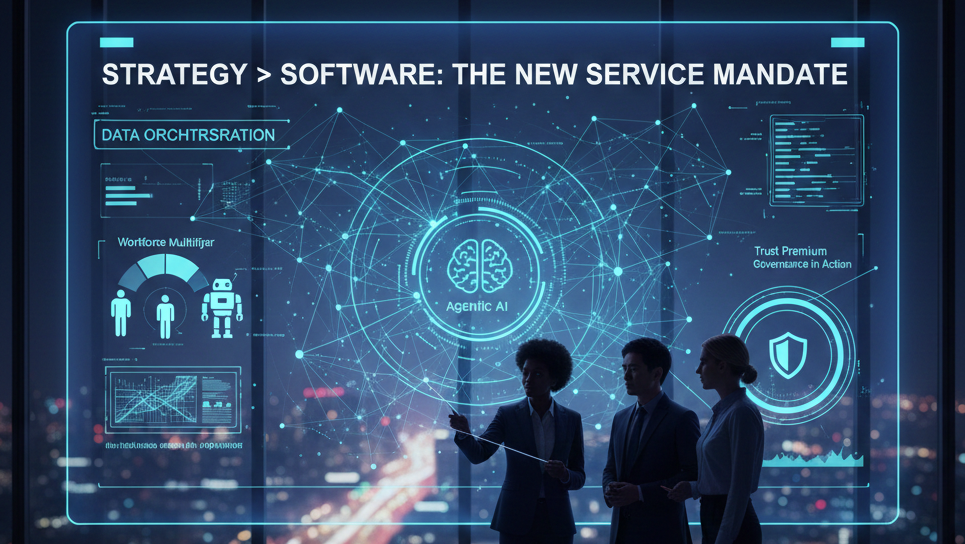
The “AI Age” has arrived at a paradoxical moment for service leaders: budgets are tightening, the talent pool is shrinking, and yet customer expectations for instant, personalized resolution are at an all-time high. To survive, leaders must move past the hype of “predictive” buzzwords and embrace a pragmatic roadmap of Data Orchestration and Human-AI Force Multiplication. This article outlines the three strategic pillars for leading a lean, high-impact service organization in the post-AI hype era.
Pillar 1: Orchestration Over Prediction
For years, the industry has chased “predictive service,” the idea that we can fix problems before they happen. While a noble goal, Gartner warns that fragmented data and the prohibitive cost of “Digital Twins” have made this unreachable for many. In the AI age, the focus must shift from predicting the future to orchestrating the present.
The Pragmatic Shift: Instead of complex simulations, focus on Data Fluidity. Use AI to unify “siloed” customer history so that whether a customer hits a bot or a human, the context is immediate.
The Goal: Eliminate the “Customer Effort” of repeating their story.
Executive Insight: IDC calls this the “Agentic Pivot“, where AI moves from a simple chatbot to an “agent” capable of navigating your internal systems to actually do the work. In 2026, the focus isn’t just a chatbot that talks, but “Agentic AI” that can navigate internal ERP and CRM systems to execute tasks autonomously. Success is no longer measured by how well a bot answers a question, but by how many backend systems it can securely “orchestrate” to solve a problem without human intervention.
By 2026, 65% of organizations will adopt Composite AI, combining generative and predictive models to create reliable, explainable workflows rather than just conversational ones.
Pillar 2: The “Force Multiplier” Workforce
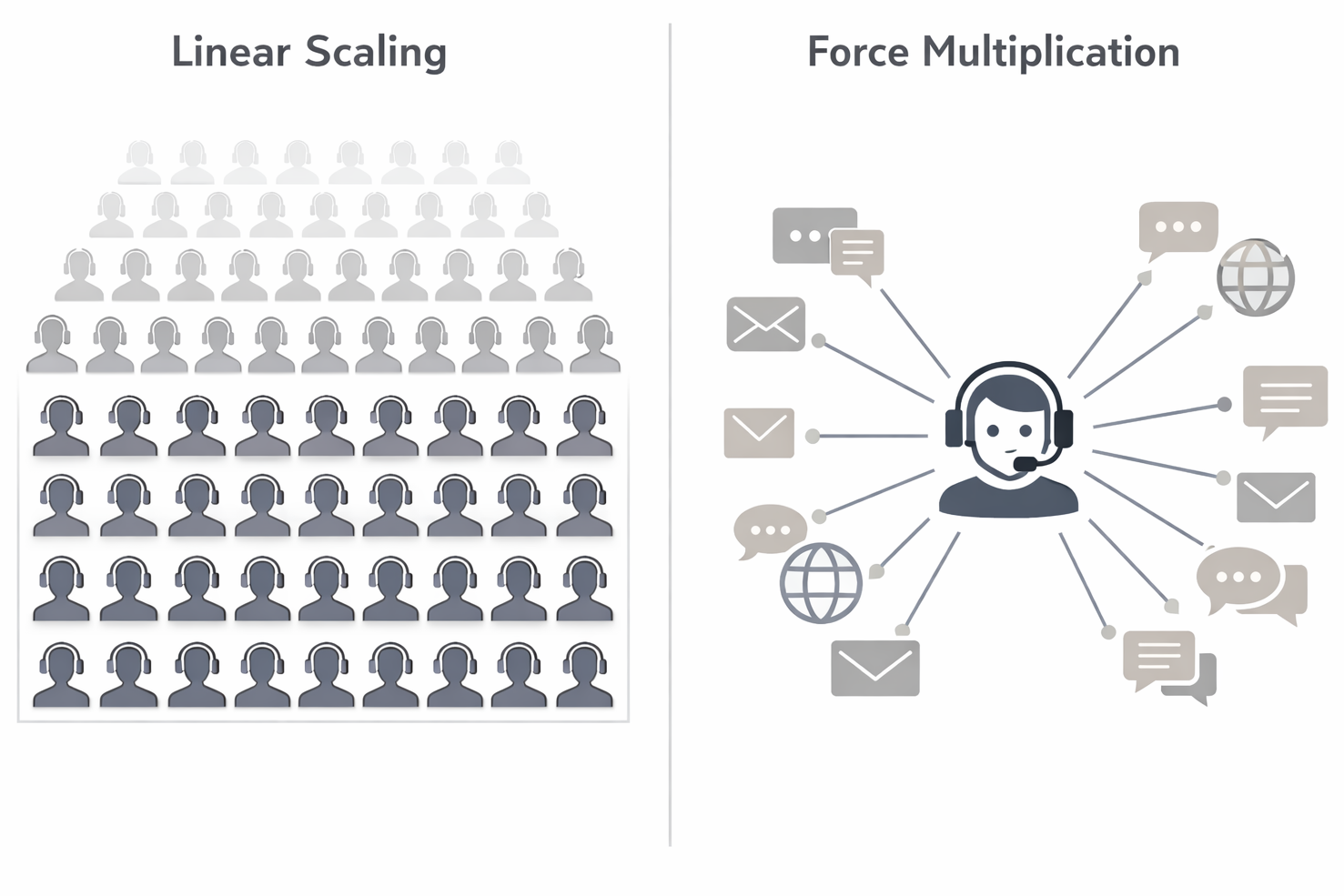
The most pressing reality for service leaders today is the shrinking workforce. Leaders are being asked to maintain, or improve, CSAT with significantly fewer resources. The old model was Linear Scaling (More customers = More agents). In the AI-first operating model, we shift to Exponential Capacity (Fixed headcount + AI Force Multipliers).
The Pragmatic Shift: Use AI to handle the “Tier 0” noise, the 70% of repetitive status checks and password resets. This allows your remaining human team to be re-skilled not as “support reps,” but as Relationship Managers.
The Goal: Transform your service department from a cost center into a Value Engine by ensuring humans only touch high-stakes, high-emotion cases.
Executive Insight: Gartner research reveals that despite fears of mass displacement, the winning strategy is Efficiency Reinvestment. In the AI age, leaders aren’t just cutting heads; they are using AI to maintain stable staffing levels while handling massive surges in volume. The “Force Multiplier” effect is what allows a lean team to survive a 40% increase in customer interactions without a corresponding 40% increase in budget.
Pillar 3: Governance as the “Trust Premium”
As automation becomes the standard in the modern service economy, Human Trust becomes a luxury good. ISG notes that “lack of governance” is the single biggest hurdle to scaling AI business benefits, with satisfaction scores dipping as enterprises struggle with AI reliability and “hallucinations.”
The Pragmatic Shift: Implement Human-in-the-Loop (HITL) auditing. High-value accounts and high-emotion triggers (like “cancellation” intent) must bypass AI entirely to protect the brand.
The Goal: Build “Digital Provenance”, the ability to prove the origin and integrity of your data and decisions to a skeptical customer base.
Executive Insight: Leadership integration is currently the greatest bottleneck. Research from ISG reveals that while 93% of organizations use AI, only 7% have fully embedded AI governance into their pipelines. In the era of scalable intimacy, the competitive advantage isn’t the fastest bot, but the most “trusted” ecosystem where AI decisions are auditable, bias-checked, and safely tethered to human oversight.
By 2027, 50% of organizations that planned to significantly cut their service workforce will reverse course, realizing that human agents are irreplaceable for ‘nuanced’ situations and brand loyalty.
The Modern Mandate: An Executive Audit
Before investing in the next “shiny object,” ask your team these three diagnostic questions to determine your organization’s AI maturity:
- The “Context Test”: Does our AI have real-time access to our CRM, ERP, and billing data, or is it just a fancy FAQ search? (True Data Orchestration requires the former).
- The “Noise Test”: What percentage of our human agents’ time is spent on “Bot Work”—the low-value, repetitive tasks that drain your highest-paid talent?
- The “Trust Test”: Do we have a formal AI oversight committee that audits bot-customer interactions for accuracy, hallucinations, and brand alignment?
Take the Next Step
If you struggled to answer “Yes” to all three, you aren’t alone. Most organizations are still in the “Reactive” phase of service. To help you benchmark your progress, use our Service-Led Growth Readiness Checklist. This tool will help you identify exactly where your “Force Multipliers” are missing and how to close the gap between your current tech stack and your 2026 goals.
Conclusion: The New Architecture of Service
Service leadership in the AI age is no longer about managing people; it’s about managing an ecosystem of talent and technology. The shift from linear scaling to exponential capacity requires a fundamental change in how we view the service department.
Those who move beyond the hype to focus on Orchestration and Force Multiplication will do more than just cut costs, they will transform their department from a cost center into a resilient engine of brand loyalty and service-led growth.