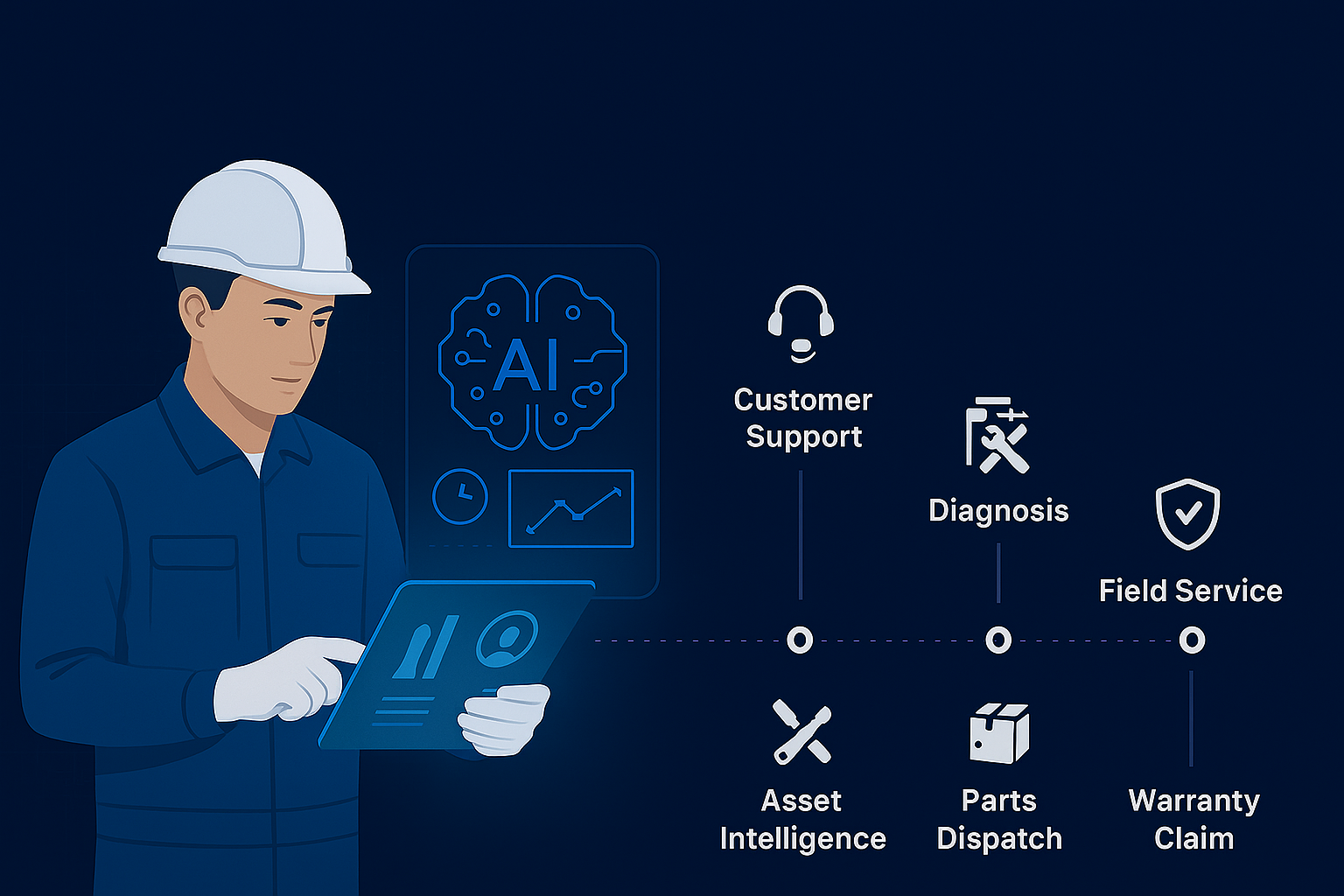

Service transformation initiatives in manufacturing and automotive organizations rarely fail outright. In fact, most begin with strong leadership sponsorship, clear KPIs, and visible early wins. Systems are implemented, teams are trained, and dashboards begin reporting improvements. From the outside, these programs look successful.
Yet talk to service leaders a year or two later, and a different story often emerges. Momentum has slowed. KPIs have plateaued. Promised outcomes feel partially realized at best. What was meant to be a step change becomes a steady state.
This article explores why that happens, not from a theoretical lens, but from the reality of how service transformations are implemented, funded, governed, and ultimately left to run.
- The Promise vs. Reality of Service Transformation
- The Expectation–Reality Curve No One Plans For
- Agile Delivery, Fixed Thinking
- When Delivery Becomes the Goal (and Outcomes Get Lost)
- The Budget Cliff and the Illusion of Completion
- The Risky Shift from Transformation to Support
- What Breaks the Stalling Pattern
- Rethinking Year 2: From Execution to Stewardship
The Promise vs. Reality of Service Transformation
Most service transformations start with a clearly articulated ambition. Leadership teams align on outcomes such as improved service efficiency, better customer experience, or scalable service revenue growth. These goals are translated into requirements, KPIs, and delivery plans, creating confidence that the organization knows where it is headed.
The challenge is not intent. The challenge is what happens once implementation begins and the organization assumes that outcomes will naturally follow execution.
- Transformation is often treated as something that will happen automatically once systems are live
- Early improvements create confidence that the program is “on track,” even before behaviors change
- Execution success is mistaken for outcome realization
- Over time, the original ambition becomes implicit rather than actively managed
The Expectation–Reality Curve No One Plans For
There is a predictable curve that most service transformations follow, even if it is rarely discussed openly. Leadership interest and expectations peak early, when the initiative is launched and positioned as strategic. As delivery progresses, attention shifts toward milestones and timelines. Eventually, the program is considered achieved simply because it is underway.
This creates a widening gap between expectation and reality.
- Leadership attention moves on once execution appears stable
- The initiative is labeled “done” before outcomes have fully materialized
- New programs are built on top of partially realized foundations
- Misalignment accumulates quietly across initiatives and systems
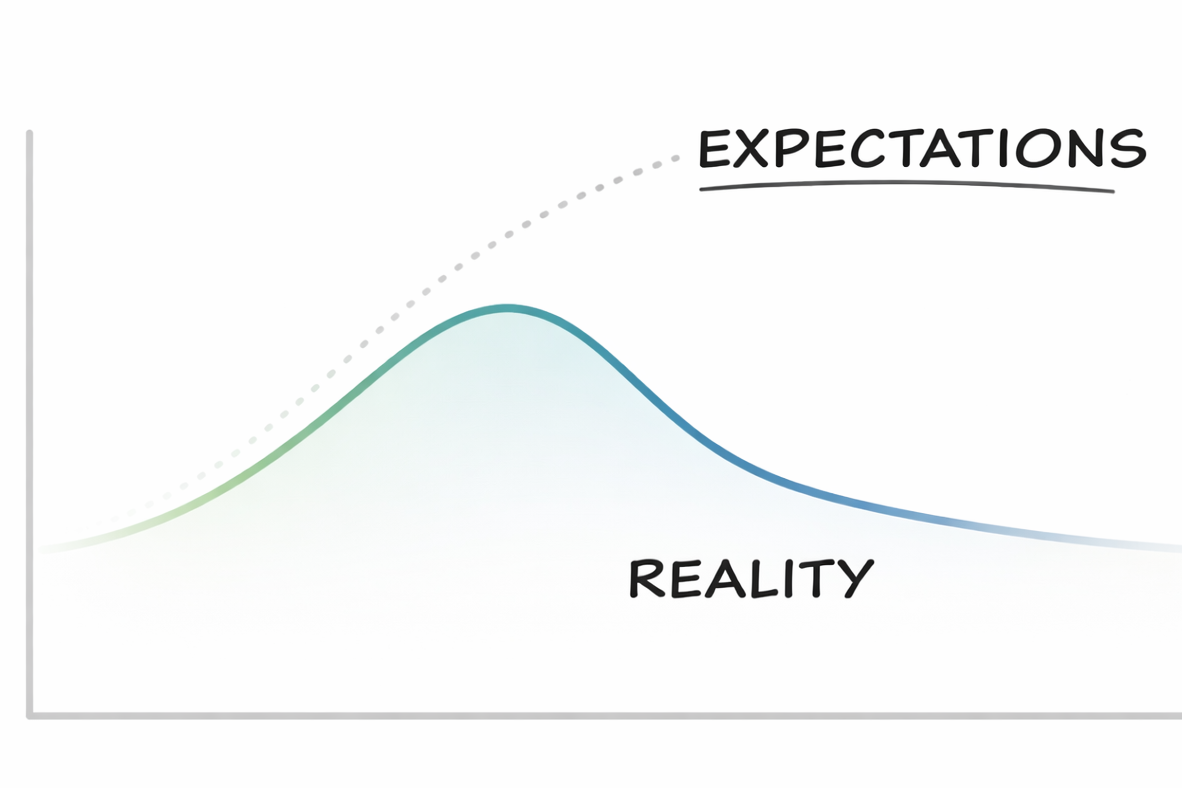
The result is not failure, but a fragmented series of well-intentioned implementations that never quite deliver what was originally envisioned.
Agile Delivery, Fixed Thinking
Many service transformations adopt agile delivery methods, but retain fixed assumptions about scope, success, and priorities. Requirements, KPIs, and success criteria are often locked early, based on what the organization believes it needs before real usage begins.
As the system goes live and users engage with real workflows, new insights emerge. These insights are often far more valuable than the original assumptions, but structurally difficult to act on.
- Backlogs become holding areas rather than prioritization tools
- Transformational ideas are deferred in favor of protecting timelines
- User-requested improvements that increase efficiency or usability are postponed
- Agility exists in delivery mechanics, not in decision-making

More mature organizations revisit priorities deliberately and treat learning as an expected output of implementation, not a disruption to it.
When Delivery Becomes the Goal (and Outcomes Get Lost)
As projects move forward, responsibility fragments across teams. Each group optimizes for what it is measured on, but no one remains accountable for the original transformation promise.
This is not a people problem, rather it is a structural one.
- Project teams focus on story completion and milestones
- Business teams focus on day-to-day operations such as case closure and renewals
- IT teams focus on stability and support readiness
- No single role owns outcome realization end-to-end
Without explicit ownership, transformations drift from purpose to process.
Who owns the outcome?
- Project teams deliver milestones.
- Business teams run operations.
- IT ensures stability.
Without a single owner accountable for value realization, transformation intent quietly dissolves.
The Budget Cliff and the Illusion of Completion
By the time a service transformation enters its second year, the funding narrative often changes. What began as a strategic initiative starts being viewed as a completed project. The core system is live, teams are using it, and early KPIs appear stable, creating the perception that major investment is no longer required.
In reality, Year 2 is when organizations begin to understand how the system truly performs at scale. Adoption gaps surface, inefficiencies become visible, and high-impact improvement ideas emerge. Unfortunately, this is also when budgets tighten and extending the program becomes difficult to justify.
- Budgets are front-loaded for deployment, not evolution
- High-ROI improvements are often discovered after stabilization
- Incremental funding becomes hard to defend against new priorities
- Value erosion happens quietly as organizations settle into a suboptimal steady state
The Risky Shift from Transformation to Support
Once initial implementation is complete, responsibility often shifts from project teams to support teams, primarily to reduce cost. While operationally sensible, this transition introduces a critical risk: intent is replaced by maintenance.
Support teams are designed to keep systems running, not to evolve them in line with strategic outcomes.
- Support focuses on stability, not transformation
- Continuous improvement loses sponsorship and urgency
- Behavioral and process changes slow down
- The system remains active, but the vision stalls
Transformation requires stewardship, not just system upkeep.
What Breaks the Stalling Pattern
Organizations that sustain momentum approach service transformation differently after go-live. Rather than declaring success, they deliberately protect the original intent through governance, ownership, and funding discipline.
These organizations typically:
- Maintain executive sponsorship beyond implementation
- Assign a clear owner accountable for outcome realization
- Review progress quarterly against intent, not just KPIs
- Re-prioritize backlog items based on business value
- Budget explicitly for post-implementation evolution
This is not about adding bureaucracy but about preventing value leakage.
Rethinking Year 2: From Execution to Stewardship
Year 2 should not be treated as a wind-down phase. It is the point at which transformation either compounds or stalls. Organizations that succeed reframe this phase as one of recalibration and learning, not closure.
- Execution gives way to stewardship
- Metrics evolve from activity to outcomes
- Leadership engagement becomes more selective, not absent
- The organization shifts from rollout to realization
This is where service transformations mature, or quietly plateau.
A Reflection for Service Leaders
Before considering a service transformation complete, it is worth asking:
- Do we still own the outcome, or just the system?
- Are KPIs improving because behaviors changed, or because reporting did?
- How many new ideas did we review, defer, and implement?
- Is anyone accountable for the objectives agreed at the start?
Service transformations rarely stall because teams stop working. They stall because attention shifts, ownership diffuses, and intent is assumed rather than managed.
Organizations that recognize this do not chase the next initiative prematurely. They stay with the harder work of realizing value long after implementation ends and that is what ultimately separates transformation success from transformation fatigue.