A few weeks ago, I watched a demo of Salesforce Agentforce where an AI agent handled a customer email inquiry end to end. The customer had written in asking about a replacement part. The agent understood the request, checked availability, generated a quote, and replied, without a human stepping in (unless something went wrong).
It was impressive, but not in the way most AI demos are impressive. What stayed with me wasn’t the chatbot. It was the implication.
If an AI agent can already manage customer inquiries, pricing, and parts availability at the front door of service, what happens when the entire aftersales value chain, from detection to delivery, starts working the same way?
Not as disconnected automations. Not as “AI features.” But as a coordinated, intelligent system that decides and acts at machine speed.
The more I see AI mature, the clearer it becomes that the real shift isn’t about replacing people. It’s about changing how service decisions are made, sequenced, and executed. This article is an attempt to think that future through calmly and realistically: what a fully autonomous service organization could look like, how it might actually work in automotive aftersales, and why getting there is as much about operating models as it is about technology.
What “Autonomous Service” Really Means in Aftersales
Before going any further, it’s worth slowing down on the word autonomous. It’s used so broadly today that it risks losing meaning.
When I say autonomous service, I don’t mean AI copilots, smarter dashboards, or faster ticket handling. I mean a model where detection, decision-making, and orchestration of service activities happen without human initiation, while humans remain essential for execution, judgment, and trust.
In this model, service no longer begins when:
- A customer calls
- An advisor opens a case
- A technician diagnoses a problem on site
Instead, service begins when the product itself signals that something is about to go wrong, and the organization already knows what to do about it. Most service organizations today are digitally enabled but operationally reactive. Autonomy is what allows service to become event-driven rather than request-driven.
This is part of a broader shift I’ve been writing about: from predictive insights that inform humans, to agent-led execution where systems are trusted to act within defined boundaries.
| Feature | Reactive (Current) | Autonomous (Future) |
|---|---|---|
| Trigger | Customer Complaint | Telemetry Signal |
| Diagnosis | Physical Inspection | Pattern Recognition |
| Warranty | Claims & Adjudication | Policy-as-Code (Pre-approved) |
| Parts | Ordered after arrival | Staged before arrival |
Autonomy in service isn’t about removing people. It’s about removing latency between signal and action.
Why Aftersales Is Naturally Suited for Autonomous Operations
There’s no shortage of discussion about AI replacing customer service. But focusing only on conversations misses where the real leverage is.
Aftersales is uniquely suited for autonomy because it sits at the intersection of high decision volume and high economic impact. Warranty eligibility, parts sourcing, dispatch choices, remote resolution, and goodwill decisions happen constantly, often across disconnected teams and systems.
In most organizations, service performance isn’t limited by technician capability. It’s limited by decision latency: the time it takes to decide what should be done, who should do it, and how it should be delivered.
That’s why autonomy matters.
80%
of common customer service issues will be autonomously resolved by AgenticAI without human intervention
These gains don’t come from faster technicians. They come from faster, better decisions.
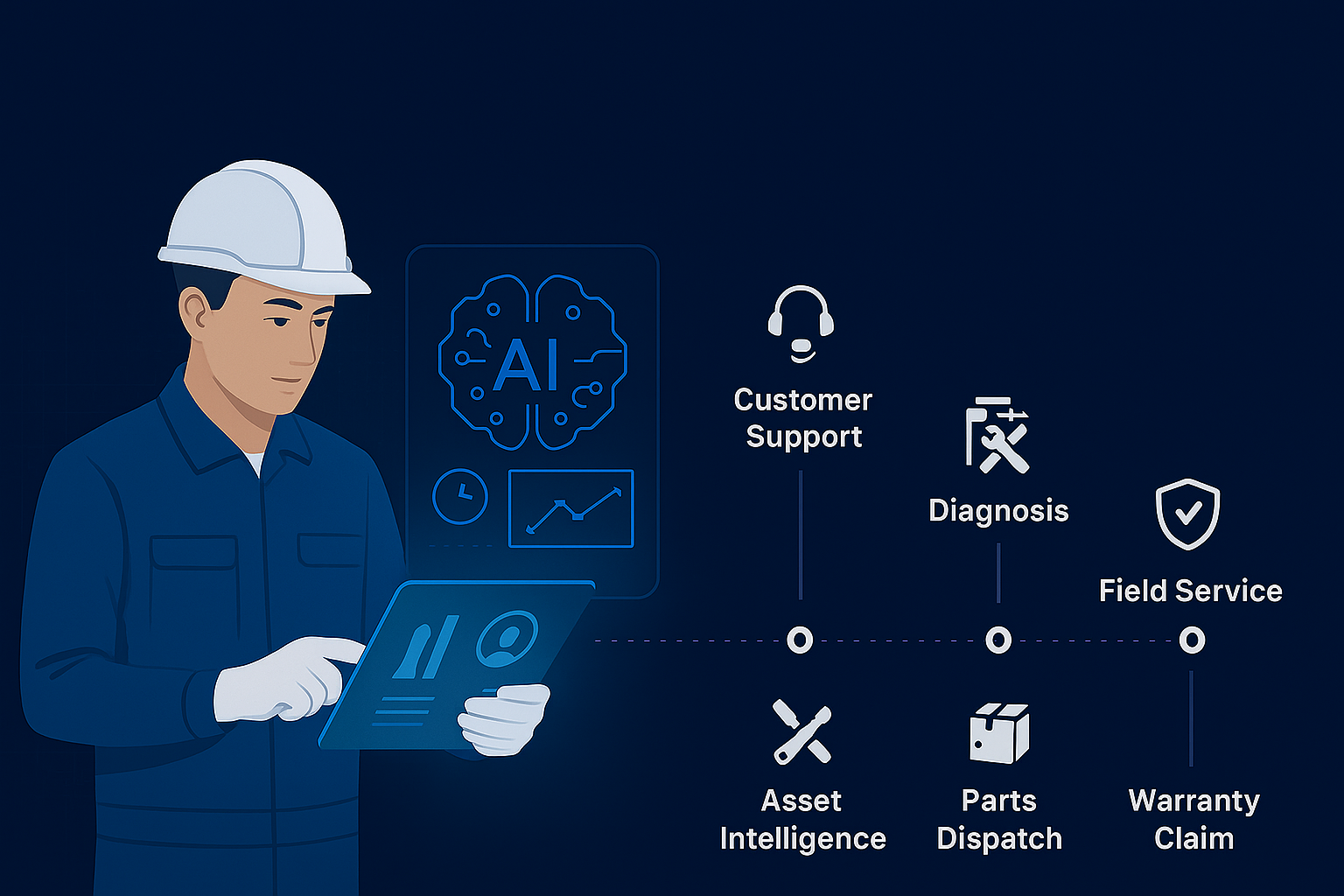
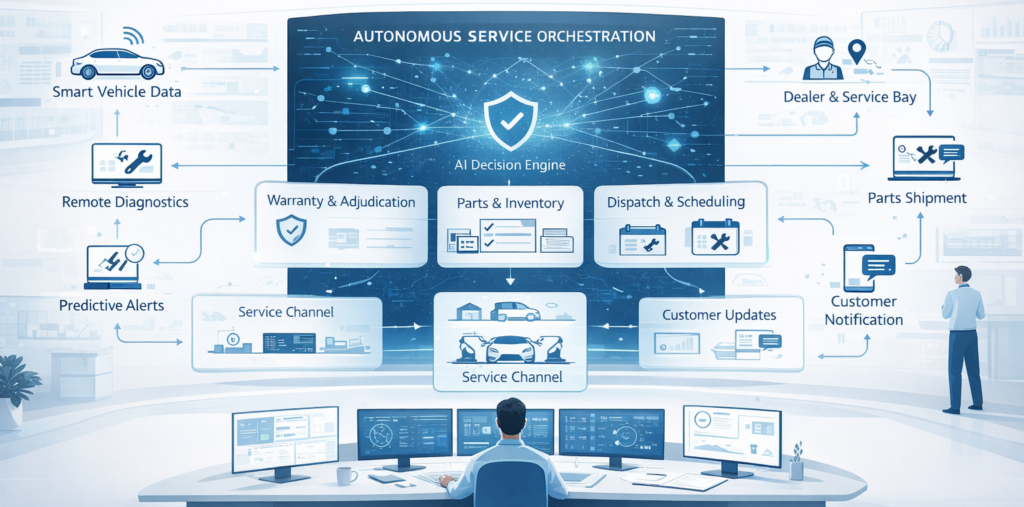
In a fully autonomous service organization, service no longer feels like a sequence of handoffs. There are no tickets bouncing between teams, no delays caused by missing approvals, and no uncertainty about what should happen next. Issues are detected by the product itself, decisions are made instantly based on confidence and policy, and execution is coordinated automatically across warranty, parts, dispatch, and service channels.
Customers don’t request service as much as they confirm it. Dealers don’t diagnose problems as much as they execute pre-orchestrated plans. Humans remain essential, but their role shifts from deciding what to do to ensuring that what gets done is safe, correct, and continuously improving. The organization behaves less like a service department and more like an intelligent operating system for aftersales.
This gap between strategy and execution is something I’ve seen repeatedly in aftersales organizations, where the intent is clear, but day-to-day service decisions are still slowed down by handoffs, approvals, and disconnected systems.
Inside a Fully Autonomous Service Organization
To make autonomy tangible, it helps to stop thinking in terms of tools and start thinking in terms of an operating system.
From Service Strategy to Machine-Executable Decisions
Service strategy still matters deeply. Humans still define trade-offs: how much cost risk to absorb, when goodwill should override policy, how aggressively to push remote resolution.
What changes is how that strategy is executed. In an autonomous service organization, strategy is translated into machine-executable decision logic. Instead of living in slide decks or tribal knowledge, these rules actively guide decisions in real time:
Repair versus replace.
Remote fix versus onsite visit.
Goodwill versus strict warranty.
Strategy stops being something reviewed quarterly and starts being something applied continuously.
Agentic Domains, Not Functional Silos
Autonomy doesn’t emerge from one super-intelligent system. It emerges from domain-specific AI agents that own outcomes across service functions.
- A warranty agent evaluates coverage, confidence, and long-term cost exposure.
- A parts agent balances availability, substitution, logistics, and urgency.
- A dispatch agent optimizes technician skill, location, and customer expectations.
- An experience agent manages communication, timing, and transparency.
These agents don’t operate in isolation. They coordinate constantly, guided by enterprise priorities. The breakthrough isn’t smarter predictions. It’s autonomous coordination across service domains.
What Organizations Need to Do to Get There
This future isn’t unlocked by buying another platform. Organizations need to rethink how service is designed:
- Moving from case-based to event-based service models
- Separating decision logic from rigid workflows
- Standardizing service policies across regions
- Investing in data confidence, not just data volume
Most importantly, they need to redesign roles, so humans supervise and improve decisions rather than making the same ones repeatedly.
A Day at an Autonomous Automotive Dealership
This is where the future becomes easier to visualize.
The Service Visit Is Decided Before the Car Arrives
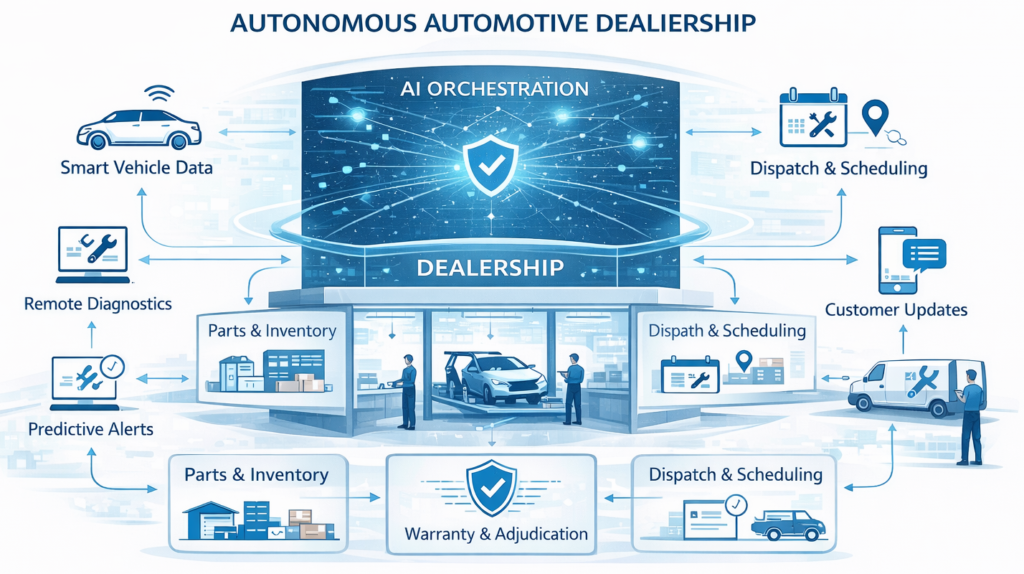
By the time a vehicle reaches the dealership in an autonomous service model, the most important decisions have already been made. The car doesn’t arrive with a vague complaint. It arrives with context.
Vehicle telemetry has already detected an anomaly, not just a fault code, but a pattern. That signal has been evaluated against millions of similar vehicles, service histories, and outcomes. The system has assessed confidence, severity, and risk. Based on that, a service plan is created automatically. Not a generic appointment, but a precise recommendation covering the repair, parts, technician skill, and service channel.
The customer doesn’t book service. They confirm a recommendation.
From Arrival to Execution: Service Without Hand-Offs
When the vehicle arrives, there is no traditional intake ritual. The system already understands the job, the plan, and the constraints. Bay assignment adjusts dynamically, technicians receive guided instructions before work begins, and warranty coverage is already resolved in the background. What disappears is the back-and-forth between advisor, dealer, and OEM, that typically slows service down. The dealership shifts from being a place of diagnosis and negotiation to a place of execution.
Delivery Becomes Outcome-Based
Once the repair is complete, the story doesn’t end. The vehicle’s health score is updated. The next likely failure is predicted. Relevant software updates are applied. The customer receives a clear explanation of what was done, why it mattered, and what to expect next.
Service becomes preventive, not episodic. More importantly, the customer leaves with clarity, not paperwork. They know what was fixed, why it mattered, and what the system is watching next. Service stops feeling episodic and starts feeling continuous.
What Dealers and Service Networks Need to Change
For this to work at scale, dealer networks must evolve. Dealership administrative effort will shrink, and execution grows. Incentives shift from volume to outcomes. OEM–dealer data sharing becomes real-time rather than periodic.
Dealers don’t disappear in this future. Their role becomes more focused, and more valuable.
15-25%
expected improvement in service throughput for automotive dealer networks adopting connected-vehicle-driven service models
The Road Ahead for Autonomous Aftersales Operations
Talking about autonomy is easy when it’s framed as a vision. It becomes more useful when it’s framed as a progression.
Gartner emphasizes that autonomous operations maturity is not binary, and organizations that design for progressive autonomy, rather than full automation, achieve faster ROI and lower transformation risk.
Levels of Service Autonomy
- At Level 1, AI supports decisions.
- At Level 2, AI recommends actions with human approval.
- At Level 3, decisions are executed automatically within defined boundaries.
- At Level 4, autonomy is the default except in regulated or safety-critical cases.
- At Level 5, the service ecosystem becomes fully self-orchestrating.
Most automotive organizations will operate across multiple levels simultaneously. The goal isn’t to rush to the highest level, rather it’s to design service architectures that allow progression.
This staged view aligns closely with how Deloitte describes digital maturity in automotive service networks and how IDC frames AI adoption curves in asset-intensive industries.
What Changes for Humans
Autonomy doesn’t remove people from service. It removes everything that distracts them.
Technicians spend less time diagnosing what to do and more time doing high-quality work. Advisors shift from explaining processes to explaining outcomes. Leaders move from firefighting exceptions to improving systems.
Accountability doesn’t disappear. It becomes clearer. Autonomous service doesn’t dehumanize work. It makes human effort finally count where it matters most.
Why This Won’t Happen Overnight
Despite the momentum, this future won’t arrive all at once.
The biggest constraints aren’t AI capabilities. They’re structural: fragmented data, regional process variance, incentive misalignment, regulatory requirements, and deeply embedded legacy technology stacks ex. ERP, FSM, warranty, and parts systems that were never designed for continuous decision-making.
This is why autonomy advances unevenly, and why many pilots stall. The challenge isn’t ambition. It’s untangling decades of operating model choices.
What Service Leaders Should Do Now
The path forward is clearer than it appears.
- Design service around events, not tickets.
- Separate decision logic from execution workflows.
- Treat warranty, parts, and dispatch as policy engines.
- Invest in confidence scoring, not just predictions.
- Redesign service roles—not just systems.
The future of service isn’t faster technicians or smarter dashboards. It’s organizations that decide, act, and learn at machine speed, while humans focus on what machines can’t.