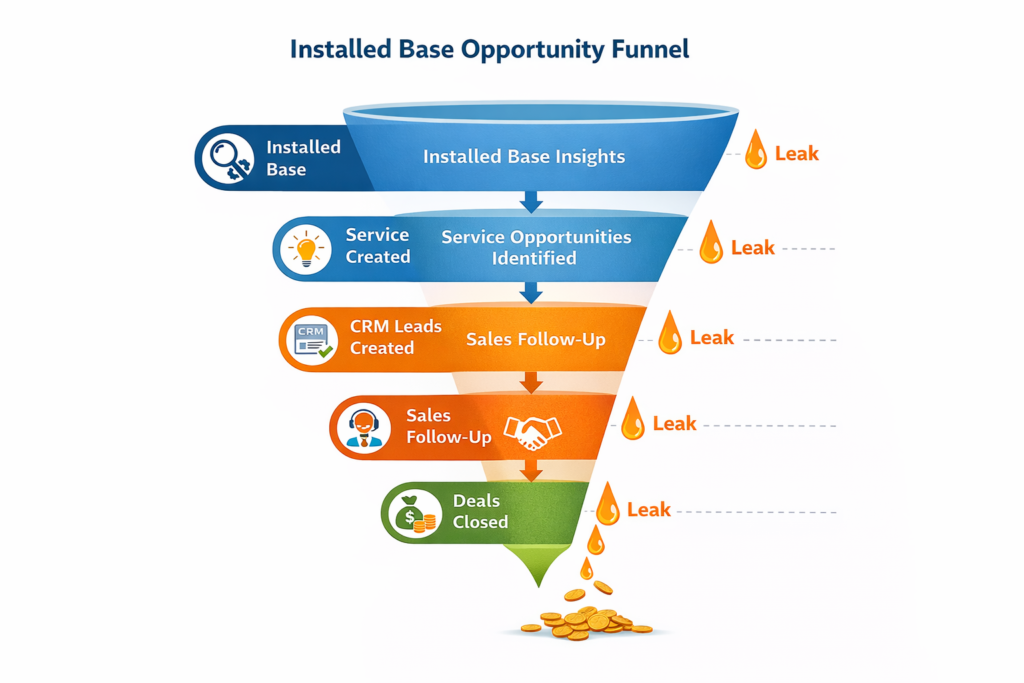
Many manufacturers invest heavily in installed base analytics by mapping asset lifecycles, identifying upgrade opportunities, and predicting component failures. The challenge rarely is identifying opportunities and manufacturers are certain that installed base revenue remains one of the largest untapped opportunities. The challenge is turning them into revenue.
Instead, organizations face a structural gap between service intelligence and sales execution.
Service teams operate in a world of high-frequency signals: maintenance alerts, part failures, lifecycle triggers, and upgrade recommendations. Enterprise sales organizations, on the other hand, are optimized for large, infrequent deals that materially impact quarterly targets.
When these two operating models collide, the result is predictable: service-generated opportunities disappear inside CRM systems.
This article explores why installed base opportunities often fail to convert into revenue, and how organizations can redesign the service-to-sales interface to capture lifecycle value at scale.
The Friction: A Tale of Two Pipelines
Consider a common scenario inside many industrial organizations.
A service analytics initiative identifies potential revenue opportunities across the installed base such as upgrade kits, retrofits, software patches, and life-extending components.
The service organization compiles a list of leads and hands them to the sales team.
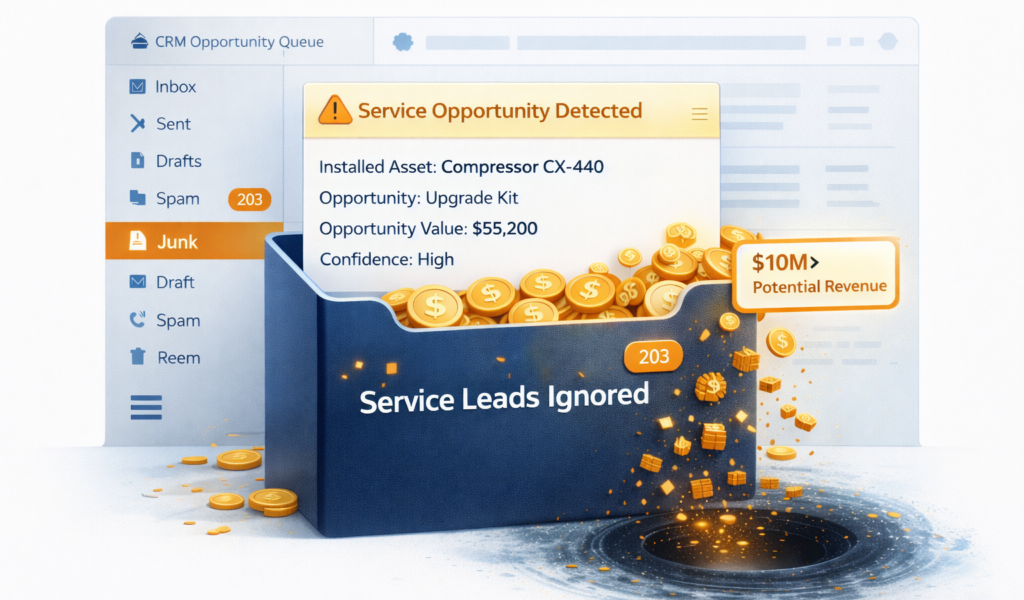
Six months later, the pipeline looks something like this:
- 200 installed base opportunities identified
- 3 deals closed
- 10 still “in progress”
- 187 disappeared somewhere inside the CRM
This example is not unusual.
Service teams have successfully identified technical needs. Sales teams have done what their incentives require, focusing on large equipment deals that influence quarterly targets.
The failure is structural.
When the high-frequency insights of service operations meet the low-frequency execution model of enterprise sales, most lifecycle opportunities simply evaporate.
The CRM Paradox
Companies spend millions on CRM licenses and installed base analytics platforms.
Yet without a dedicated commercial path to act on the insights, many of those opportunities quietly die inside CRM pipelines.
Data without an execution model becomes expensive noise.
This pattern highlights a broader challenge across many industrial organizations: service teams increasingly generate insights about the installed base, but the commercial system required to convert those insights into revenue often lags behind. In many cases, service revenue strategies exist on paper long before execution mechanisms catch up.
The Structural Bias: Sales Is Built for the “Big Game”
The leakage in service revenue is rarely caused by laziness or neglect. It is largely the result of economic incentives and sales design.
Enterprise sales organizations are built to pursue large deals. The economics of field selling reinforce this behavior.
A widely cited Harvard Business Review analysis estimates that an outside sales visit typically costs between $300 and $500 per meeting, once travel, preparation, and follow-up time are considered.
If a service-generated opportunity involves a $5,000 retrofit or component replacement, the cost of pursuit can exceed the margin of the deal itself.
Several structural factors reinforce this bias.
- Compensation Design: Most compensation plans reward large capital deals or new customer acquisitions. Few include incentives tied to installed base health or lifecycle revenue.
- Pipeline Psychology: Sales leaders review large deals in weekly pipeline meetings. Opportunities worth $10k–$20k rarely receive the same attention.
- Administrative Burden: If the CRM process requires the same documentation for a $2k parts order as for a $2M equipment sale, the administrative overhead alone discourages pursuit.
The result is predictable: enterprise sales teams focus on the “whales” while smaller lifecycle opportunities remain untouched.
The Economics of Ignored Revenue
The cost of ignoring installed base opportunities extends beyond individual deals.
Research consistently shows that expanding relationships with existing customers is significantly more profitable than acquiring new ones.
A landmark study by Bain & Company found that increasing customer retention by just 5% can increase profits by 25% to 95% across many industries.
At the same time, acquiring new customers can cost five to seven times more than selling to existing ones.
When service opportunities are ignored, companies lose more than small orders. They also create an opening for third-party competitors to enter the account through parts replacements, retrofits, or maintenance services.
What begins as a $5,000 missed opportunity can gradually erode account control over time.
Lifecycle Economics
- Increasing retention by 5% can boost profits 25–95%
- Selling to existing customers costs 5–7x less than acquiring new ones
- Lifecycle services often generate higher margins than equipment sales
Source: Bain & Company
The economics of installed base revenue often look very different from new equipment sales.
| Metric | New Equipment / New Logo Sales | Installed Base Opportunities |
|---|---|---|
| Cost of Acquisition (CAC) | High – field sales visits, long deal cycles | Low – existing relationship (5–7x cheaper) |
| Typical Close Rate | 5–15% | 30–50% |
| Margin Profile | Competitive / often discounted | Higher margins (OEM parts, upgrades, retrofits) |
| Strategic Outcome | Revenue growth | Customer retention and account control |
Despite these economics, many organizations still prioritize new equipment deals over lifecycle opportunities within the installed base.
Five Structural Breakpoints in the Service–Sales Handoff
When installed base opportunities fail to convert, the breakdown typically occurs at predictable points.
- The Data Trust Gap: Sales teams receive leads tied to assets that may have been decommissioned or replaced. After encountering a few inaccurate leads, confidence in service-generated insights quickly declines.
- Qualification Mismatch: Service teams identify technical needs, while sales teams look for budget, authority, and timing. Without shared qualification criteria, many opportunities stall early.
- The SLA Void: Few organizations define clear service-level agreements between departments. How quickly must a lead be acted upon? When should it be returned or reassigned?
- No Channel for “Micro-Deals”: Enterprise sales teams are built for large opportunities. Expecting them to pursue hundreds of small lifecycle transactions is equivalent to asking whale hunters to go fly fishing.
- KPI Blindness: Organizations track overall bookings but rarely monitor metrics such as installed base conversion rate or service-generated revenue capture.
When several of these issues appear together (weak data trust, unclear ownership, and slow response cycles), even well-funded initiatives struggle to gain traction. Over time the organization becomes rich in analytics but poor in execution, a pattern that explains why many service transformation programs stall after year two.
Installed Base Leakage Self-Assessment
Use the checklist below to evaluate your organization.
Scoring
If three or more boxes apply, your organization likely has significant leakage between service insight and commercial execution.
In many industrial environments, this type of friction can result in 20–30% of potential installed base revenue remaining uncaptured, often representing millions of dollars annually in missed lifecycle opportunities.
Designing a Better Service–Sales Interface
Fixing installed base leakage requires redesigning the interface between service insight and commercial execution. Several structural changes consistently improve results.
Create a Fast-Track Channel
Not every opportunity belongs in the enterprise sales pipeline.
Organizations that successfully monetize installed base insights often route smaller opportunities to inside sales teams or digital commerce channels designed for high-velocity transactions.
These teams operate on different metrics—volume and response time rather than deal size.
Define a “Sales-Ready” Lead Standard
Service-generated opportunities should meet basic qualification criteria before entering the sales pipeline.
A simple three-point checklist often works well:
- Verified asset identification
- Confirmed customer contact
- Clear trigger event (e.g., end-of-life component)
This reduces noise and improves trust between teams.
Implement a Service–Sales SLA
Internal handoffs benefit from the same discipline as customer contracts.
A common model includes:
- 48-hour response requirement for new leads
- Clear feedback if the opportunity is rejected
- Automatic reassignment to inside sales if the lead is not acted upon
These mechanisms prevent opportunities from disappearing into the CRM backlog.
Agentic AI as the Revenue Enabler
Technology can help reduce friction in the service-to-sales handoff. Emerging approaches such as Agentic AI in after-sales are beginning to automate tasks like opportunity validation, asset verification, and automated quoting, creating an execution layer between service analytics and commercial action.
Asset verification: AI agents can cross-reference service logs, contract data, and asset history to validate opportunities before they enter the pipeline.
Automated quoting: For standardized retrofits or component replacements, AI tools can generate quotes automatically and send them directly to customers.
This allows organizations to capture high-volume lifecycle opportunities while reserving human sales capacity for complex deals.
Conclusion: From Hunting to Harvesting
Traditional enterprise sales organizations are designed to pursue large deals. That model works well for equipment sales, but it often struggles to capture the smaller lifecycle opportunities hidden within the installed base.
As manufacturers invest more heavily in installed base analytics, the real challenge is no longer identifying opportunities, it is building the commercial infrastructure to act on them.
Organizations that succeed treat the service-to-sales interface as an operational system, not an informal handoff. Clear lead standards, response SLAs, and dedicated channels for lifecycle opportunities can dramatically increase revenue capture.
In many cases, the most profitable opportunities are not new deals waiting to be hunted, they are already sitting inside the CRM, waiting to be harvested.