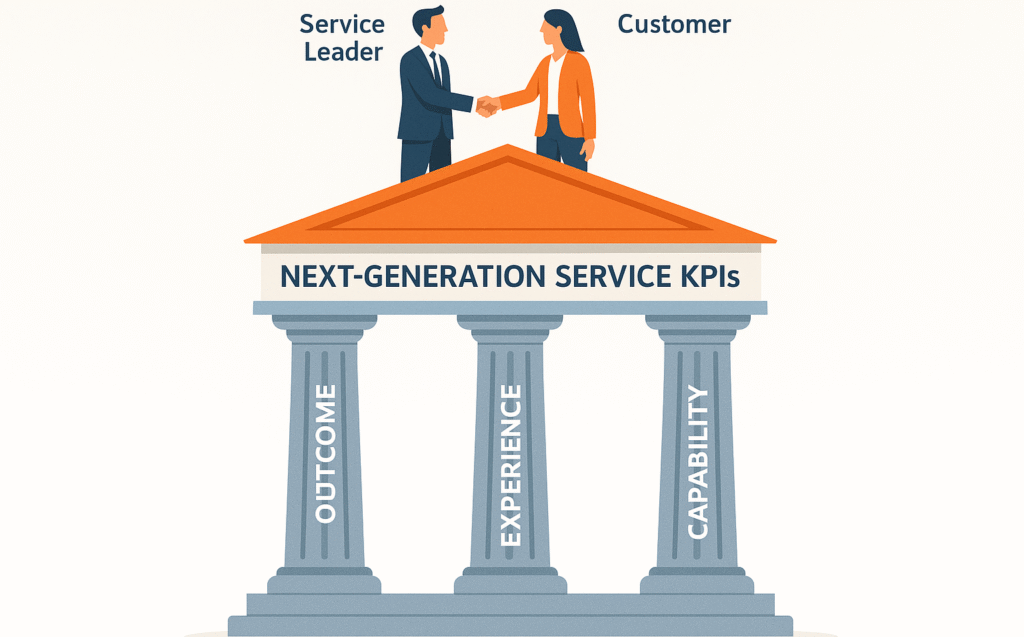

This is the fifth article in our KPI Deep Dive series, where we explore the metrics that define success in manufacturing and automotive after-sales service. After examining execution metrics such as First Time Fix Rate (FTFR) and Mean Time to Repair (MTTR), forward-looking indicators like Proactive Resolution Rate (PRR), and structural foundations such as Installed Base Coverage Rate (IBCR), we now turn to a metric that ultimately validates all of them:
Service Gross Margin.
If IBCR measures how much of your installed base you control, Service Gross Margin answers a harder question:
Is your service strategy actually creating value, or just activity?
For a broader view of how this KPI fits within a complete performance system, refer Field Service KPIs for Manufacturing & Automotive
What It Really Measures
Service Gross Margin measures the profitability of your service business after direct service delivery costs are accounted for.
Service Gross Margin = (Service Revenue – Direct Service Costs) ÷ Service Revenue × 100
Direct costs typically include field labor, spare parts consumption, logistics, subcontractors, and warranty-related expenses. It excludes corporate overhead and SG&A.
At a surface level, this looks like a financial metric. In reality, it is far more revealing.
Service Gross Margin reflects:
- Pricing discipline
- Contract structure
- Operational efficiency
- Installed base maturity
- Preventive vs reactive service mix
It answers a fundamental leadership question:
Are we scaling service intelligently — or just scaling cost alongside revenue?
Why it Matters
Service Revenue Is Easy to Report. Margin Is Hard to Sustain.
Most manufacturing organizations today are actively pursuing service-led growth. Revenue from after-sales is growing, dashboards are improving, and service is gaining strategic visibility.
But revenue alone does not indicate maturity.
Many organizations see service revenue increase without a corresponding improvement in profitability. This gap is not incidental. It typically reflects deeper issues in contract pricing, execution efficiency, and lifecycle control.
Service Gross Margin exposes that gap.
It forces a shift from:
“Are we growing service?” to “Are we growing profitable service?”
From Installed Base to Profitable Service
Service organizations do not become profitable by increasing activity alone. They follow a structural progression.
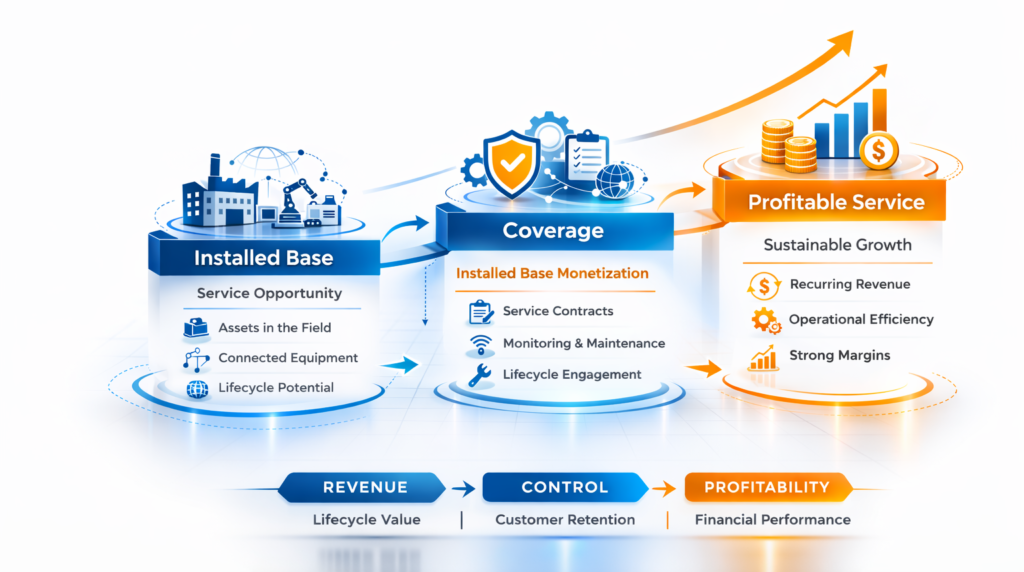
Every manufacturer starts with an installed base. But without coverage, that installed base represents opportunity, not revenue. Coverage brings structure through contracts, monitoring, and lifecycle engagement. Only when this coverage is combined with strong execution does service become consistently profitable.
This progression connects directly with broader service transformation themes explored across in Why Service Revenue Remains Untapped.
Service Gross Margin sits at the end of this journey. It is where strategy is tested.
Margin Reflects the Entire System
Unlike isolated KPIs, Service Gross Margin is an output metric. It reflects the combined effect of everything underneath it.
- Low FTFR increases repeat visits and cost leakage
- High MTTR inflates labor and downtime-related expense
- Low PRR leads to expensive reactive interventions
- Weak IBCR results in fragmented, low-margin work
When margin is under pressure, the root cause is rarely singular. It is systemic.
This is why Service Gross Margin is one of the most powerful indicators of service maturity.
Investors and Boards Pay Attention
In asset-intensive industries, recurring service margins often command higher valuation multiples than product margins. Stable, contract-backed service profitability signals resilience and long-term customer retention.
As manufacturing organizations increasingly shift toward lifecycle and outcome-based models, Service Gross Margin becomes a strategic indicator, not just a finance metric.
Why Service Gross Margin Erodes and How to Improve It
Margin erosion is rarely sudden. It builds gradually through structural weaknesses across pricing, operations, and execution.
Pricing and Contract Design
Contracts are often priced to win deals rather than sustain lifecycle profitability. In outcome-based models, underestimating failure rates or service effort can significantly erode margins over time.
Improvement requires tighter alignment between commercial and service teams, better cost modeling, and a clear understanding of risk exposure across the asset lifecycle.
Reactive Cost Structure
When service remains reactive, costs become unpredictable and inflated. Emergency dispatches, expedited parts, and unplanned labor drive inefficiencies.
Improving Proactive Resolution Rate (PRR) and strengthening coverage through Installed Base Coverage Rate (IBCR) gradually shift service toward planned interventions, which are inherently more cost-efficient and margin-friendly.
Warranty and Parts Leakage
Warranty claims, incorrect parts usage, and lack of visibility into consumption patterns can quietly erode margins.
Organizations that treat parts and warranty data as strategic assets, rather than operational by-products, are better positioned to identify leakage and take corrective action early.
Operational Inefficiencies
Execution gaps directly translate into margin loss. Low first-time fix rates, repeat visits, and inefficient technician utilization increase cost per job without increasing revenue.
Improving core execution KPIs is not just about operational excellence, it is a direct lever for profitability.
What Good Service Gross Margin Looks Like
There is no single benchmark for Service Gross Margin. Performance varies based on industry, contract model, and product complexity.
However, mature organizations demonstrate clear patterns.
First, margin is not treated as a single number. It is segmented and actively managed — by contract type, product line, and customer segment. This allows leaders to identify which parts of the business are truly profitable.
Second, margin stability improves over time. Reactive spikes reduce, planned work increases, and cost predictability strengthens. This is often a sign that proactive service models are taking hold.
Third, margin improvement is linked to structural levers — better pricing, improved coverage, and stronger execution — rather than short-term cost cutting.
Finally, high-performing organizations recognize that margin is not just a finance outcome. It is a reflection of lifecycle control.
Sustainable margin is a signal that service is being managed as a system, not a series of transactions.
Related Metrics
Service Gross Margin connects directly to several KPIs across the service performance framework:
- Installed Base Coverage Rate (IBCR) – foundation for monetization
- Proactive Resolution Rate (PRR) – cost avoidance through prevention
- First Time Fix Rate (FTFR) – execution quality
- Mean Time to Repair (MTTR) – efficiency of recovery
- Service Revenue Ratio – evolution toward recurring revenue
For a role-based breakdown of how these metrics align across leadership levels, see The Field Service KPI Dashboard
Service revenue growth is visible.
Service gross margin is revealing.
If installed base coverage builds the foundation, Service Gross Margin determines whether that foundation creates durable value.
In service-led manufacturing, profitability is not an outcome to optimize later, it is the proof that the strategy is working.