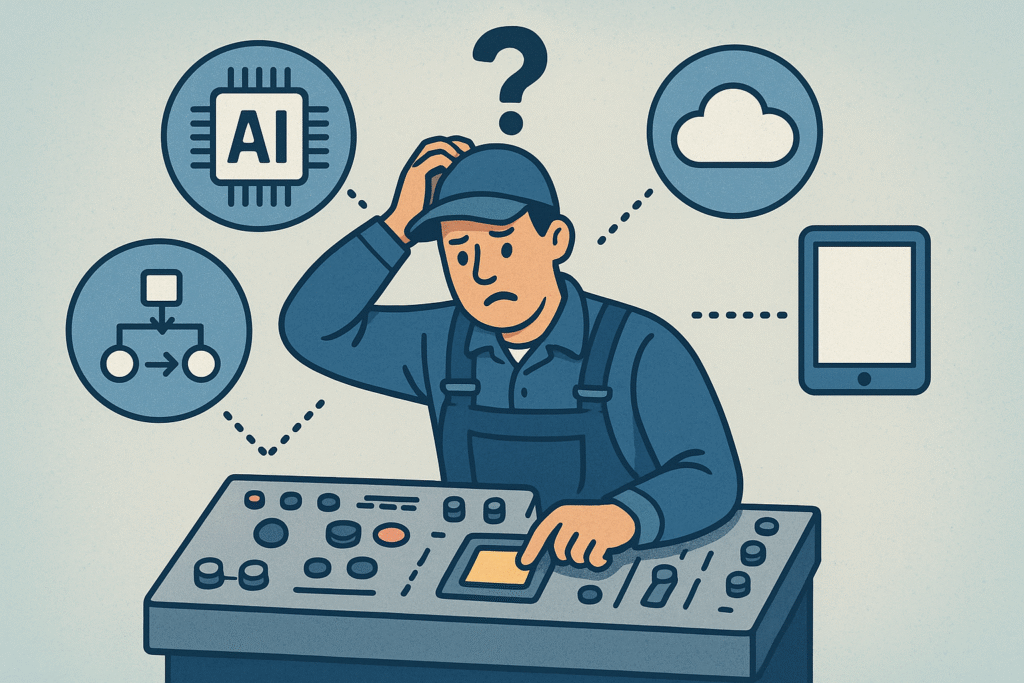
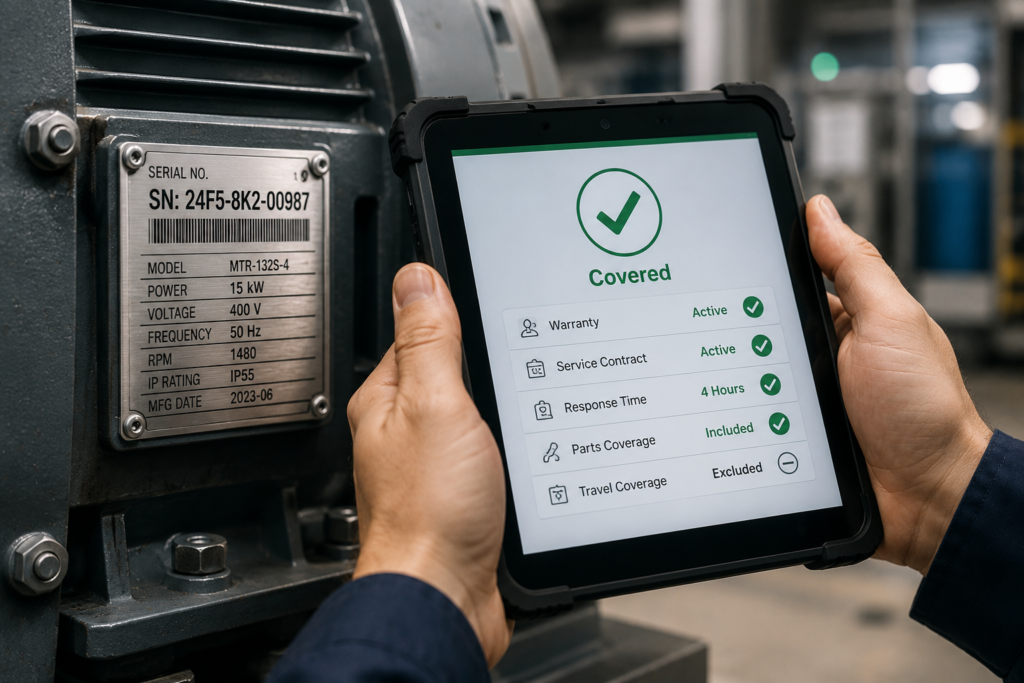
Manufacturers have gotten sophisticated at selling service contracts. Multi-year agreements, tiered coverage, connected service add-ons, outcome-based pricing, the commercial side of the business has moved a long way from a simple warranty card in a box.
Then a customer calls with a broken asset, and the organization asks itself a set of questions that sound almost embarrassingly basic:
- Is this covered?
- Is travel included?
- Is this under warranty or contract?
- Does the SLA apply to this specific asset?
- Are parts billable?
- Is remote support part of the deal?
The contract exists, signed and filed somewhere. The entitlement decision that whether this asset, on this day and for this customer is covered, is still made manually, by a person, under time pressure, usually while the customer is waiting on the line.
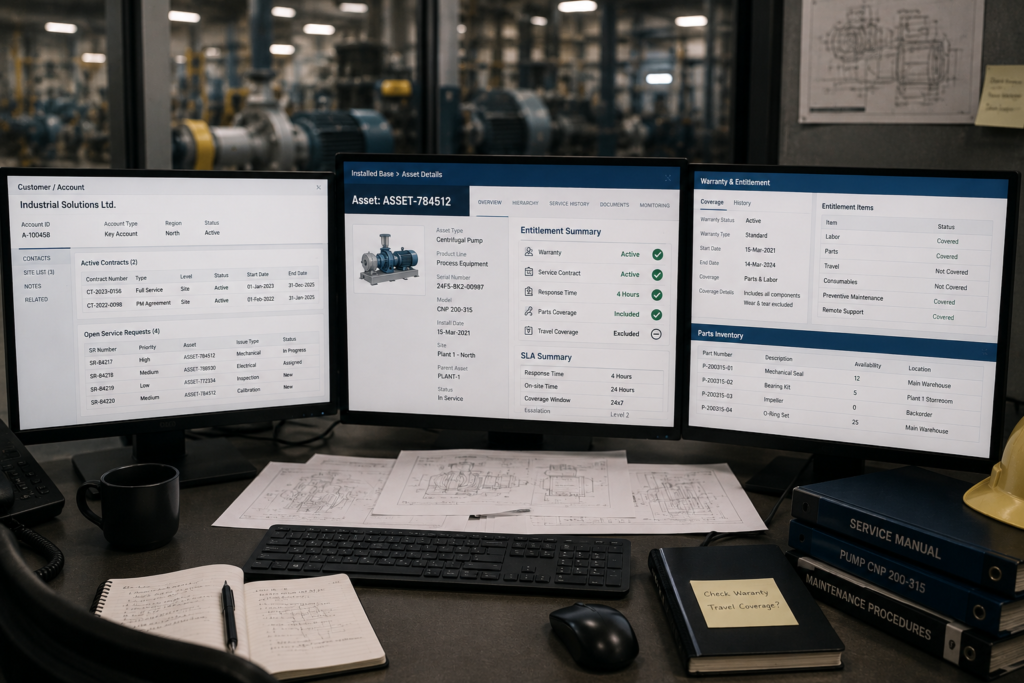
Service contract design is usually messy and fragmented with organizations having too many contract types, entitlement codes that mean different things by region, no single owner for the full portfolio. That’s the backdrop here, not the subject. The question in this piece is different: what happens the moment someone has to convert that mess into a yes or no, in real time, with a customer on the phone?
The Moment Every Service Organization Recognizes
A customer reports an issue. A dispatcher opens whatever it takes to answer one question: is this covered, and that usually means several systems, not one:
- CRM, for the commercial contract details
- The warranty system, for coverage windows
- The installed base platform, for asset configuration and history
- The dealer portal, for regional coverage rules
- ERP, for billing status
- A spreadsheet, maintained by a service coordinator, that quietly holds every exception nobody ever coded into a system
Fifteen minutes later, the answer arrives: “I think this should be covered.”
That “I think” is the actual problem. Not the fifteen minutes, the uncertainty underneath it. A dispatcher who has to guess is one bad guess away from either giving away billable work or billing a customer who was entitled to free service. Neither outcome is neutral. One costs margin. The other costs trust.
| System | What it answers |
|---|---|
| CRM | Commercial terms of the contract |
| Warranty system | Parts and labor coverage window |
| Installed base platform | Asset configuration and service history |
| Dealer portal | Regional coverage rules and variants |
| ERP | Billing status and invoicing hold |
| Coordinator’s spreadsheet | The exceptions nobody built into any system |
What Is an Entitlement, Actually?
An entitlement is the operational expression of a commercial agreement, the point where a signed contract stops being a legal document and starts being an instruction for what a technician can and can’t do on site. It usually covers some combination of:
- Labor coverage
- Parts coverage
- Travel coverage
- Response time commitments, the same SLA metrics that show up in most field service KPI dashboards
- Preventive maintenance visits
- Remote diagnostics
- Software updates
- Consumables
Customers buy outcomes. Somewhere between the sale and the service call, those outcomes have to get translated into a set of rules a dispatcher or technician can actually apply in the moment. That translation layer is entitlement management, and in most organizations, it barely exists as a system, it exists as a set of habits.
Where the Real Damage Happens
Two consequences show up constantly, and both trace back to the same root causes: systems that don’t talk to each other, and coverage that’s tracked at the customer level while service happens at the asset level. The contract portfolio behind all this is usually stitched together from several contract types, with entitlement codes that can mean different things depending on region or dealer, covered in more depth in the service contract design piece. What that produces operationally, day to day, are two consequences worth walking through.
Coverage Is Tracked at the Wrong Level
In plenty of organizations, entitlement data does live inside a system, this isn’t purely a case of knowledge trapped in people’s heads. The complication is where that data sits. Entitlements are often recorded at multiple levels – customer, asset, location, and sometimes contract line item – while the technician standing in front of a specific unit needs one clean answer at the asset level. “Are parts covered on this serial number” doesn’t have a direct answer; it requires pulling up the account’s coverage, then working out whether it applies to this particular asset, which usually means checking more than one screen before landing on a real answer.
Layered on top of that is the piece that genuinely isn’t in any system: standing goodwill. A customer who got a one-off exception two years ago, or an account manager who quietly agreed to extend a courtesy period past the contract terms, rarely gets that written into a formal entitlement record. That arrangement lives with whoever made the call, and it disappears the moment that person moves on or forgets.
Customers Can’t See What They Actually Bought
Log into most customer portals today and coverage shows up as a single line: “Active Contract.” That tells the customer almost nothing useful. What they actually want to know is more specific:
Can I call support at 2 AM? Is travel included if the technician has to drive two hours? How many preventive maintenance visits do I have left this year? Is this specific upgrade covered under my current plan?
None of that is visible, so the customer has to call and ask which puts the exact same manual, error-prone entitlement lookup in front of the customer that already frustrates the dispatcher internally. The contract was sold as a source of clarity. The portal delivers ambiguity instead, and every ambiguous interaction chips away at the customer’s confidence that the contract they paid for actually does what it says.
Why Entitlement Management Fails
The honest answer isn’t a technology gap. Most of the systems involved, CRM, ERP, warranty, asset management, are perfectly capable of storing entitlement data. The real problem is that entitlement management doesn’t have a natural owner.
Sales ops owns the contract. Service ops owns the technician on site. IT owns the systems those two groups pull from. None of them wakes up thinking “entitlement management is my job,” because it was never designed as a discipline, it emerged as a byproduct of selling contracts and running service operations separately, then trying to reconcile the two after the fact.
The systems themselves usually didn’t arrive together either. A CRM gets adopted for sales. A separate warranty module comes bundled with an ERP upgrade years later. An installed base platform shows up through an acquisition, carrying its own entitlement logic from a company that ran things differently. Dealer portals get bolted on to support a channel that predates most of this software. Each addition solved a real problem at the time. None of them was built with the others in mind, and nobody was ever handed the job of making them agree with each other.
That’s why the fix rarely starts with buying new software. It starts with someone in the organization deciding that entitlement management is a specific, ownable responsibility, not a side effect of five other systems doing their separate jobs correctly.
The Cost of Getting It Wrong
None of this is abstract. When entitlement decisions are made manually and inconsistently, the same handful of consequences show up over and over, and they compound quietly rather than showing up as one obvious line item.
Revenue leakage. Technicians default to performing work for free rather than risk an awkward billing conversation, especially under time pressure or with a frustrated customer standing in front of them. Parts are the most common casualty here. A technician unsure whether a component is covered will usually hand it over rather than stop the job to check, and that’s precisely the kind of leakage that shows up when you look closely at aftermarket parts pricing and margin. One uncertain call rarely matters. Multiplied across a fleet of technicians making that same call every day, it adds up to real margin loss.
Customer disputes. The customer walked away from the sales conversation believing something was covered. The service organization, working from a different interpretation of the same contract, expected payment. Both sides think they’re right, and both have a point, which makes these disputes slower to resolve and more damaging to the relationship than a straightforward billing error would be.
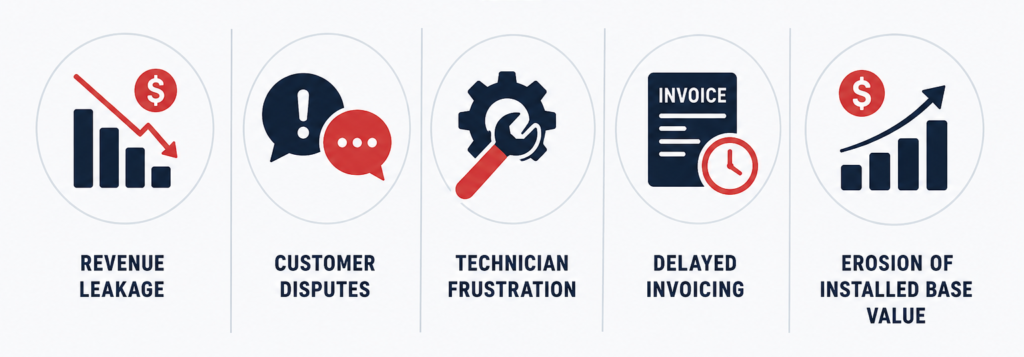
Technician frustration. The person trained to fix equipment ends up negotiating coverage terms on someone’s doorstep, a role nobody signed up for and few are equipped to handle well. Over time, this pushes good technicians toward the path of least resistance to give the customer the benefit of the doubt, which quietly reinforces the leakage problem above.
Delayed invoicing. Invoices sit in a queue waiting for someone to manually confirm coverage after the fact, adding days or weeks to a billing cycle that should have been resolved in the moment. That delay isn’t free either, it ties up working capital and pushes DSO in the wrong direction.
Erosion of the installed base’s real value. Every one of these costs individually looks small. Rolled up across a full installed base, they represent a meaningful gap between the revenue an OEM’s service contracts are designed to generate and what actually reaches the books, the kind of gap that adds up to real money hiding in a manufacturer’s installed base far more often than balance sheets suggest.
Each of these is a direct, measurable cost. Together, they represent the gap between what a service contract promises on paper and what it actually delivers once it meets an operational reality that wasn’t built to support it.
What Good Looks Like
A technician enters a serial number. The system returns, instantly:
- Warranty status
- Contract coverage
- Applicable SLA commitments
- Included services
- Explicitly excluded services
- Billing instructions
No emails. No phone calls back to a coordinator. No fifteen minutes of guessing dressed up as a decision. The same scenario from the opening of this article with the dispatcher juggling six systems, collapses into a single query with a single, confident answer. The technician spends less time negotiating and more time fixing. The customer gets an answer instead of an “I think.” The invoice goes out correctly the first time.
How to Fix Entitlement Management
Knowing what good looks like doesn’t make it obvious how to get there, especially without a multi-year system overhaul. A few things tend to separate the organizations that make real progress from the ones that stall out:
Build an entitlement layer above the existing systems, not a replacement for them. Ripping out CRM, ERP, and the warranty system to build one unified platform is rarely realistic and rarely necessary. What works is a thin layer that sits above all of them, pulls the relevant data from each, and resolves it into a single answer at the asset level. The underlying systems keep doing their jobs; this layer’s only job is resolving conflicts and producing one clean answer.
Map contract terms down to the asset level explicitly, with clear precedence rules. When a customer has coverage at the account level, a warranty at the asset level, and a regional dealer variation on top of both, something has to decide which one wins for a given part or labor line. That logic needs to be written down and owned, not worked out fresh by whoever happens to be on the call.
Define entitlement rules clearly, with service ops in the room from the start. This doesn’t need a dedicated owner or a new function, rather it needs a clear, written definition of how coverage resolves across levels, agreed on before anyone builds anything. The mistake most organizations make is letting sales ops, IT, or other divisions define that logic on their own, since neither is the one accountable for executing it. Service ops is the function actually applying the entitlement decision on site, so it needs to be part of defining the rules, not just handed a system to use after the fact. Get that definition wrong, or leave service out of building it, and the layer above the systems just inherits the same ambiguity it was meant to resolve.
Phase it in by product line or region instead of attempting it all at once. Start with the highest-volume product line or the region with the worst dispute rate, prove the model resolves real cases correctly, and expand from there. A big-bang rollout across the entire portfolio is where most of these initiatives lose momentum and get shelved.
None of this requires solving the whole problem on day one. It requires a clear, agreed definition of how entitlement resolves, and built with the function that actually has to execute it, the same decision most organizations have been avoiding since the systems first came apart.
Final Thought
Service contracts generate revenue. Entitlement management determines whether that revenue survives the moment it meets operational reality. Manufacturers have invested heavily in selling the promise. Very few have invested proportionally in the system that has to keep that promise, one service call at a time.
Still Answering “Is This Covered?” by Hand?
I’d love to hear how this shows up in your org!
Share your experience via the contact form. Practitioner inputs shape the content on this site.