
Field service organizations are not short on KPIs. Most track dozens of metrics across dashboards, reports, and operational reviews. Yet despite this apparent maturity, many struggle to improve outcomes that actually matter: uptime, customer trust, service profitability, and scalability.
The issue is not measurement. It is design.
Too often, KPIs evolve organically with some copied from peers, inherited from software templates, or added incrementally as new problems surface. The result is a fragmented measurement landscape where teams are busy tracking performance but unclear on what actions those metrics should drive.
This article takes a different approach. It explains how manufacturing and automotive organizations should design, structure, and govern field service KPIs as a connected system- one that links execution to decisions, aligns roles, and evolves with service maturity.
Why Field Service KPI Programs Fail
Most field service KPI programs do not fail because the metrics are wrong. They fail because the system around those metrics is poorly designed. KPIs are added incrementally, reviewed inconsistently, and disconnected from how decisions are actually made. The result is visibility without direction and measurement without impact.
KPIs Are Treated as Universal Metrics
A common failure is treating KPIs as universally applicable rather than context-dependent tools. Metrics that work well in one service model are often transplanted into another without adjustment. A KPI designed for a centralized, OEM-led service organization behaves very differently in a decentralized or dealer-driven environment.
Without accounting for asset criticality, service mix, and execution ownership, KPIs quickly lose meaning.
KPIs Are Owned by Functions, Not Roles
KPIs are frequently aligned to functions rather than roles. Financial metrics sit with finance, operational metrics with service managers, and execution metrics with dispatchers or technicians. Without a clear hierarchy, insights do not translate into coordinated action.
Teams optimize locally, but performance does not improve systemically.
KPIs Are Reviewed Too Late to Drive Decisions
Many organizations rely heavily on lagging indicators reviewed monthly or quarterly. These explain what already happened, but offer little guidance on what to change next. Over time, KPI reviews become post-mortems rather than decision forums.
Dashboards Create Visibility Without Accountability
Dashboards are often mistaken for solutions to deeper KPI design problems. Visualizing KPIs does not automatically improve service performance. Without clear ownership, escalation paths, and decision rights, dashboards become passive reporting tools. Many organizations fall into “KPI theater,” where metrics are reviewed regularly but rarely acted upon.
These failure modes point to a deeper issue: KPIs are rarely designed as part of a coherent system tied to how service actually operates.
What Field Service KPIs Must Align To
Field service KPIs do not exist in isolation. They reflect how service is organized, governed, and executed. KPIs must reflect the Service Operating Model.
In manufacturing environments with centralized service ownership, KPIs tend to emphasize consistency, cost control, and global visibility. In contrast, automotive organizations operating through dealer networks must balance OEM standards with local autonomy, making metrics such as compliance, coverage, and partner performance far more nuanced.
The same KPI can therefore send very different signals. A low technician utilization rate may indicate inefficiency in one model and deliberate capacity buffering in another. A high first-time fix rate might reflect strong diagnostics or simply selective job assignment.
Effective KPI design starts by acknowledging this reality. Metrics must be interpreted through the lens of the operating model, not compared blindly against benchmarks or peers.
For a broader view of how service models shape performance, see Manufacturing & Automotive After-Sales Service: Strategy, KPIs & Digital Transformation.
The Core Dimensions of Effective Field Service KPIs
Once KPIs are grounded in the operating model, the next question is what dimensions of performance they must cover.
Customer Outcome KPIs
Customer-focused KPIs capture what matters most to customers: uptime, reliability, responsiveness, and effort. Metrics such as uptime, proactive resolution rate, or first-time fix rate shift attention away from internal activity toward external outcomes.
This shift is critical in manufacturing and automotive environments, where service performance directly affects production continuity, safety, and customer trust. Outcome-oriented KPIs help organizations move beyond measuring how busy service teams are, toward understanding whether service is actually delivering value. The importance of outcome-centric measurement is explored further in Why Uptime Is the KPI That Really Matters in Service.
Operational Performance KPIs
Operational KPIs measure how efficiently and reliably service processes run. Metrics such as mean time to repair, SLA compliance, first time fix rate, and parts availability reveal bottlenecks that drive cost and dissatisfaction.
These KPIs remain essential because they expose the constraints within service operations. However, they should be treated as enablers of customer and business outcomes, not as goals in isolation. Optimizing operational metrics without considering their downstream impact often leads to unintended trade-offs. These KPIs remain essential, but they are enablers and not the end goal.
Strategic and Business KPIs
Strategic KPIs connect field service performance to financial and growth objectives. Contract attach rates, renewal rates, service margin, and revenue per installed base indicate whether service is evolving from a cost center into a sustainable value driver.
These metrics are especially important as manufacturers and automotive companies pursue servitization, subscriptions, and outcome-based contracts. Without strategic KPIs, service organizations struggle to justify investment or demonstrate their contribution to long-term business performance.
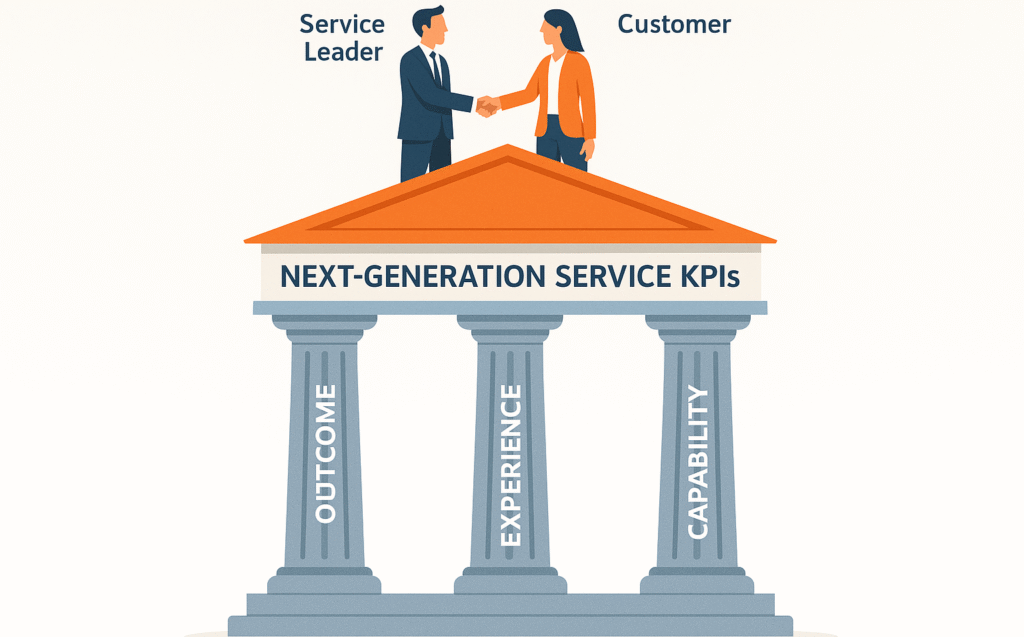
This broader view aligns with the shift described in The Next Frontier of Service KPIs: Outcome, Experience, Capability, where service performance is measured not just by efficiency, but by business impact.
High-performing organizations deliberately balance all three dimensions, adjusting emphasis as maturity evolves.
Structuring KPIs by Role and Decision Level
Even well-designed KPIs fail if they are not structured for action. Different roles in a service organization make different types of decisions, at different time horizons, with different levers available to them. Structuring KPIs by role and decision level ensures that metrics are not only visible, but usable by the people expected to act on them.
Strategic KPIs for Direction and Investment
At the strategic level, executives focus on outcomes. Their KPIs answer questions about growth, profitability, scalability, and customer retention. These metrics guide investment decisions and signal long-term priorities.
Tactical KPIs for Control and Trade-offs
Service and operations managers operate at the tactical layer. Their KPIs translate strategic intent into controllable levers, helping identify systemic inefficiencies and manage trade-offs across regions, teams, and service lines.
Operational KPIs for Daily Execution
At the operational level, dispatchers and technicians rely on execution metrics such as schedule adherence, response times, and job completion quality. This layer generates the data that flows upward, validating assumptions and informing course corrections.
When this hierarchy is clear, insights cascade downward as guidance and flow upward as feedback. When it is not, organizations end up measuring activity without impact.
A detailed role-based view of this structure is covered in The Field Service KPI Dashboard: What Executives, Managers & Technicians Should Really Track.
Why KPI Trade-offs Are Unavoidable
There are no perfect KPIs, only deliberate trade-offs.
Improving first-time fix rates may reduce utilization in the short term. Tight SLA compliance can increase travel and overtime costs. Expanding proactive or preventive work may temporarily reduce capacity for reactive demand.
These trade-offs are not failures of measurement; they are realities of service operations. Problems arise when organizations pretend they do not exist.
High-performing teams make trade-offs explicit. They choose which metrics matter most at a given stage, communicate why certain compromises are acceptable, and revisit those decisions as conditions change. KPIs become a language for decision-making rather than a scoreboard.
Governing KPIs as a Living System
Designing the right KPIs is only half the challenge. Sustained performance improvement depends on how those KPIs are governed over time- who owns them, how often they are reviewed, and how they evolve as the service organization matures. Without deliberate governance, even well-designed KPI frameworks gradually lose relevance and impact.
Start with Decisions, Not Metrics
A practical KPI framework starts with decisions, not metrics. Leaders must first clarify what choices they need to make be it about investment, capacity, pricing, or service models. Only then should they select KPIs that inform those decisions.
Limit KPIs by Role and Assign Ownership
Fewer metrics per role lead to better focus. Clear ownership ensures accountability, especially in complex service organizations where responsibilities span functions and geographies.
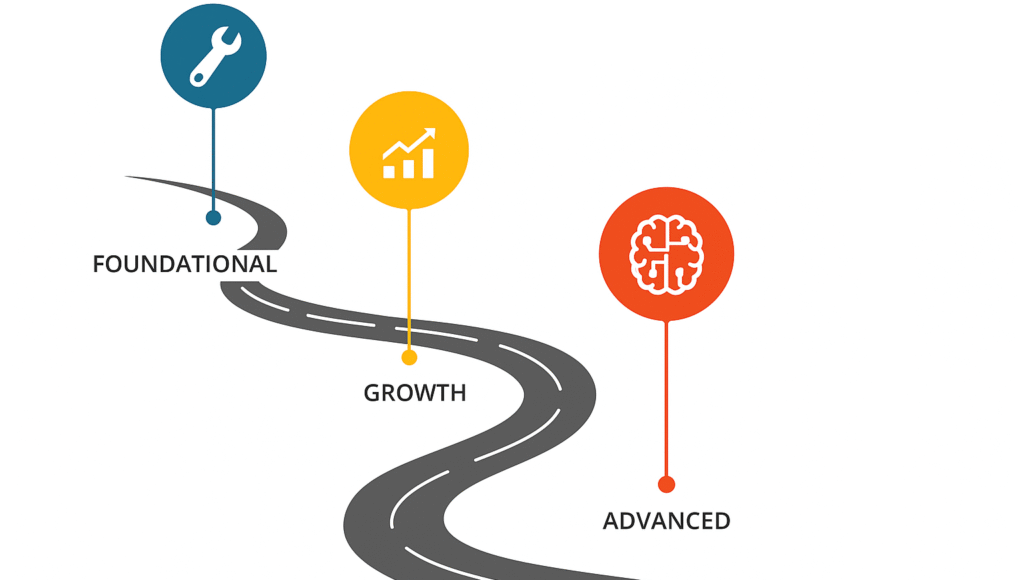
Review and Evolve KPIs as Service Maturity Changes
KPIs should not be treated as permanent fixtures. Regular review cycles allow metrics to evolve as service maturity increases and business models shift. Equally important is the willingness to retire KPIs that no longer serve a purpose.
This maturity-based approach is detailed in A KPI Framework for Field Service: From Basics to Strategic Impact, including a downloadable framework for benchmarking and prioritization.
How AI Fits into the Same KPI Logic
AI does not require a new measurement philosophy, rather it extends the same one. AI-related KPIs measure readiness, confidence, and learning rather than immediate operational performance. Metrics such as predictive accuracy, optimization success, or data coverage indicate whether AI systems are improving decision quality over time.
Initially, these should be treated as developmental indicators, not frontline targets. Over time, as trust and accuracy improve, AI-driven insights increasingly influence cost, uptime, and customer outcomes thus becoming part of the same KPI system rather than a separate one.
Over time, these capabilities increasingly support outcome-oriented KPIs such as proactive resolution, uptime, and service availability.
What Leaders Must Do Differently
KPIs only create value when they drive behavior. Executives must use KPIs to steer strategy and investment, not micromanage operations. Service managers must use them to identify systemic bottlenecks rather than police performance. Frontline teams must experience KPIs as enablers, not controls.
When KPIs are aligned across roles, service organizations move from data collection to data-driven execution. Metrics become a shared language that connects strategy, experience, and delivery.
KPIs should guide decisions, not decorate dashboards.