
Billions invested. Countless pilots. Little proof. The AI gold rush is cooling, realism is the new innovation strategy.
For two years, Generative AI dominated headlines, conferences, and boardrooms. Every CEO wanted a “GenAI strategy.” Every product pitch sounded the same: revolutionary, transformative, disruptive.
Now the numbers are in and they tell a sobering story.
- $200 billion: global AI investment expected by 2025 (Goldman Sachs)
- 9 %: companies reporting material financial impact from GenAI (McKinsey 2025 State of AI)
- 30 %: GenAI projects Gartner predicts will be abandoned after proof of concept by end of 2025 (similar story with AgenticAI)
- 70–85 %: GenAI deployments failing to meet ROI expectations (NTT Data 2024)
After the initial euphoria, executives are learning the hard way: technology alone doesn’t deliver transformation, readiness does.
In manufacturing and field service especially, the story repeats itself. I’ve seen leaders pour millions into AI pilots – predictive models, chatbots, copilots – only to hit a wall when legacy data or processes couldn’t keep up. From my work with a large, diversified manufacturer, I’ve seen a telling shift: even when an AI intervention is pitched, their leadership team often says, “Our data isn’t ready yet.” That kind of maturity – recognizing that data quality, not dashboards, determines AI’s value – is what separates hype from discipline.
Boards Are Finally Asking the Right Questions
A year ago, every board meeting had “AI” on the agenda. Today, it’s still there, but the tone has changed.
According to McKinsey, global AI adoption has plateaued around 72 %, yet only a fraction of organizations can quantify ROI. Gartner’s 2025 Hype Cycle shows Generative AI perched at the Peak of Inflated Expectations, while traditional AI (forecasting, optimization, scheduling) sits in the Plateau of Productivity, quietly delivering real value.
Meanwhile, MIT Sloan Management Review & BCG found that although 85 % of executives are experimenting with GenAI, only 22 % have changed a core process because of it. The rest are still running pilots.
Boards are no longer asking, “Can we use AI?” They’re asking, “Should we?” and “What problem are we solving?”
Why AI Keeps Falling Short
Generative AI promised instant transformation with faster insights, automated decisions, smarter service operations. But behind the marketing decks, the reality has been far more complicated. Data quality, integration gaps, and lack of change readiness have turned many ambitious programs into costly proof-of-concepts.
Data Illusion
Enterprises believed AI could fix messy data. Instead, it amplified the mess. Gartner (2025) warns that 60 % of AI projects without AI-ready data will fail by 2026.
Pilot Fatigue
The “pilot trap” has become a corporate epidemic, about 95 % of GenAI pilots don’t scale. A manufacturer we supported decided not to scale its GenAI self-service due to lack of governance and ownership. That decision saved them time, money, and credibility.
ROI Disillusionment
McKinsey’s survey found that most GenAI programs deliver narrow efficiency gains, not transformative outcomes. The excitement about copilots hasn’t yet translated into measurable EBIT impact.
Shiny Object Reflex
GenAI was the first big chase – everyone wanted a copilot, a chatbot, a quick win. Now, the spotlight has shifted to Agentic AI, with Salesforce’s Agentforce positioned as the next frontier: AI that can reason and act autonomously. There’s real potential here, but also déjà vu, chasing capability before readiness. Before handing autonomy to algorithms, organizations must first fix process design, governance, and data hygiene.
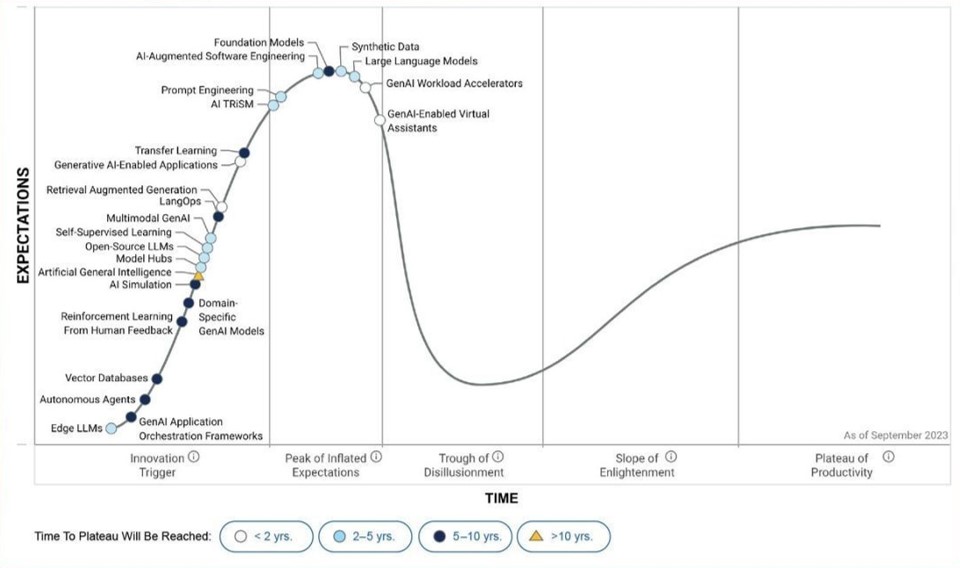
Gartner’s 2025 AI Hype Cycle says it best: Generative AI remains in the hype spotlight, while predictive and optimization AI has matured into measurable business value.
The noise is loud, but the returns are quiet.
The flashy demos grab headlines; the “boring” algorithms keep factories running and service trucks on time.
The takeaway: The GenAI hype may be fading, but AI’s real value is finally becoming normal, less about novelty, more about results.
The Boring Path to ROI
The real winners in the AI race aren’t loud, they’re patient. They’re quietly doing the boring but essential work:
- Building clean, connected data pipelines before fancy dashboards.
- Strengthening process governance before layering automation.
- Investing in adoption and change readiness before expecting transformation.
One manufacturer I work with exemplifies this. They’ve deliberately delayed large-scale AI programs until their data maturity model hits target levels. It’s a slower path, but the payoff will be far higher and far more sustainable.
The lesson: the boring path is the profitable path.
Before the algorithm, fix the foundation. Before scaling AI, scale your readiness.
In service organizations, this means starting small, for instance, using AI to optimize scheduling or predict parts demand, and then expanding only when the results are proven. Every use case should tie directly to a measurable business metric: uptime, cost per visit, revenue per technician, or customer satisfaction.
That’s why successful organizations are laying the foundation for what I called a “Service-Led Growth Mindset”: value that compounds from data discipline, not from hype cycles.
Where We Go from Here
The AI gold rush has slowed, but it hasn’t ended. We’re entering a transition phase, from optimism to accountability, from hype to hard metrics.
GenAI will remain a powerful tool, and AgenticAI will unlock new potential, but only for organizations that build from a place of readiness, not reaction. The winners of the next phase won’t be the ones chasing headlines. They’ll be the ones with clean data, aligned processes, and clear ROI expectations.
The hype phase is over. The age of skepticism, governance, and grounded execution has begun.