

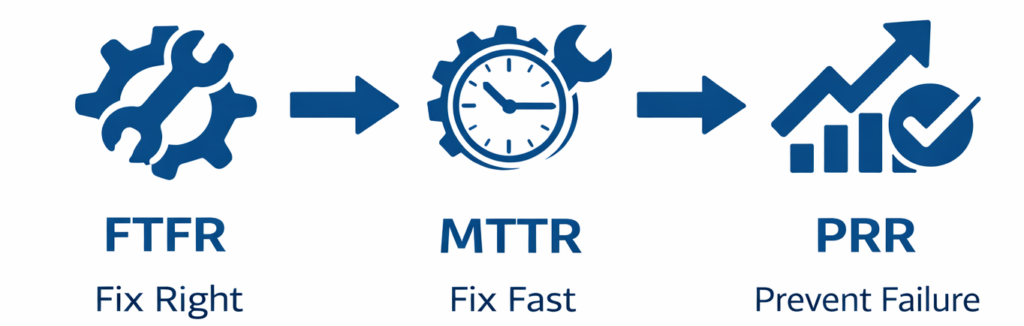
This is the third article in our KPI Deep Dive series, where we explore the metrics that define success in manufacturing and automotive after-sales service. After examining First Time Fix Rate (FTFR) and Mean Time to Repair (MTTR) – two KPIs that measure how well organizations respond to failures, we now turn to a metric that reflects where the industry is heading: Proactive Resolution Rate (PRR).
PRR captures a fundamental shift in service strategy. As manufacturers adopt condition monitoring, predictive analytics, and AI-driven insights, service excellence is no longer defined only by how quickly failures are fixed, but by how often failures are prevented altogether.
From Reactive Excellence to Proactive Service
Over the past decade, after-sales organizations have made meaningful progress in improving reactive service performance. KPIs such as FTFR and MTTR have helped leaders reduce rework, shorten downtime, and bring greater discipline to field operations. For many mature organizations, these metrics are now well understood, closely managed, and steadily optimized.
At the same time, the industry is already moving beyond purely reactive service. Leading manufacturers are investing in asset monitoring, predictive maintenance, remote diagnostics, and early-warning systems. In practice, this means issues are increasingly identified and addressed before customers experience a breakdown.
How the Industry Is Tracking This Today
Most organizations are already measuring elements of PRR, even if they don’t call it that.
Common examples include:
- Prevented failures identified through predictive maintenance programs
- Avoided downtime hours reported in service contracts or customer reviews
- Condition-based work orders triggered by asset monitoring
- Remote resolution rates where issues are fixed without dispatch
These measures are valuable, but they remain siloed: owned by different teams, tracked in different systems, and reported inconsistently. As a result, leadership often lacks a single view of how effectively proactive insights are being converted into tangible outcomes.
PRR consolidates these fragments into a single, executive-level KPI.
PRR does not replace existing KPIs. Instead, it encompasses what the industry is already doing and elevates it into a single leadership metric that connects prediction, intervention, and avoided impact. As AI moves from pilots to production in after-sales service, PRR becomes a natural next step in measuring service maturity.
What It Really Measures
Proactive Resolution Rate (PRR) measures the percentage of service issues that are resolved before they result in customer-impacting failure.
In simple terms, PRR answers the question:
How often did we fix or mitigate a problem before the customer experienced downtime or disruption?
A proactive resolution may include:
- Preventive service triggered by condition-based alerts
- Early intervention based on predictive analytics
- Remote fixes that prevent on-site failure
- Software or configuration updates applied before issues surface
What PRR does not include is routine preventive maintenance executed on a calendar basis without evidence of impending failure. For PRR to be meaningful, the intervention must be data-driven and impact-oriented, not just scheduled activity.
PRR therefore measures not just prediction accuracy, but organizational readiness to act on insight.
Why it Matters
Several industry forces are converging to make PRR increasingly relevant for manufacturing and automotive service leaders.
First, asset complexity is rising. Products are becoming more connected, software-enabled, and operationally critical, increasing both the cost and consequences of unplanned downtime. Analyst research from firms such as Gartner and IDC consistently highlights downtime reduction as a top priority for asset-intensive industries.
Second, AI and advanced analytics investments are moving out of experimentation and into scaled deployment. Executive teams are now asking a harder question: What measurable business value are we getting from these investments? PRR provides a clear, outcome-oriented answer.
Finally, traditional service KPIs are approaching diminishing returns. Improvements in FTFR and MTTR are often incremental once baseline maturity is reached. PRR enables a different kind of value creation, cost avoidance rather than cost optimization, by eliminating failures before they occur.
Why PRR Increases, and How to Improve It
Improving PRR requires coordinated progress across people, process, and technology.
People
- Build diagnostic capability, not just repair skills
- Reduce reliance on tribal knowledge by capturing expert insights
- Enable faster collaboration between field service, engineering, and technical specialists
- Encourage confidence in acting on predictive insights, not waiting for failure
Process
- Define what qualifies as a proactive resolution and track it consistently
- Improve failure intake and triage to prioritize early intervention
- Embed closed-loop learning so prevented failures inform future actions
- Align incentives to reward prevention, not just rapid response
Technology
- Use asset monitoring and analytics to detect early failure signals
- Integrate service execution systems with asset and parts data
- Enable remote diagnostics and guided interventions
- Improve visibility into avoided downtime and prevented service events
What Good PRR Looks Like
There are no industry-wide PRR benchmarks yet, and that is expected for an emerging KPI. Mature organizations focus less on absolute targets and more on trend improvement and use-case coverage.
Early indicators of strong PRR maturity include:
- A growing share of service actions initiated proactively
- Clear visibility into prevented failures or avoided downtime
- Consistent execution of predictive insights across regions
- Leadership-level reporting of proactive outcomes
Over time, PRR should rise as data quality, trust in analytics, and cross-functional alignment improve.
Insight:
Most organizations already practice proactive service. The differentiator is not capability, it is measurement. PRR connects prediction to action and makes prevention visible at the leadership level.
Related Metrics
PRR works best when viewed alongside established after-sales KPIs:
- First Time Fix Rate (FTFR) – quality of reactive resolution
- Mean Time to Repair (MTTR) – speed of recovery
- Mean Time Between Failures (MTBF) – asset reliability
- Avoided Downtime – direct business impact
- Remote Resolution Rate – digital service effectiveness
Together, these metrics provide a complete picture of service performance across prevention, response, and recovery.
In the age of AI-enabled service, excellence is no longer defined only by how fast organizations fix failures. It is increasingly defined by how many failures never happen at all.
Proactive Resolution Rate makes that value visible.