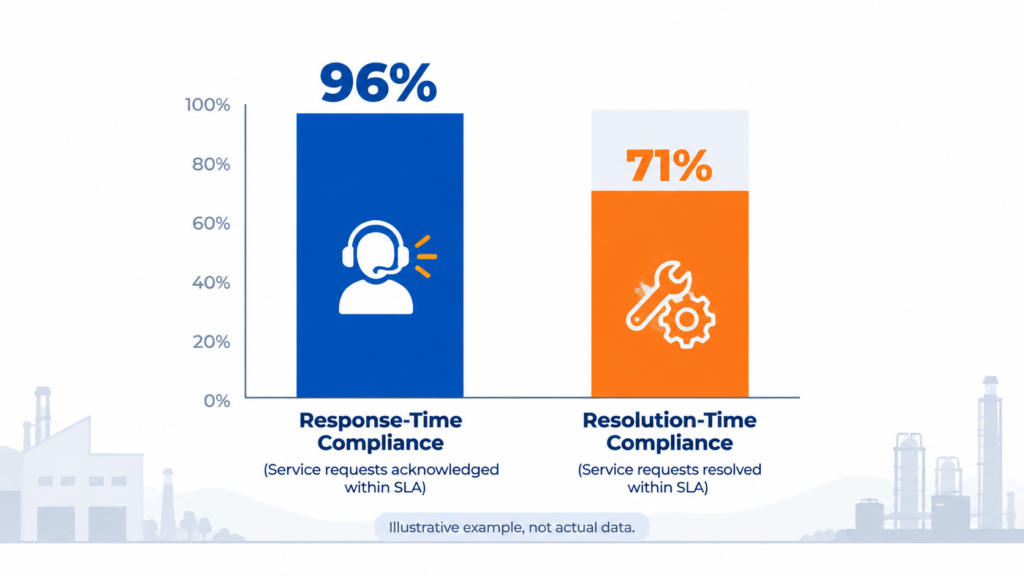
Most service organizations report SLA compliance somewhere north of 95%. Most of those same organizations still get called out by customers for slow service. Those two facts are not a contradiction but a definition problem.
SLA Compliance Rate doesn’t tell you whether the customer got what they were promised. It tells you whether you hit whichever clock you chose to measure. In most field service organizations, nobody has actually looked hard at which clock that is.
SLA Compliance Rate measures the percentage of service jobs that meet their contracted time target. The target can be defined against response time, on-site arrival, or resolution time, and most organizations default to reporting response time because it’s the easiest to hit, even though resolution time is what the customer actually experiences.
What SLA Compliance Rate Measures
SLA Compliance Rate = (SLA-Covered Jobs Meeting Target ÷ Total SLA-Covered Jobs) × 100
That formula looks clean. The problem sits one level below it: “meeting target” depends entirely on which moment in the job lifecycle the SLA is measured against.
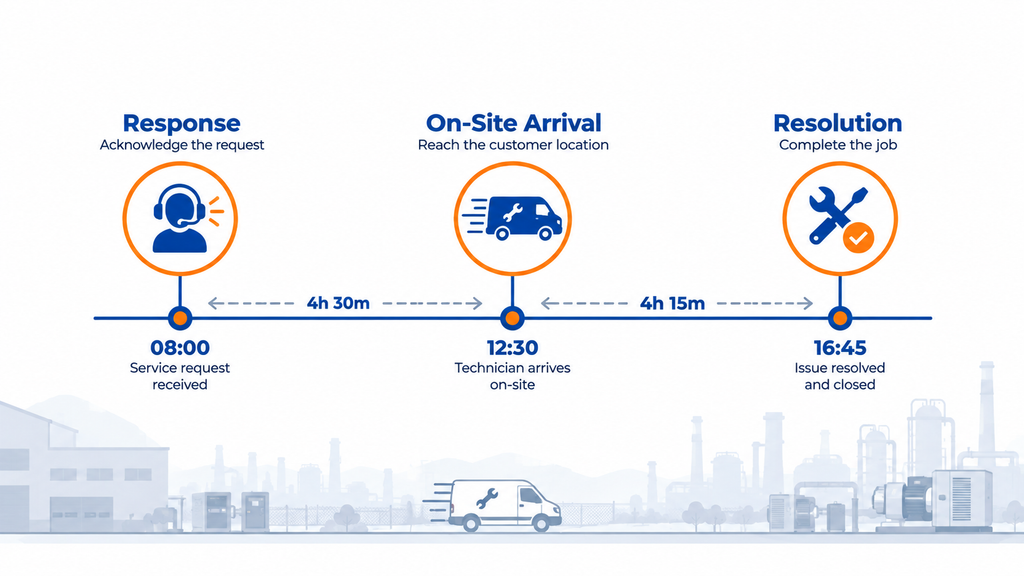
A service contract can define compliance at any of three points:
- Response time: the technician or system acknowledges the request
- On-site time: the technician physically arrives
- Resolution time: the asset is actually back in operation
Most contracts are written loosely enough, and most FSM platforms are configured by default, to report against response time, because it’s the easiest clock to hit and the easiest one to automate. A dispatcher acknowledging a ticket within 15 minutes counts as compliant even if the technician doesn’t arrive for six hours, and the asset doesn’t run again until the next day.
Illustrative SLA clause pattern (composite, not from an actual client contract)
Contracts commonly define response and resolution as separate obligations, tiered by severity: a Critical incident might carry a 1-hour response commitment and a 4-hour resolution target, while a Low-severity issue might allow days. The clause that actually does the damage is the one defining when the clock starts. Many specify that the resolution period doesn’t begin until the provider has been “sufficiently informed of the nature of the problem,” a phrase broad enough to justify almost any delay in starting the clock and narrow enough that nobody disputes it after the fact.
That single clause, not the target itself, is usually where SLA compliance and customer experience part ways.
The strategic question this KPI answers: are we measuring how fast we respond, or how fast we actually fix the problem?
Why SLA Compliance Rate Matters
A blended, response-only SLA number distorts three things leadership actually cares about:
Customer experience. A technician can “respond” within SLA and the asset can still sit down for hours. The customer doesn’t experience the response, they experience the downtime. Compliance on the dashboard and frustration in the field can both be true at the same time.
Entitlement exposure. Entitlement management decides what’s covered under a given contract; SLA compliance decides whether that coverage was honored on time. The two are frequently tracked by different teams, which means a contract can be entitlement-compliant and SLA-delinquent without anyone noticing until the customer complains.
Scheduling incentives. Dispatch team optimizes for whatever gets measured. If response time is the number that shows up in the executive report, scheduling will start prioritizing jobs that make the response clock look good and batch easy acknowledgments, while genuinely complex multi-technician jobs, the ones that actually need resolution-time discipline, get pushed to whenever capacity allows.
Why SLA Compliance Erodes, and How to Improve It
SLA compliance erodes because someone eventually asks a different question than the one the dashboard was built to answer.
Here’s the pattern: response-time compliance looks good for years. Leadership stops asking about it because the number is green. Nobody separately tracks resolution time, because it was never part of the original report. Then a large account escalates. The response was on time, but the fix took two days, and the resulting review reveals that “compliant” never meant what everyone assumed it meant.
By that point, the gap isn’t a measurement oversight. It’s a trust problem with a named customer attached to it.
Most FSM platforms don’t help here by default. They’re built to track whichever clock the contract technically specifies, not to flag when that clock is the wrong one for the customer relationship. A dashboard can tell you that you hit your SLA. It can’t tell you that you hit the wrong SLA.
The ambiguity isn’t accidental, and it isn’t quite dishonest either. Rather it’s economically convenient. Guaranteeing a technician on-site within four hours requires a dense network of stocked parts and available technicians close to every customer, which is expensive to sustain everywhere. Vendors who can afford that density build genuine on-site commitments into their SLA. Vendors who can’t redefine “response” to mean an acknowledgment or a callback instead, because that’s operationally cheap and still lets them advertise the same headline number in a bid. Nobody in the RFP process is incentivized to flag the difference, because both versions look identical on paper.
The fact that a vendor felt the need to spell out that its four-hour window means a callback, not a technician arriving, is itself telling. This only gets written after enough customers assumed it meant the opposite.
How Leading Organizations Improve SLA Compliance Rate
People
- Make service delivery and dispatch accountable to resolution-time compliance, not response-time compliance alone
- Require an explicit, documented sign-off at contract creation, not after a dispute
- Define which clock definition applies for each severity tier
Process
- Report SLA compliance segmented by clock type: response, on-site arrival, and resolution, as three numbers, not one blended figure
- Fold SLA clock definitions into entitlement rules at the point of contract sign-off, instead of leaving them to whatever the FSM platform defaults to
- Audit a sample of “compliant” jobs quarterly against the clock the customer actually experienced, not just the clock the system logged
Technology
- Configure FSM systems to capture all three timestamps on every job, even when the contract only requires one. You can’t fix a measurement gap you never recorded
- Integrate SLA tracking with the entitlement and contract system so “was this covered” and “was this on time” are answered from the same data set, not reconciled by hand after a complaint
To fix SLA measurement, report compliance by clock type (response, on-site arrival, and resolution) instead of one blended figure, and tie clock definitions to entitlement rules at contract sign-off rather than leaving them to FSM platform defaults.
What Good SLA Compliance Looks Like
There’s no universal benchmark for SLA Compliance Rate, because acceptable performance depends on contract tier, asset criticality, and how the SLA itself is worded. What separates mature organizations isn’t a higher number, it’s a more honest one.
High-performing service organizations segment SLA compliance by:
- Severity tier
- Clock type (response / on-site / resolution)
- Asset criticality
- Customer or contract segment
They also treat a widening gap between response-time and resolution-time compliance as a leading indicator. By the time that gap shows up as a customer escalation or a contract renewal conversation, it’s already cost more than a dashboard fix would have.
| KPI | What It Measures | Common Blind Spot |
|---|---|---|
| SLA Compliance Rate | Whether a job met its contracted time target | Which clock, response, arrival, or resolution, was actually used |
| Mean Time to Repair | How long it takes to restore a failed asset | Often reflects waiting time, not repair time |
| First Time Fix Rate | Whether a job closes correctly on the first visit | Frequently a parts or information gap, not a technician skill gap |
Executive Insight
SLA compliance is a measurement choice, not a service outcome, and most organizations never consciously made that choice. They inherited it from whichever clock their FSM system defaulted to and never went back to check if it still matched what their customers actually cared about.
Related Metrics
- Entitlement Management: defines what’s covered before SLA compliance measures whether it was honored in time
- Complex Field Service Scheduling: the dispatch layer that can quietly optimize for the clock that’s easiest to hit rather than the one that matters
- Mean Time to Repair (MTTR): the metric resolution-time SLA compliance should be read alongside, not in place of
- First Time Fix Rate (FTFR): the execution quality a resolution-time SLA protects, and a response-time-only SLA does nothing to guarantee
For a broader view of how these fit within a complete performance system, see the Field Service KPI Dashboard.
If your team is reassessing FSM configuration or evaluating a new platform, SLA clock definition is one of the settings worth interrogating directly rather than accepting the vendor default, a starting point worth working through is the FSM Vendor Assessment Framework.
Caught between a dashboard that says you’re compliant and a customer who doesn’t feel it?
Share your experience via the contact form. Practitioner inputs shape the content on this site.