Most manufacturers have digitized their warranty claims intake. Some have adjudication workflows. A few have fraud detection in place. But warranty costs still surprise them every quarter.
The reason isn’t the tools. It’s where the problem actually lives.
Warranty management is three things simultaneously: a financial control, a quality sensing system, and a customer trust mechanism. Most organizations optimize one layer (usually claims processing) and remain blind to the other two. The result is a system that looks functional on the surface while quietly leaking money, intelligence, and customer confidence underneath.
Warranty Management in manufacturing isn’t a claims processing function. It’s a financial control, a quality sensing system, and a customer trust mechanism, all running simultaneously. Optimizing one while ignoring the others doesn’t reduce cost. It just moves where the problem hides.
The Warranty Management Lifecycle in Manufacturing
Effective warranty management spans six stages and most organizations are only strong in the middle.
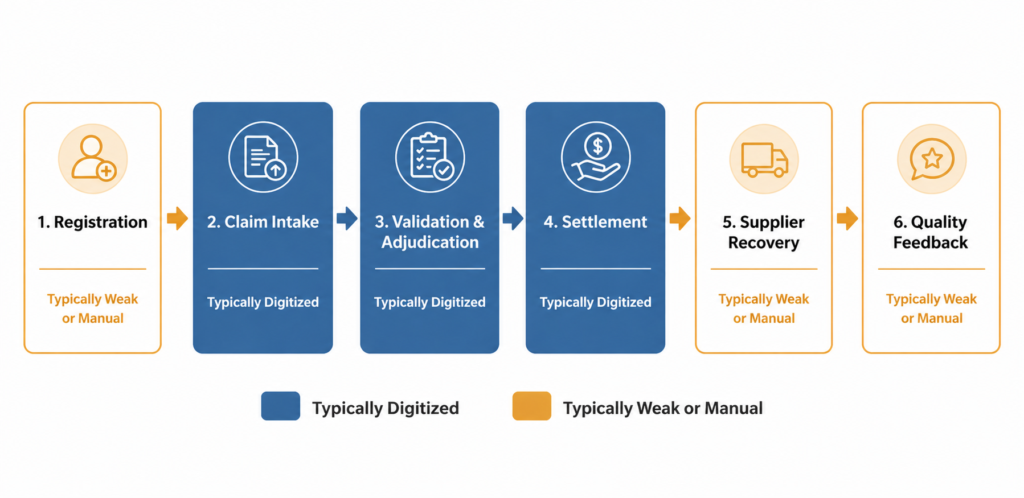
The middle stages (intake, validation, adjudication) received the most investment because that’s where the visible friction was. Paper forms, manual approvals, slow settlements. Digitizing these was the right first move.
But the two ends of the chain (registration and quality feedback) remain structurally weak in most organizations, even those who consider themselves digitally mature. And the leakage that matters most flows through exactly those weak points.
Where Warranty Management Breaks Down in Manufacturing
The Registration Gap: The Failure Before the Claim
Most customers discover they aren’t registered when they try to file a claim. By then, two things have already gone wrong: the customer experience is broken before a single repair has been attempted, and the manufacturer has lost the clean data that makes every downstream step such as eligibility checking, fraud detection, quality analytics more reliable.
A customer discovering they’re unregistered during a claim isn’t a registration process failure. It’s a customer experience failure, and it’s entirely preventable.
Good registration doesn’t require a portal login or a card in the box. It is triggered automatically at point of sale or product handover, integrated with the dealer’s DMS or the manufacturer’s ERP, and confirmed to the customer with a coverage summary. The customer learns what’s covered and for how long. The manufacturer receives clean, matched registration data linked to serial number, sale date, and coverage tier.
VIN mismatches, coverage gap disputes, and incorrect warranty start date errors are common causes of unnecessary claim rejections and are largely downstream consequences of broken registration, not adjudication failures. In the context of end-to-end aftersales management, registration is the first post-sale touchpoint. Organizations that treat it as an afterthought are starting that relationship on the wrong foot.
Dealer Warranty Fraud and Claim Abuse: Where the Real Money Goes
This is the section most warranty process reviews underweight and the one that matters most for controlling actual cost.
Warranty fraud and abuse is not a fringe problem. Research cited in Warranty Fraud Management (Kurvinen, Toyryla & Murthy, Wiley 2016) estimates that warranty and service abuse leads to 3–15% of total warranty costs depending on industry and detection maturity. In the US alone, dealer and service provider fraud cost approximately $2.6 billion in 2018. US vehicle manufacturers set aside $14.4 billion in warranty accruals in 2024, a 29% increase from 2023 and the largest annual total ever recorded (WarrantyWeek, 2025).
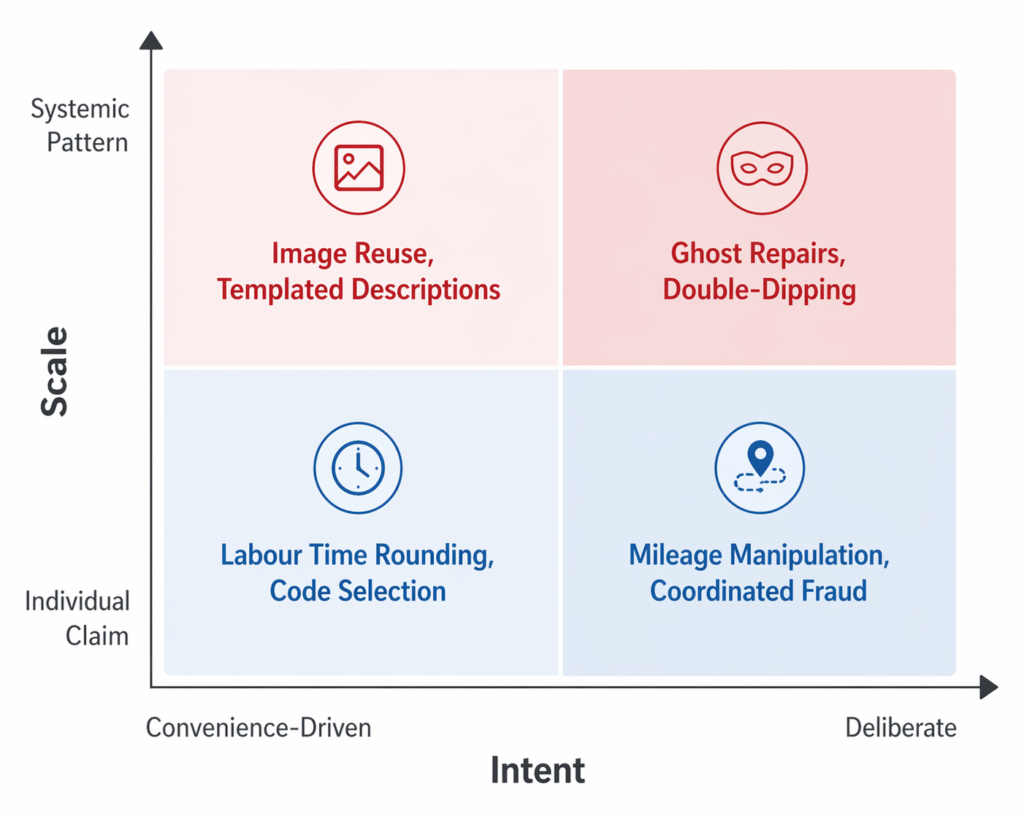
Five specific patterns drive the majority of outward leakage:
- Image Reuse: The same diagnostic photograph submitted across multiple vehicles, different fault codes, different repair dates
- Labour Time Inflation: Claiming hours beyond the standard repair time matrix, or beyond what is plausible for the reported fault
- Failure Code Mismatch: selecting fault codes based on reimbursement value rather than actual diagnosis
- Double-dipping: Charging both the customer and the manufacturer for the same repair, most common near warranty expiry
- Ghost Repairs: Work claimed as completed that was never performed
Why dealers Do This: The Structural Reasons
Most outward leakage isn’t deliberate fraud. It emerges from a system that makes accurate documentation difficult and penalizes no one for cutting corners:
- Throughput Pressure: dealer service departments are measured on volume. Warranty claim administration is time-consuming and rarely a priority for service managers focused on throughput
- Low incentives for accurate documentation: dealers are reimbursed for the repair, not for documentation quality. There is no commercial upside to spending extra time on claim accuracy
- Weak audit visibility: OEM warranty audits are infrequent, often predictable, and typically sample-based. The probability of any individual claim being scrutinized is low
- Inconsistent enforcement: when abuse is detected, outcomes vary significantly by dealer size and commercial relationship. Large dealers are rarely penalized proportionally
Manufacturers often hesitate to react to these fraudulent claims. Acting on dealer warranty abuse requires confronting the network, the same network that drives the majority of revenue. As Warranty Fraud Management notes, most manufacturers are reluctant to pursue claims without overwhelming evidence, and many are wary of the reputational cost of publicly acknowledging their own network is gaming the system. That hesitancy is as significant a barrier as the abuse itself.
The fix isn’t confrontation. It’s making the data so visible, and detection so automated, that abuse becomes structurally difficult and legitimate dealers have no reason to worry.
The Quality Signal Nobody Is Reading
Warranty claims data is one of the richest sources of product and process intelligence available to manufacturers and one of the most consistently underused.
When claims are processed transactionally, organizations miss early failure patterns that predict larger field issues, installation or operator-caused failures that training could address, supplier components disproportionately driving warranty cost, and geographic or batch-specific anomalies that indicate a production quality event.
The irony: engineering teams commission field surveys and product studies while warranty claims (already collected, already categorized) sit in a system nobody queries systematically. This connects directly to aftersales KPIs that most organizations track without ever feeding the underlying data back into product or supply chain decisions.
How to Reduce Warranty Leakage: Intake Design, AI, and Process Readiness
Intake Design: Making Accurate Submission the Path of Least Resistance
Digitizing intake was necessary. Designing it well is different.
The fundamental problem with most current intake systems is that they accept submissions first and validate later, thereby routing incomplete or inconsistent claims through the adjudication queue only to reject them days later for a missing field the dealer could have completed at submission. This rework loop is one of the most common hidden contributors to extended claim cycle times, and it sits entirely outside the field service system where most Mean Time to Repair analysis focuses.
Good intake design inverts this. Pre-populated fields from vehicle or asset history mean the dealer confirms rather than re-enters. Guided submission flows prompt for the specific evidence required based on the fault type selected, before submission and not as a rejection reason after. Real-time eligibility confirmation means no dealer or customer discovers mid-claim that coverage doesn’t apply. And consistency checks at point of entry such as fault code against parts list, claimed hours against the standard repair matrix to surface discrepancies in real time rather than after the claim has sat in a queue for three days.
The goal of good intake design isn’t to make it easier to submit a claim. It’s to make it harder to submit a bad one without the dealer or customer feeling the friction
The practical outcome is twofold: legitimate dealers move faster because pre-population and guided flows reduce their admin burden, and the volume of structurally flawed claims entering adjudication drops, reducing cost and cycle time simultaneously.
AI in Warranty Management: Where It Delivers and What It Needs
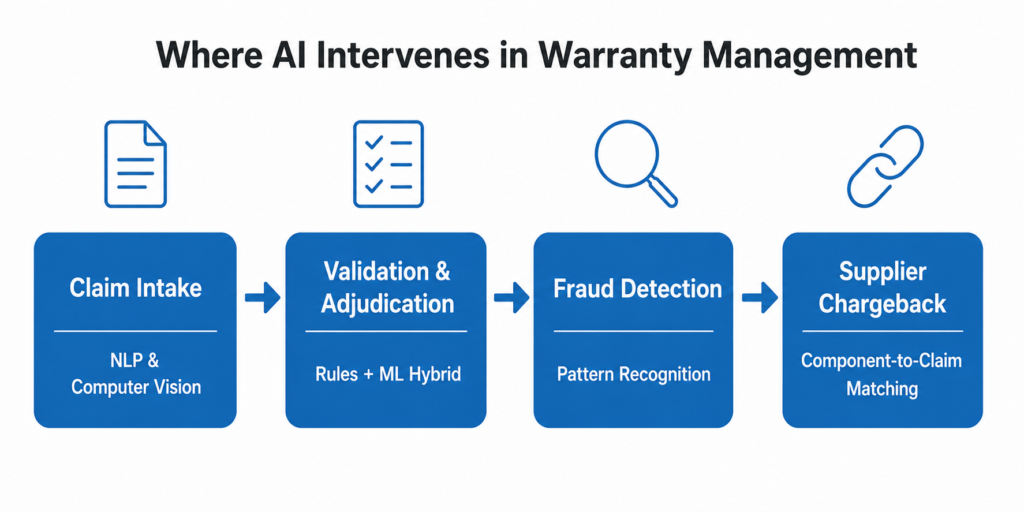
AI in warranty is a real capability, not a roadmap aspiration. Four application areas deliver near-term value:
- Intake: NLP and computer vision extract structured data from technician notes, fault descriptions, and uploaded images, and flag when the written description and image don’t correspond to the same failure mode
- Validation: ML models handle adjudication edge cases where coverage is ambiguous, or product history creates context that static rules can’t account for
- Fraud Detection: The highest ROI application. Image fingerprinting, labor time anomaly detection, failure code frequency analysis, and repair clustering across dealer networks. One major technology manufacturer implemented data-driven fraud detection and identified $11 million in fraud within nine months, saving $67 million over five years
- Chargeback Matching: AI-assisted matching of claims to supplier components and contract terms, an emerging application, but increasingly where the next tranche of value sits
One important qualification: AI amplifies what exists. Organizations without clean registration data, structured failure codes, or consistently applied adjudication rules will not get meaningful value from AI, regardless of the model’s sophistication. Before investing, it’s worth assessing whether your warranty data foundation can actually support the use cases you’re targeting. The AI Readiness Assessment applies directly here, as does the broader AI prioritization framework for aftersales
Warranty Management Benchmarks: What Good Looks Like
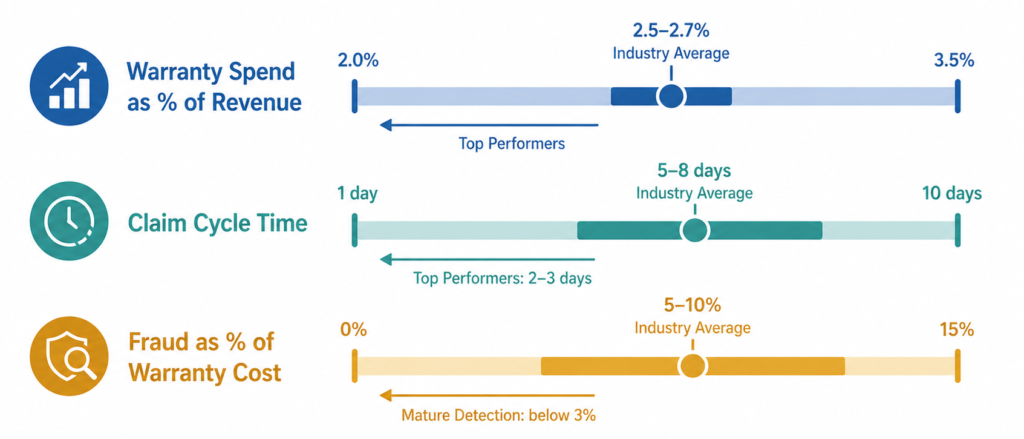
Three numbers matter most: warranty spend as a share of revenue, claim cycle time, and fraud as a percentage of total warranty cost.
The pattern across all three is consistent: organizations with active analytics programmes and structured intake processes operate toward the better end of every range. Those still relying on periodic manual audits tend to discover, when they eventually instrument the data, that they are sitting closer to the worse end than they assumed.
Warranty cost feeds directly into service gross margin, one of the clearest indicators of whether a service organization is genuinely profitable or simply busy. Uncontrolled warranty expense is a structural margin drag that no pricing adjustment fully recovers.
Final Thoughts
Warranty digitization addressed the most visible inefficiency in paper, manual entry, slow approvals. What it didn’t address is the structural leakage that sits inside a digitized but unanalyzed claim stream.
The dealer submitting the same image across forty claims. The repair that was never performed. The product quality signal buried in ten thousand failure codes that nobody queried. The customer who discovers mid-claim that they were never registered at all.
That’s where the real cost is. And it’s where the real opportunity sits for manufacturers willing to look past the intake portal and ask what the data is actually telling them.