Every aftersales organization is being told they need AI. Fewer are being told what stage their data, architecture, and processes can actually support today. That gap between AI ambition and AI readiness is where most investments quietly underdeliver.
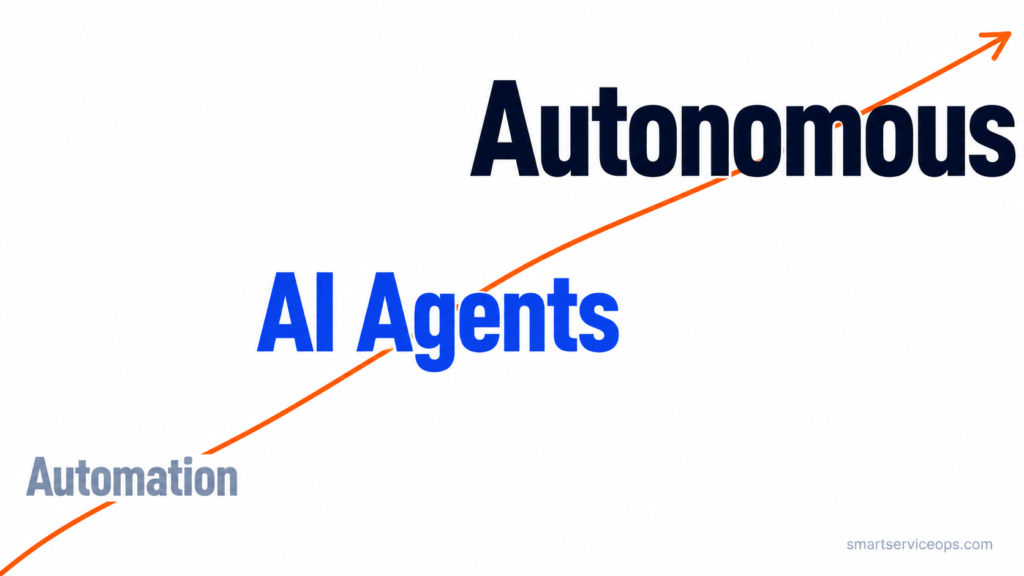
AI in aftersales moves through three distinct stages: automation, AI agents, and autonomous operations. Most organizations are somewhere between the first and second. Very few are close to the third, regardless of what the roadmap slide says.
This page maps the full journey, with the option to go deeper into any stage. The question isn’t whether AI belongs in your aftersales operation. It’s which stage your data and architecture can actually support today and what specifically needs to change to reach the next one.
Start With Readiness, Not Ambition
Most AI failures in aftersales aren’t technology failures but sequencing failures. Organizations invest in capabilities their data or architecture isn’t ready to support.
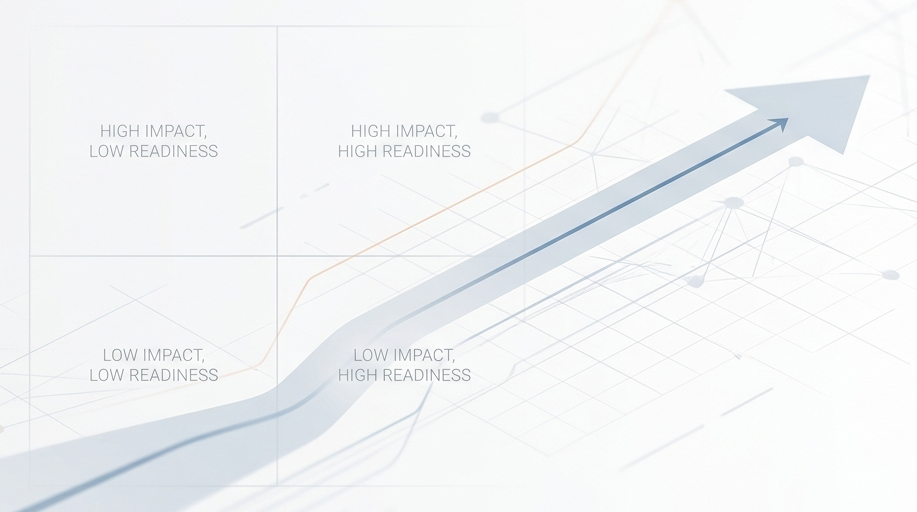
A readiness assessment isn’t a formality before the “real” roadmap work begins. It’s the step that determines whether the roadmap is realistic at all. Before scoping any AI investment, three questions need honest answers: How structured is your data across systems today? Where does your integration architecture currently break down? What decision, specifically, would this AI capability improve?
Organizations that skip this step tend to buy capability aligned to a vendor’s roadmap rather than their own operational reality.
The Readiness Check: If you can’t answer what percentage of your warranty or field data is structured versus free-text, you’re not ready to scope AI investment, you’re ready to scope a data cleanup project first.
Go deeper:
- The AI Readiness Trap: Why AI Readiness Assessment Should Come Before Roadmap: why sequencing, not ambition, determines AI ROI
- Where Should You Start with AI in Aftersales? A Practical Prioritization Framework: a scoring approach for picking your first AI investment
Why this matters: Getting this stage right doesn’t guarantee AI success downstream but getting it wrong guarantees wasted investment regardless of which vendor or platform you choose next.
Automation vs. AI: The Distinction Everyone Blurs
A significant share of what’s currently sold as “AI” in aftersales is automation with better marketing. The distinction matters commercially, not just semantically.
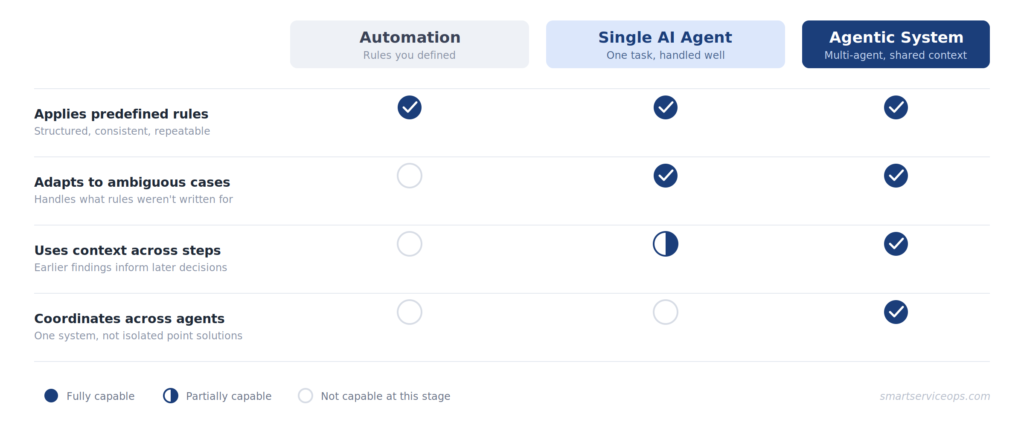
Automation applies a rule you defined. It’s rules-based processing, structured validation, workflow triggers. It’s fast, consistent, and does exactly what it’s told, nothing more.
AI, in the genuine sense, identifies patterns you didn’t define in advance. It handles ambiguity, context, and edge cases that static rules were never built to catch.
Neither is inherently superior. Automation is cheaper, more stable, and handles the majority of routine aftersales volume perfectly well. The problem is treating automation as a stepping-stone you can skip. AI layered on top of broken or manual processes amplifies the chaos rather than resolving it.
The Rebrand Test: If a vendor’s “AI” feature can be fully described using the words “if this, then that”, it’s automation. That’s not a criticism of the feature. It’s a reason to price and evaluate it as automation, not AI.
Go deeper:
- GenAI Hype Is Over: Welcome to Reality: Separating genuine capability from hype cycle noise
- How AI Can (Actually) Help After-Sales Service – Beyond the Hype: Real use cases across complaint triage, scheduling, and predictive maintenance
Why this matters: Every AI investment decision downstream from budget, vendor selection, and timeline depends on correctly classifying what you’re actually buying at this stage.
Agentic AI: The Business Case
Once automation is in place, the next stage is AI agents and increasingly, agentic AI, where multiple agents work across a process rather than a single point solution handling one task.
The business case for agentic AI is strongest where three conditions overlap: high transaction volume, meaningful ambiguity in individual cases, and a measurable cost of getting it wrong. Warranty claims, complaint triage, and parts demand forecasting tend to meet all three. Low-volume, low-ambiguity processes rarely justify the investment yet.
Where Agentic AI Pays Off First: The highest-ROI starting point is almost never the most visible process. It’s the one with the most hidden manual judgment calls happening at scale today such as fraud detection in claims, rather than customer-facing chat.
Go deeper:
- Business Case for Agentic AI in Aftersales: Quantifying Incremental Value Beyond Copilots: The full ROI framework
- Agentic AI in After-Sales: The Missing Execution Layer That Automation Couldn’t Fix: Why most automation investments stall short of true agentic capability
Why this matters: This is the stage where most current aftersales AI budget is being spent and where the gap between vendor promise and delivered value is widest.
Proof Point: Agentic AI in Warranty Operations
Warranty operations is one of the clearest places to see this maturity model applied in practice, because the process naturally spans all three levels, automation, agents, and (eventually) autonomous orchestration.
At the agent level, two applications consistently deliver the clearest measurable return: claim adjudication, where AI assesses ambiguous cases that static rules can’t cleanly resolve, and fraud detection, which finds patterns across thousands of claims that no predefined rule set would catch.
The organizations getting the most value aren’t the ones with the most agents deployed. They’re the ones whose agents share context, where the intake agent’s findings inform the fraud agent’s risk scoring, rather than each agent optimizing its own step in isolation.
The Integration Reality: Two disconnected AI agents create the same architectural problem as five. The number of agents matters less than whether they’re actually talking to each othe
Go deeper:
- AI in Warranty Operations: From Automation to Agents to Autonomous Operations: The full maturity breakdown, including claim adjudication and fraud detection as the two highest-ROI agent applications
Why this matters: Warranty is the sharpest test case for this entire framework, if the maturity model doesn’t hold up here, it won’t hold up anywhere else in aftersales either.
Where This Is Heading: Autonomous Operations
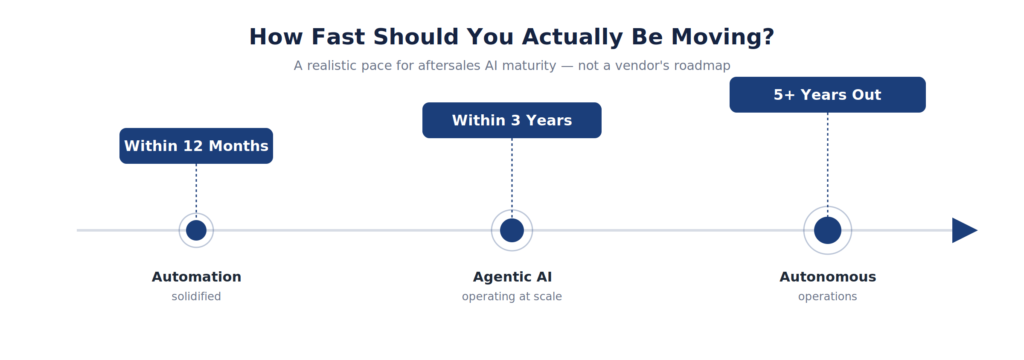
Autonomous aftersales operations, where agents share context across the full lifecycle without step-by-step human intervention, is the direction the industry is heading. It is not where most organizations should be planning to arrive in the next 12 months.
Three things need to be true before autonomous operations are achievable: integration architecture resolved across every system in the ecosystem, data structured consistently across all of them, and process redesign planned alongside the technology investment because roles change fundamentally once agents handle routine judgment calls.
The Destination Trap: Autonomous aftersales isn’t a platform you purchase. It’s an architectural outcome that emerges from getting automation and agentic AI right first, with integration work running in parallel the whole time.
Go deeper:
- The Fully Autonomous Service Organization: What AI-Led Aftersales Really Looks Like: What the end state actually looks like operationally
- The 2026 Service Blueprint: From Predictive AI to Agentic Operations: Near-term sequencing for the next 12-18 months
- The Service Organization of 2030: Powered by AI, Led by Customer Value: The longer horizon view
Why this matters: Treating autonomous operations as a near-term buying decision, rather than a multi-year architectural outcome, is the single most common expectation-setting mistake in current aftersales AI planning.
The Organizational Shift Nobody Plans For
Every stage of this framework has a technology dimension and a people dimension. The people dimension consistently gets addressed after go-live rather than alongside the investment.
As agents take on routine judgment calls, roles shift. Adjudicators become exception handlers. Fraud analysts become model supervisors. This isn’t a downgrade in headcount value rather a redefinition of where human judgment adds the most leverage. Organizations that plan for this shift retain and redeploy talent; organizations that don’t discover the shift has already happened, without anyone having prepared the team for it.
The Force Multiplier Reframe: The leadership question isn’t “how much headcount does AI let us cut.” It’s “what can our best people now focus on that they couldn’t before.”
Go deeper:
- Service Leadership in the AI Age: From Cost Containment to Force Multiplication: The leadership mindset shift this requires
Why this matters: Technology and architecture decisions are reversible. Losing skilled people because their role changed without warning generally isn’t.
Start Where Your Data Can Support You, Build Toward Where the Technology Is Going
The aftersales organizations that will look fundamentally different in five years aren’t the ones that bought the most AI today. They’re the ones that sequenced deliberately with automation first, selective agentic investments second, integration architecture running in parallel throughout, and a clear view of what autonomous operations actually requires.
Not sure which stage your organization is actually ready for? The free AI Readiness Assessment takes ten minutes and gives you a clear starting point rather than a vendor’s roadmap. If you’re further along and evaluating platforms, the FSM Vendor Assessment Framework is built specifically to cut through vendor claims and score capability against your actual requirements.
View Frequently Asked Questions
What’s the difference between AI automation and agentic AI in aftersales?
Automation applies predefined rules to known scenarios. Agentic AI identifies patterns and handles ambiguity that wasn’t explicitly programmed in advance, and when multiple agents share context, coordinates across a full process rather than a single task.
Where should aftersales organizations start with AI investment?
With a readiness assessment, not a platform purchase. The starting point should be the process with the highest volume, the most ambiguity, and the clearest cost of error such as warranty fraud detection and claim adjudication.
Is autonomous aftersales achievable today?
For most organizations it is not possible within the next 12 months. It requires resolved integration architecture, consistently structured data across systems, and organizational redesign, all of which take years to build properly rather than being purchased as a product.
How long does it take to move from automation to agentic AI?
This varies by organization, but most that skip straight to agentic AI without solid automation and clean data in place end up rebuilding the foundation later, costing more time overall than sequencing it correctly from the start.
Still Answering “Is This Covered?” by Hand?
I’d love to hear how this shows up in your org!
Share your experience via the contact form. Practitioner inputs shape the content on this site.