Organizations across automotive and industrial manufacturing are actively investing in AI for warranty operations. Across the warranty processes such as claims intake, claims adjudication, fraud detection, chargeback matching, AI applications are being scoped, piloted, and in some cases deployed across all four. The direction is right. Warranty operations have significant inefficiency, significant leakage, and significant data that has historically gone unanalyzed. AI has a genuine role to play in addressing all three.
What is less clear in most organizations is what they are actually buying, what it will deliver at their current maturity level, and how today’s investment connects to where warranty operations need to be in three to five years.
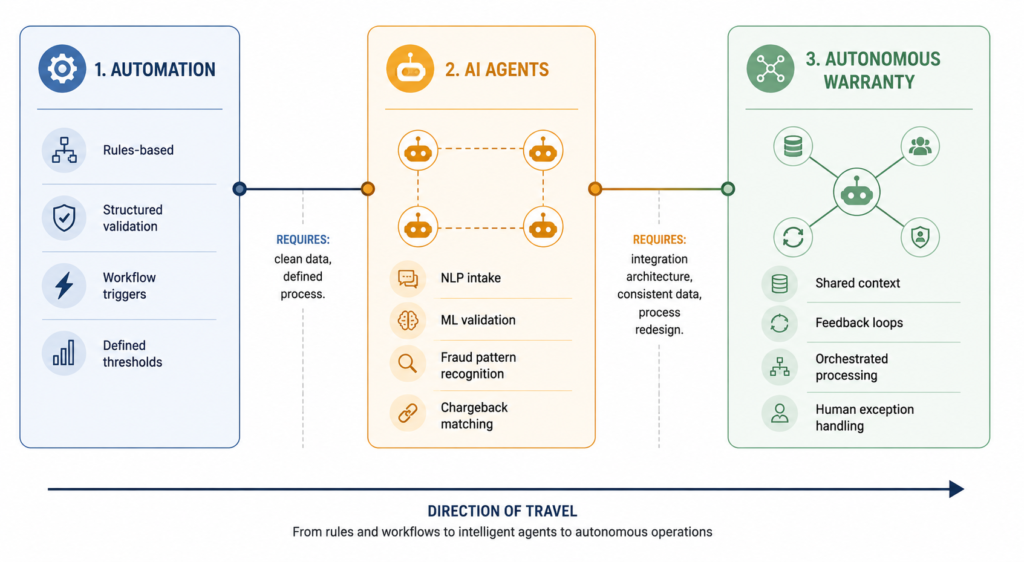
This article maps three levels of warranty AI maturity in warranty claims and operations i.e. automation, agents, and autonomous, and what it takes to move between them.
The question isn’t whether AI belongs in warranty operations. The question is which level your data and architecture can actually support today, and what you need to build toward next
Read More: Warranty management in Manufacturing – the full warranty lifecycle and where leakage occurs.
Level 1: Automation – The Foundation Most Organizations Are Still Building
Before discussing AI, it is worth being precise about what AI is not, because a significant portion of what is currently being sold as AI in warranty is automation, and the distinction matters commercially and practically.
Automation in warranty is rules-based processing, structured validation logic, workflow triggers, and RPA. It is faster and more consistent than manual processing. It is genuinely valuable. But it does exactly what it was told to do and nothing more. It handles known patterns like defined rules, fixed thresholds, structured logic.
What automation handles well in warranty: claim eligibility checking against defined coverage rules and dates; labour time validation against published repair time matrices; missing field detection at intake before claims enter the adjudication queue; automatic routing of standard claims to fast-track settlement. These are all process improvements that most warranty operations need and many have not yet fully implemented.
The organizations that have not fully implemented these automation capabilities should do that before investing in AI. Automation is the foundation. AI built on top of broken or manual processes amplifies the chaos rather than resolving it. Also, automation is significantly less expensive to implement and maintain. If automation delivers the majority of what an organization needs from warranty processing improvement, the case for AI investment needs to be built on what remains and not on repackaging automation as AI.
If your warranty system can’t automatically flag a missing field at intake, it isn’t ready for AI fraud detection. Automation is the prerequisite, not the alternative.
Level 2: AI Agents – Where Most Ambition Sits Right Now
AI agents represent genuine capability that automation cannot replicate, and they are where most active warranty AI investment is currently focused. The distinction between automation and an AI agent is specific and important: automation applies a rule you defined; an AI agent identifies patterns you didn’t define in advance.
Claim Adjudication and Fraud Detection: The Two Highest-ROI Agent Applications
Among the four AI agent applications reshaping warranty operations, claim adjudication and fraud detection deliver the clearest measurable return, because they act on patterns and edge cases that predefined rules were never built to catch.
- Intake using NLP and computer vision. Extracts structured, matchable data from unstructured inputs such as technician notes written in free text, dealer-submitted fault descriptions, uploaded diagnostic images. Flags when the written description and the uploaded image don’t correspond to the same failure mode. Automation can check whether a field is populated. An AI agent can assess whether what’s in the field makes sense in context of everything else in the claim.
- Validation using ML-assisted adjudication. Handles edge cases where coverage is ambiguous, product history creates context that static rules cannot account for, or the combination of fault code, parts list, and labor time is individually plausible but collectively unusual. Surfaces these for human review rather than auto-approving or auto-rejecting. Automation applies the rule. An AI agent identifies where the rule doesn’t cleanly apply and escalates appropriately.
- Fraud detection leveraging pattern recognition at scale. Image fingerprinting across claim batches, labor time anomaly detection at technician and dealer level, failure code frequency analysis, repair clustering across the dealer network. Detects patterns that no predefined rule set would have caught because nobody defined them in advance. This is the clearest example of what AI does that automation genuinely cannot do such as identifying unknown patterns across thousands of claims simultaneously. It is also the highest ROI application and the most defensible starting point for organizations making their first AI investment in warranty.
- Chargeback matching using component-to-claim linkage. Matches warranty claims to supplier components and contract terms to build recovery cases automatically. Flags where cost recovery is contractually available and where the evidence trail supports pursuit. This is an emerging application, most organizations are not yet here, but as warranty cost management matures it is increasingly where the next tranche of recoverable value sits.
The Integration Problem Nobody Discusses Upfront
This is where most warranty AI investments run into their most significant practical constraint and it is rarely surfaced before platform selection.
Most warranty systems are bespoke. They sit disconnected from ERP, field service platforms, CRM, parts systems, and whatever AI platform the organization has separately invested in. Each AI agent is another system that needs to integrate with the warranty platform and with every other system those agents draw data from.
An organization running agents across intake, validation, and fraud detection is managing multiple separate integration dependencies, each with its own data pipeline, its own maintenance requirement, and its own failure mode. The number of agents matters less than whether they share context. Two disconnected agents create the same architectural problem as five. Each is optimizing its own step in isolation. The intake agent doesn’t inform the fraud agent’s risk scoring. The validation agent’s outcomes don’t feed back into the fraud model. The claim moves through each stage without the intelligence from the previous stage travelling with it.
This is not a reason not to invest in AI agents. It is a reason to scope the integration architecture before selecting the platforms, not after. In most warranty transformation engagements, the integration conversation happens after platform selection. That sequence consistently produces more complexity than capability.
Level 3: Autonomous Warranty – The Direction, Not the Destination
Autonomous warranty is where the industry is heading. It is not where most organizations should be planning to arrive in the next 12 months and framing it as an immediate objective creates expectations that current integration and data maturity cannot support.
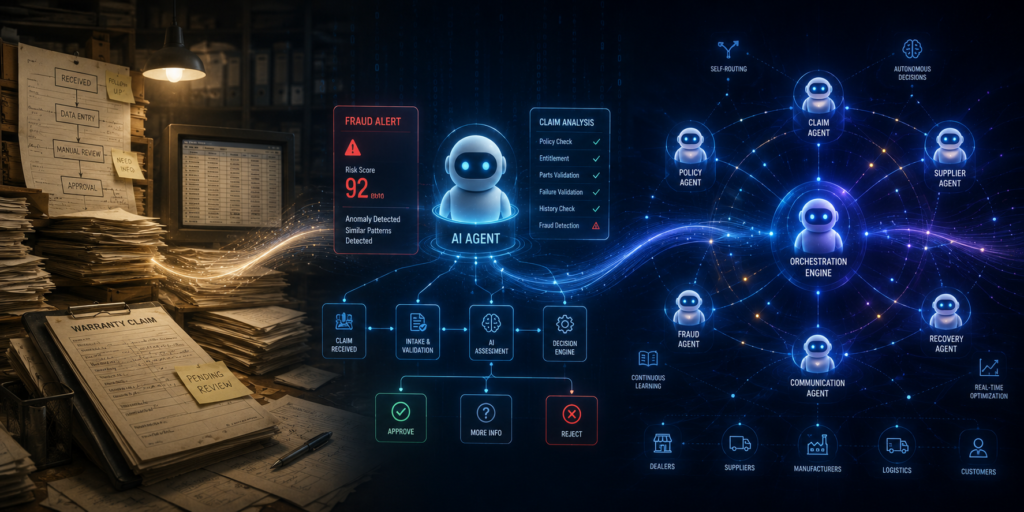
Autonomous warranty is an orchestrated system where agents share context across the full warranty lifecycle. The intake agent’s findings inform the fraud agent’s risk scoring before the claim enters adjudication. The fraud agent’s outcome updates the validation model. A claim that settles cleanly teaches the system what clean looks like. A claim that escalates tells the system what to watch for next time. Human intervention is reserved for defined exception categories, not for routine processing at every stage.
The difference between Level 2 and Level 3 is not more agents. It is agents that communicate – sharing context, feeding outcomes back into earlier stages, and improving collectively over time. This is agentic AI in the meaningful sense: not just agents executing tasks, but agents coordinating across a workflow with shared memory and feedback loops that make the whole system more accurate than any individual component.
Multiple AI agents doing separate things in warranty is not autonomous warranty. It’s multiple integration projects that happen to use AI.
Three things need to be true before Level 3 is achievable:
- Integration architecture resolved. Every system in the warranty ecosystem such as warranty platform, ERP, field service, parts, CRM talking to every other system in real time, with clean data flowing consistently between them. This is the single biggest gap between where most organizations currently are and where autonomous warranty requires them to be. It is also the least glamorous investment and the most foundational one.
- Data structured and consistent across all systems. Agents sharing context requires the data those agents draw from to be clean, consistently defined, and structured the same way across every platform. Most warranty data today is not. The same failure code means different things in different systems. The same asset exists as multiple records. The same dealer appears under three different identifiers. Autonomous warranty cannot be orchestrated on top of this.
- Process redesign alongside technology investment. Autonomous warranty redefines the warranty team’s role. Adjudicators become exception handlers. Fraud analysts become model supervisors. That organizational change needs to be planned and resourced alongside the technology investment, not addressed after go-live when the team discovers their role has changed without preparation.
The realistic roadmap for most organizations:
Complete Level 1 automation where it isn’t yet in place. Make selective Level 2 agent investments in the highest-ROI applications such as fraud detection because it delivers the clearest measurable return and requires the least real-time integration with other agents to function. Build the integration architecture as a parallel workstream, not as an afterthought. Plan Level 3 as a three-to-five-year architectural outcome, not a platform purchase.
Autonomous warranty isn’t a product you can buy. It’s an architecture you build, starting with the integration foundation that most organizations haven’t yet laid.
Plan for Where You’re Going, Invest for Where You Are
The warranty operations that will look fundamentally different in five years are not the ones that bought the most AI today. They are the ones that made deliberate, sequenced investments with automation first, selective agents second, integration architecture running in parallel and a clear view of what Level 3 requires and what they are actively building toward.
The vendors selling autonomous warranty today are selling a destination as if it were a product. It isn’t. It is an architectural outcome that emerges from getting Level 1 and Level 2 right, with the integration infrastructure in place to connect them into something greater than the sum of its parts.
Start where your data and architecture can support. Build toward where the technology is going. The gap between the two is not a reason to wait, it is precisely the gap that a well-sequenced investment program is designed to close.