
For decades, the OEM-dealer relationship in automotive and industrial manufacturing was one of mutual dependency that mostly worked. Dealers needed OEM products, training, and brand equity. OEMs needed dealer infrastructure, local market knowledge, and customer reach. The arrangement was imperfect but stable.
That stability is eroding, and OEMs are accelerating the erosion themselves.
The same organizations investing in dealer portals, connected asset platforms, and direct service contract sales are simultaneously signalling to their dealer networks that their role is contracting. Dealers read those signals clearly, even when OEMs don’t intend them. And when dealer motivation drops, service quality, customer retention, and brand consistency drop with it, in precisely the last-mile markets OEMs cannot afford to lose.
The irony is structural: OEMs are undermining the network they still depend on, in pursuit of capabilities that network was never designed to provide.
OEMs are building portals to see past their dealers, while expecting those same dealers to deliver the customer experience their brand promises.
This article is written for OEM aftersales and service strategy leaders. Not as an argument for preserving the dealer model as it exists, it needs to change. But as a case for changing it deliberately, rather than eroding it accidentally.
What Dealers Were Built to Do
The dealer model emerged as a practical solution to two problems OEMs couldn’t solve centrally: geography and trust.
Customers needed local access to service, parts, and expertise. OEMs couldn’t be everywhere, and even where they could, customers trusted local businesses with long-standing market presence more than distant manufacturer representatives. Dealers bridged both gaps. They had the physical infrastructure, the technician workforce, and the community relationships that made aftersales work at the local level.
Over time, dealers accumulated something more valuable than infrastructure: customer intimacy. In many automotive and industrial markets, the dealer is the brand to the end customer. The OEM manufactures the product. The dealer owns the relationship. Customer intelligence such as service history, asset knowledge, customer preferences, site-specific operational context sat with the dealer, not in any OEM system.
That accumulated intimacy is exactly what OEMs now want to access directly. And that is where the tension begins.
Where the OEM-Dealer Model Is Breaking Down
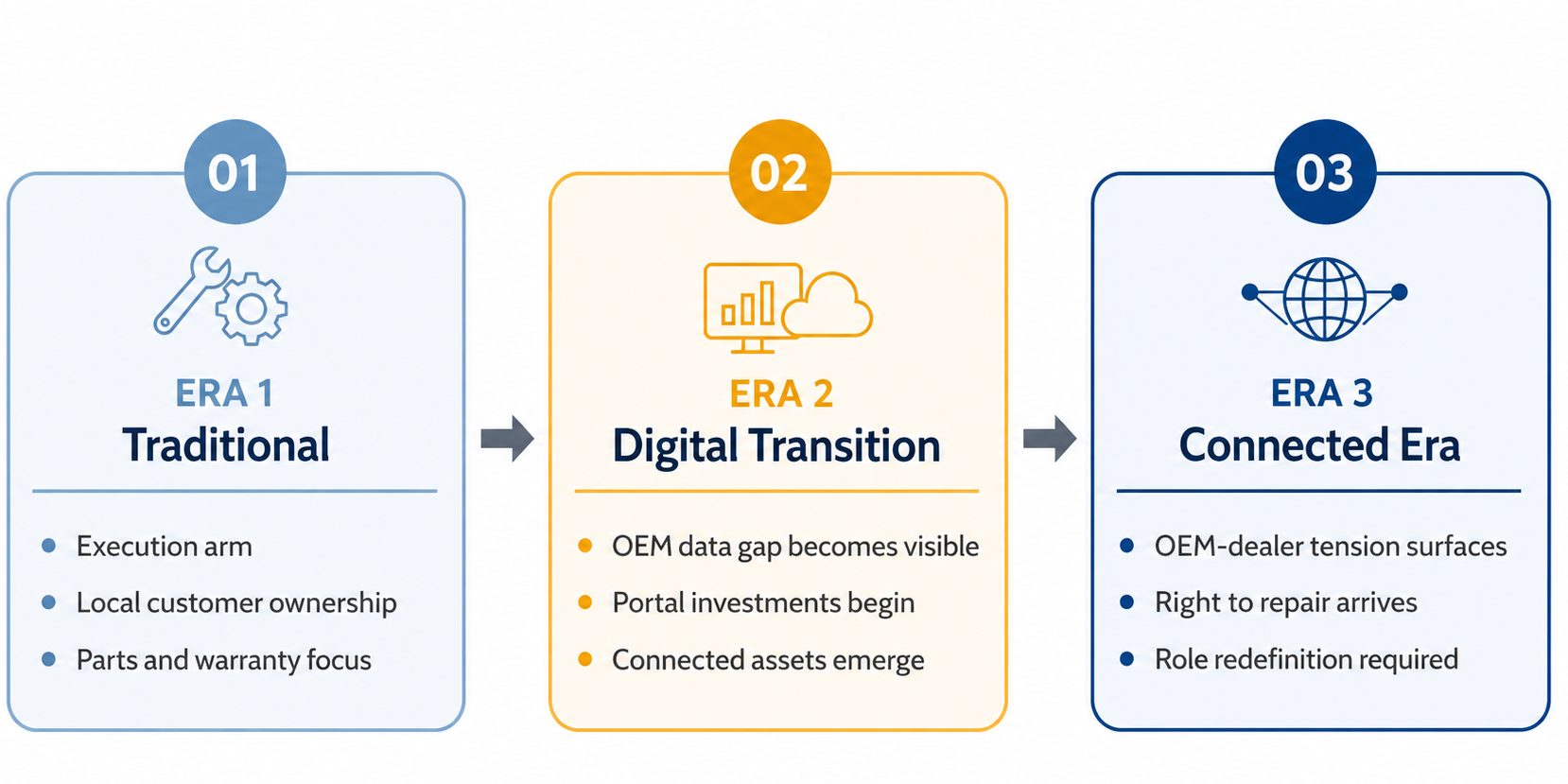
The friction between OEMs and their dealer networks isn’t the result of one strategic decision. It has built across four parallel pressure points, each individually manageable, collectively corrosive.
Direct Customer Visibility
OEMs want to know who owns their assets, what condition those assets are in, and when they are due for service or replacement. Dealers have historically sat between the OEM and this data, sometimes by design, often simply because no integration existed to move it upstream.
The response from most OEMs has been investment in dealer-facing portals: platforms that give dealers access to asset data, service history, and entitlement records, while simultaneously giving OEMs visibility into what’s happening in the field. The vision is sound. The execution consistently disappoints.
The reason is almost always the same: the underlying data (asset records, install base, service history, contract entitlements) is too incomplete, duplicated, or inconsistent to surface meaningfully. The portal becomes a mirror for a data quality problem that existed long before the technology investment. OEMs discover this after go-live, not before, because data readiness was treated as an implementation task rather than a program prerequisite.
The result is a tool that underdelivers for dealers, creates frustration rather than capability, and leaves OEMs with visibility gaps they built the portal specifically to close.
Connected Assets and Telematics
Remote diagnostics and IoT connectivity have changed what’s technically possible in aftersales. OEMs can now monitor equipment health directly, identify fault conditions before failure, and in some cases initiate remote resolution without a technician visit.
In theory, this should make dealers more effective. They can arrive at a job with a pre-diagnosed fault with the right parts already ordered and fix the equipment, leading to a shorter resolution time. In practice, it surfaces a question that dealers feel but rarely articulate directly: if the OEM can see the asset, predict the failure, and in some cases fix it remotely, what exactly is my role?
The answer to that question is not being addressed proactively in most OEM aftersales strategies. It is being left for dealers to work out themselves, which is not reassuring for a network being asked to invest in service capability and customer relationships simultaneously.
Service Contracts and Recurring Revenue
Multi-year service contracts have become one of the most strategically important revenue streams in aftersales as it is predictable, margin-rich, and customer-retentive. OEMs want a larger share of that revenue directly, rather than allowing it to flow through dealer-sold and dealer-managed agreements.
The commercial logic is understandable. The execution creates direct conflict. When OEMs sell contracts that bypass the dealer or compete with dealer-offered agreements, dealers don’t just lose revenue, they lose the ongoing customer touchpoint that the contract created. A service contract is not just a financial instrument. It is a structured reason for regular customer contact, which is the foundation of relationship-based aftersales.
Remove that from the dealer’s hands and you remove the mechanism that keeps them invested in the customer’s long-term satisfaction.
Parts Margin Pressure
Parts have been the highest-margin lever in OEM aftersales for years, often intentionally priced to maximize extraction from the installed base. But pricing has crossed a threshold in many markets where the margin calculus no longer works in the OEM’s favor.
When genuine parts are priced significantly above independent alternatives, dealers find ways to source around OEM supply. Customers do the same. The dealer network, which should be the OEM’s strongest and most trusted parts distribution channel becomes price-motivated to undermine the very exclusivity the OEM depends on. The sustainable parts pricing question is one most OEM commercial teams have not yet formally addressed.
Right to Repair: The External Signal OEMs Cannot Ignore
These four friction points are being accelerated by legislative pressure that is still in its early stages but moving in one clear direction.
- EU Directive 2024/1799 entered into force July 2024, effective across member states July 2026. Mandates manufacturers make parts, tools, and repair information available to independent repairers at fair prices
- EU Repairs Clause specifically breaks OEM design right monopolies on visible automotive replacement parts, ending over three decades of protected aftermarket exclusivity
- US REPAIR Act (H.R. 1566) reintroduced February 2025 with bipartisan support. Would require OEMs to provide independent repairers with access to the same diagnostic data and tools available to franchised dealers
- FTC vs John Deere lawsuit filed January 2025 alleging deliberate restriction of diagnostic software to dealerships. The clearest industrial equipment precedent yet
Current legislation is limited in product scope and industrial equipment is not fully covered yet. But the direction is unambiguous and the scope will expand. OEMs treating right to repair as a compliance exercise rather than a strategic signal will find themselves repeatedly reactive as each new regulation arrives.
Every OEM initiative to own the customer relationship directly is simultaneously a signal to dealers that their role is shrinking. Motivation follows accordingly.
What the Dealer Model Needs to Become
The answer is not dealer elimination. The last-mile execution problem that created the dealer model in the first place hasn’t gone away, rather it has become more complex. What needs to change is the role definition, the commercial structure, and the support OEMs provide to make that role viable.
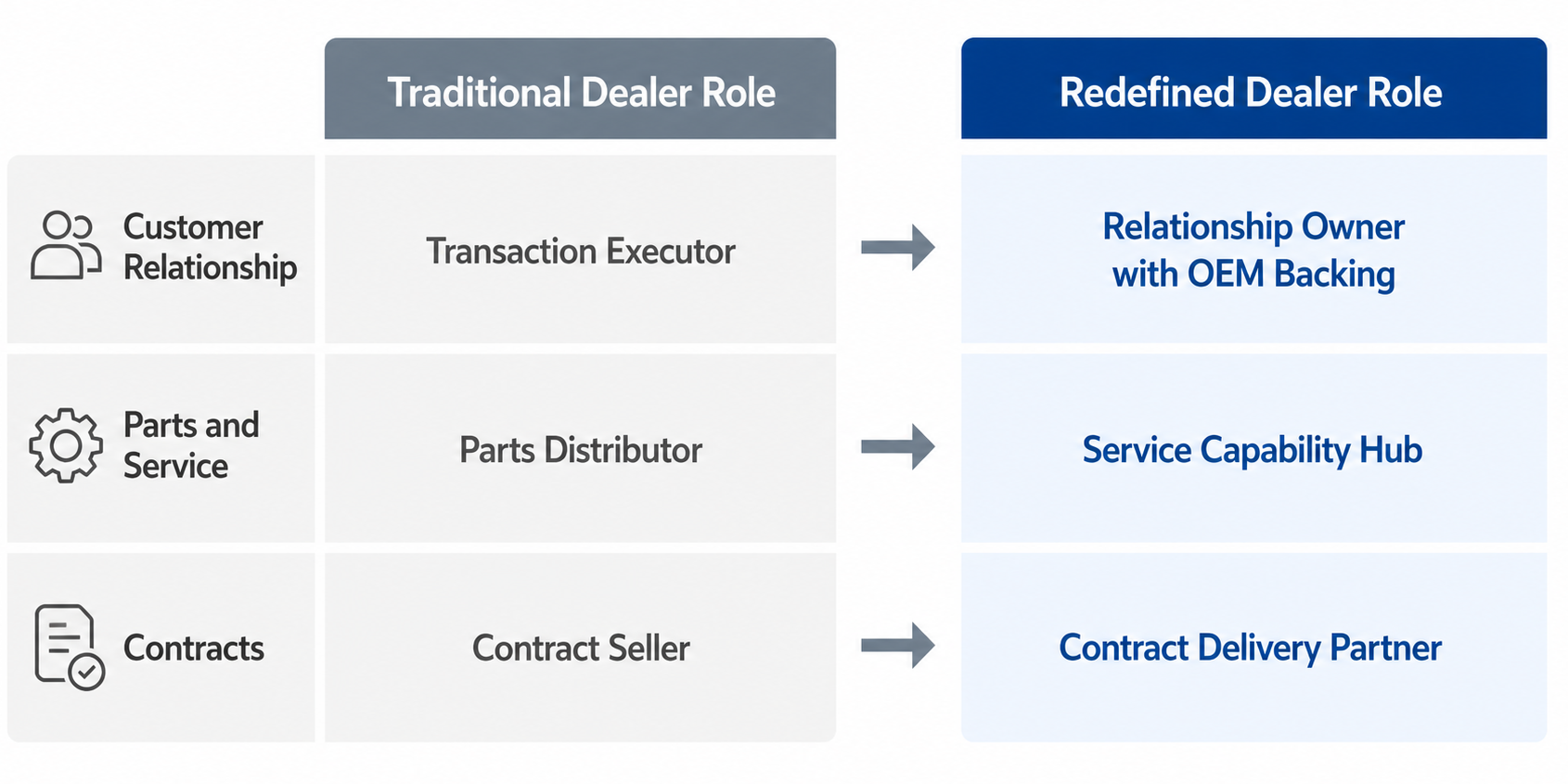
Three shifts define the redefined dealer model.
- From transaction executor to relationship owner with OEM backing: Dealers should remain the primary face of the customer relationship. OEMs should provide the data infrastructure such as clean asset records, real-time entitlement visibility, service history that makes dealers more capable rather than more bypassed. The dealer portal vision is right. The sequence has been wrong. Data quality has to be solved before the portal goes live, not discovered as a problem after it does.
- From parts distributor to service capability hub: As parts exclusivity erodes under right to repair legislation and independent aftermarket growth, the dealer’s defensible value shifts from what they can supply to what they can do. Diagnostic depth, technician expertise, and product-specific knowledge become the differentiator. An independent repairer can access the same parts. They cannot replicate the same capability if OEMs invest in building it deliberately through training, certification, and tooling programs.
- From contract seller to contract delivery partner: Rather than competing with dealers on contract revenue, OEMs should structure agreements that are sold and fulfilled through the dealer network, with OEM visibility and quality standards embedded. The dealer earns the customer relationship. The OEM earns the data, the brand consistency, and the installed base intelligence that a well-executed contract generates. This requires rethinking how service contracts are structured and governed, which is more complex than most OEM commercial teams anticipate when they first draw the model.
What the Transition Actually Requires
Redefining the dealer role is a strategy. Making it real is an organizational and operational challenge that sits across people, process, and technology, and cannot be solved by addressing only one.
| People | Process | Technology |
|---|---|---|
| Dealer technician certification as the primary differentiator once parts exclusivity erodes | Data quality as a program workstream before any portal investment, not an implementation task after go-live | Dealer portal built on clean install base and asset data, sequenced correctly |
| OEM account management shifting from compliance oversight to genuine partnership | Joint contract structure with clear OEM-dealer revenue and ownership split | Connected asset telematics shared with dealers as an action layer, not used to bypass them |
| Internal OEM teams reorienting from channel management to service delivery co-ownership | Entitlement visibility for dealers in real time, without calling the OEM to confirm coverage | Diagnostic tooling and software access as a dealer capability investment to get ahead of right to repair rather than complying reluctantly |
| Change management: dealer principals need to see the new model as commercially viable, not just strategically logical for the OEM | Warranty and escalation handling across the OEM-dealer boundary without the customer feeling the seam | AI-assisted service scheduling and predictive maintenance insight shared with dealer, not just held centrally |
The technology column is worth pausing on. OEMs that proactively share diagnostic tools, telematics data, and service intelligence with their dealer network are doing exactly what right to repair legislation will eventually require them to do anyway. Getting ahead of that, framing it as a dealer capability investment rather than a regulatory concession, is both strategically smarter and commercially more defensible.
For organizations assessing where to start, the AI Readiness Assessment framework applies directly here: the same data foundation questions that determine AI readiness determine dealer portal readiness and connected asset sharing readiness. The bottleneck is almost always the same.
Final Thoughts: The Window Is Narrow
OEMs that move deliberately by investing in dealer capability, sharing data rather than hoarding it, building contract models that make dealer participation commercially attractive will retain a motivated network capable of delivering on the brand promise at local level. That network becomes a genuine competitive advantage as independent repairers gain legislative access to parts and diagnostic information.
OEMs that continue gradual disintermediation while expecting full dealer motivation will find themselves with a legislatively opened market, a demotivated dealer network, and independent repairers better positioned than anyone in their aftersales team currently models.
The dealer isn’t obsolete. But the model that sustained them for forty years is changing faster than most OEM aftersales strategies currently reflect.
The question isn’t whether the dealer model needs to change. It’s whether OEMs will lead that change or be forced into it.