Here is a paradox that practitioners in manufacturing aftersales recognize immediately.
The manufacturer is the original source of asset information. They designed the product, configured it to the customer’s specification, and shipped it from their own facility. No one knows more about that asset at the moment it leaves the factory.
Yet within two to three years of field operation, many manufacturers have less accurate asset data than their own customers do.
Customers know what is installed. They know what has been modified, relocated, or quietly decommissioned. They know who serviced it and when. Manufacturers, meanwhile, are often working from records that were accurate at commissioning and have drifted from operational reality ever since.
This is the core failure of installed base management, and it plays out across the industry regardless of sector maturity, systems investment, or digital transformation spend.
The problem is not the absence of technology. Manufacturers today operate CRM platforms, ERPs, field service management systems, IoT connectivity layers, and asset management tools. The gap is between what those systems were designed to capture and what operational reality actually produces over time.
The stakes are also rising. AI copilots, predictive maintenance engines, and service intelligence platforms now dominate manufacturing boardroom conversations, but every one of them depends on high-quality installed base data as their operational foundation. When that foundation is fragmented, AI initiatives struggle to scale beyond pilots regardless of model sophistication. Poor installed base management has become the primary constraint on the next generation of service transformation.
Why Installed Base Management Fails in Practice
It Is More Than an Asset Registry
Many organizations initially approach installed base management as a master data or technology initiative. The early framing is usually straightforward: capture serialized assets, link them to customers, maintain the records in a central system.
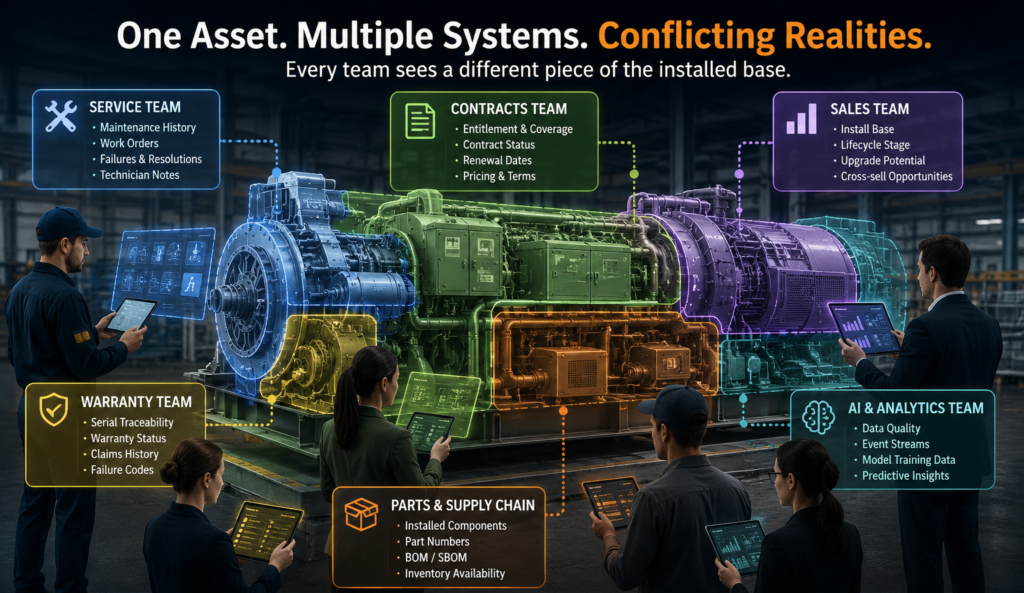
What emerges in practice is significantly more complex. A usable installed base is not a list of products. It is a living operational record that spans multiple layers of information, each maintained by different functions with different operational priorities.
Different functions across the organization depend on different subsets of this information, and their needs are rarely aligned.
| Function | Primary Data Needs | Key Failure Risk |
|---|---|---|
| Service Operations | Asset configuration, maintenance history, parts relationships | Repeat visits, poor parts readiness, slower diagnosis |
| Warranty | Serial number, ownership, coverage dates, claim history | Warranty leakage, duplicate coverage, entitlement disputes |
| Contracts | Active asset list, lifecycle status, service eligibility | Missed renewals, inactive assets under active contracts |
| Sales / Account Management | Installed footprint, upgrade eligibility, contract expiry | Missed commercial opportunities, poor targeting |
| Supply Chain / Parts | Configuration, BOM relationships, parts history | Excess inventory, wrong parts dispatched |
| Dealer Operations | Asset ownership, dealer-serviced assets, regional coverage | Disconnected service histories, fragmented OEM visibility |
The challenge becomes larger still in organizations running multiple business units with different product lines, service models, asset hierarchies, and dealer ecosystems. Over time, every function adds attributes, exceptions, and relationships to the installed base model. What begins as a clean asset registry gradually evolves into bloated data structures, inconsistent governance, and disconnected operational workflows.
The challenge is rarely collecting asset data initially. The challenge is sustaining operational trust in that data over time.
Where Data Gets Corrupted
Most organizations recognize that installed base data degrades in the field. Fewer appreciate how early the damage begins.
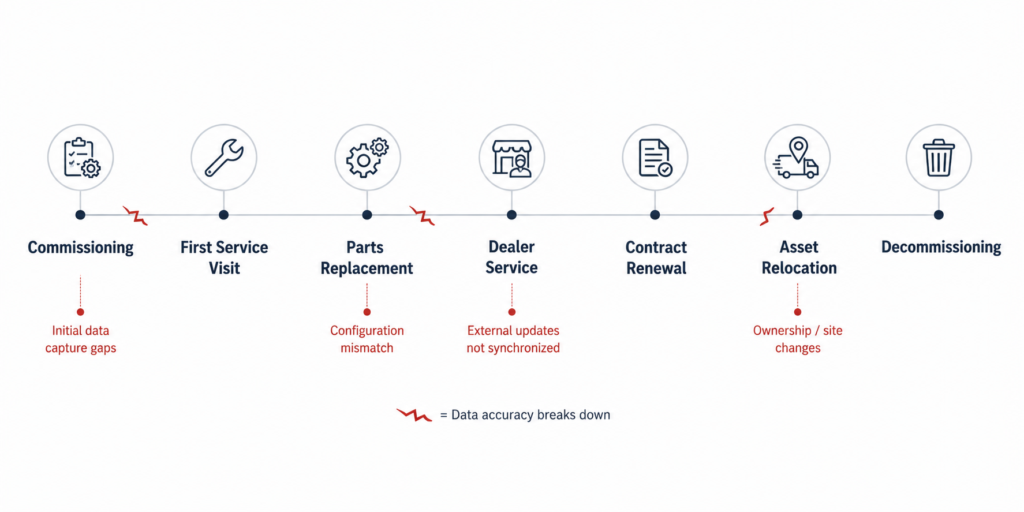
The commissioning-to-operational handoff is one of the most consistently underestimated failure points in asset lifecycle management. Projects install equipment, punch lists get closed, and asset records get created by whoever is responsible for the ERP upload, often at system level rather than component level, without accurate site or ownership data, and by project teams whose incentive is closeout rather than data quality. By the time the asset transitions to service operations, the record is already incomplete.
From that point, degradation compounds. Assets are relocated without records being updated. Products are modified in the field with no formal update to the installed record. Serial numbers are captured inconsistently. Ownership changes as customers are acquired or restructured. Acquisitions introduce duplicate asset structures from legacy ERPs. Regional processes vary in discipline. Dealer networks maintain separate service records that are never reconciled with OEM systems.
What makes this particularly hard to solve is that the people responsible for maintaining asset data are measured on operational execution, not data governance. Field technicians are evaluated on response times, closure rates, and first-time fix rates, not on the completeness of asset hierarchies. Dealers are measured on service revenue and customer retention. Data discipline is nobody’s primary job. And in that vacuum, accuracy drifts.
Installed base initiatives that begin with strong intent gradually become harder to sustain as operational complexity accumulates around them.
The Ownership Problem: One of the biggest reasons installed base visibility struggles at scale is the absence of clear ownership. Installed base data sits at the intersection of sales, service, warranty, contracts, supply chain, and dealer operations, but in most organizations, no single function truly owns the lifecycle accuracy of that data. This is especially acute in organizations operating through dealers or indirect service channels, where the last-mile service relationship and the asset knowledge that comes with it sit outside the OEM entirely. Dealers know the equipment. The OEM, working from its own systems, often has a materially different picture of the same asset. Recognizing that installed base visibility problems are frequently ownership problems disguised as technology problems is usually the first step toward resolving them. (See: Why OEM-Dealer Relationships Break Down in Aftersales)
The Business Consequences
Poor installed base management is not a data quality problem contained within IT or master data functions. It propagates directly into revenue, operational efficiency, and the organization’s capacity to execute on its strategic priorities.
Without accurate installed base visibility, manufacturers routinely experience missed contract renewals, low service contract attach rates, entitlement mismatches, poor upgrade targeting, warranty leakage from unauthorized claims, and inconsistent service eligibility across customer accounts. These issues become increasingly costly as manufacturers expand into lifecycle services, subscription offerings, and outcome-based service models, all of which depend on knowing exactly what is installed, where, and under what coverage terms. Many manufacturers underestimate how much service revenue opportunity remains hidden inside fragmented installed base data.
When service teams lack accurate asset configurations, maintenance history, and parts relationships, execution suffers across every dimension. Technicians spend time establishing what should already be known. Parts readiness declines. Diagnosis takes longer. These inefficiencies accumulate into measurable impacts on both operational KPIs and customer experience, and frequently contribute to broader service contract complexity across manufacturing organizations.
| KPI | What Poor Installed Base Management Causes | Impact |
|---|---|---|
| First-Time Fix Rate | Technicians arrive without accurate asset configuration or service history | Lower. Repeat visits increase, customer confidence drops |
| Mean Time to Repair | Incomplete asset records mean technicians diagnose in the field what the system should already know | Higher. Avoidable time lost on every job |
| Parts Availability | Field modifications and BOM gaps mean the wrong parts are ordered or stocked | Worse. Delays extend repair cycles and technician wait time |
| Warranty Cost | Claims processed against lapsed, duplicate, or incorrectly owned assets create avoidable leakage | Higher. Warranty spend exceeds entitlement boundaries |
| Technician Utilization | Repeat visits and parts delays consume field capacity that should be generating revenue | Lower. Productive hours lost to upstream data failures |
| Contract Renewal Rate | Incomplete asset lists mean eligible contracts expire before the commercial team sees them | Lower. Renewal opportunities missed at the account level |
The impact on AI initiatives deserves particular attention. Predictive maintenance models, AI copilots, and automated diagnostics all require structured service histories, accurate asset relationships, reliable failure records, and consistent hierarchies across business units. When installed base data is fragmented, these initiatives cannot scale beyond pilots regardless of model quality or vendor capability. The bottleneck is not the algorithm rather the asset data beneath it. Many AI readiness initiatives in manufacturing significantly underestimate this dependency.
Perhaps the most overlooked consequence is the gradual erosion of organizational trust. Once confidence in the installed base declines, teams stop relying on the platform and build workarounds such as spreadsheets, local databases, shadow processes. Different parts of the organization begin operating with different versions of the truth. At that point the challenge is no longer technical. It is organizational, and organizational trust is far harder to rebuild than data.
When trust in the installed base declines, organizations stop relying on the platform, and start building workarounds.
What Successful Organizations Do Differently
Organizations that improve installed base management sustainably resist the impulse to solve complexity with more technology. Instead, they focus on the operational and governance disciplines that determine whether asset data remains trustworthy over time.
- Define a minimum viable installed base before adding complexity. Rather than attempting to capture every possible attribute upfront, mature organizations first align on the data that is genuinely required to support operational decisions. Lifecycle-critical attributes, ownership responsibilities, and governance priorities are defined explicitly. Everything else is deferred. This prevents the scope accumulation that causes most installed base initiatives to collapse early.
- Embed asset updates into operational workflows, not governance exercises. Standalone data quality programs rarely sustain accuracy over time. The organizations that do this well make asset updates a byproduct of work that is already happening: commissioning workflows establish baseline records at installation, service work orders update maintenance history at closure, parts replacement updates configurations in the same transaction, and warranty claims validate ownership as a condition of processing.
- Assign ownership explicitly, not collectively. Who creates asset records? Who validates updates? Who is accountable for lifecycle accuracy when an asset is relocated or modified? These questions need answers assigned to specific roles and not distributed across a governance committee. Installed base accuracy improves significantly when accountability is operationally embedded rather than centrally isolated.
- Accept that different functions need different views. Not every business unit or function requires an identical asset structure. Mature organizations balance centralized governance with flexible consumption models, allowing each function to access the installed base in ways that match their operational needs, without forcing a single monolithic structure that serves everyone imperfectly.
None of these are technology decisions. All of them require organizational commitment that outlasts the implementation project. That is precisely why they are rare and why organizations that build this discipline early tend to maintain a durable operational advantage over those still cycling through platform migrations in search of a shortcut.
Final Thoughts
Installed base management is consistently treated as a CRM initiative, a data migration effort, or a technology implementation challenge. In practice, it is an ongoing asset lifecycle management discipline, one that requires sustained governance, embedded workflows, and organizational commitment to data accuracy as a strategic asset.
The manufacturers best positioned for AI-enabled service transformation, predictive maintenance, and subscription growth are the ones who have built a foundation of trustworthy installed base data beneath their ambitions.
The challenge is not creating asset records. It is sustaining operational trust in those records through field modifications, ownership changes, dealer handoffs, acquisitions, and the accumulated complexity of years of service execution. That discipline is unglamorous, absent from vendor roadmaps, and rarely discussed at industry conferences. But it is the difference between a service transformation that scales and one that stalls at the pilot stage.