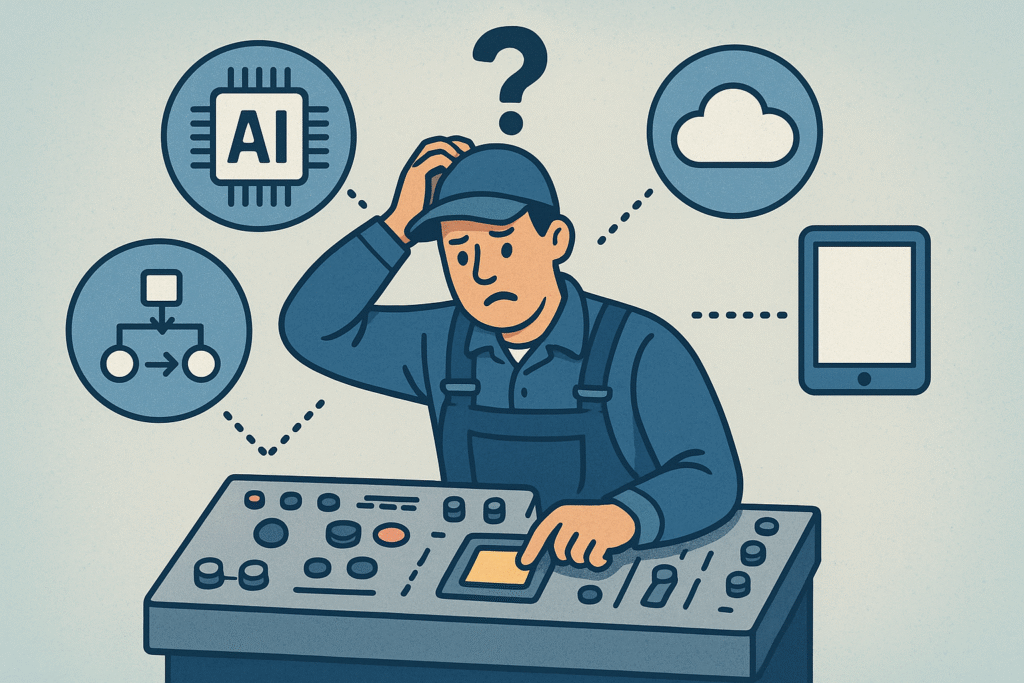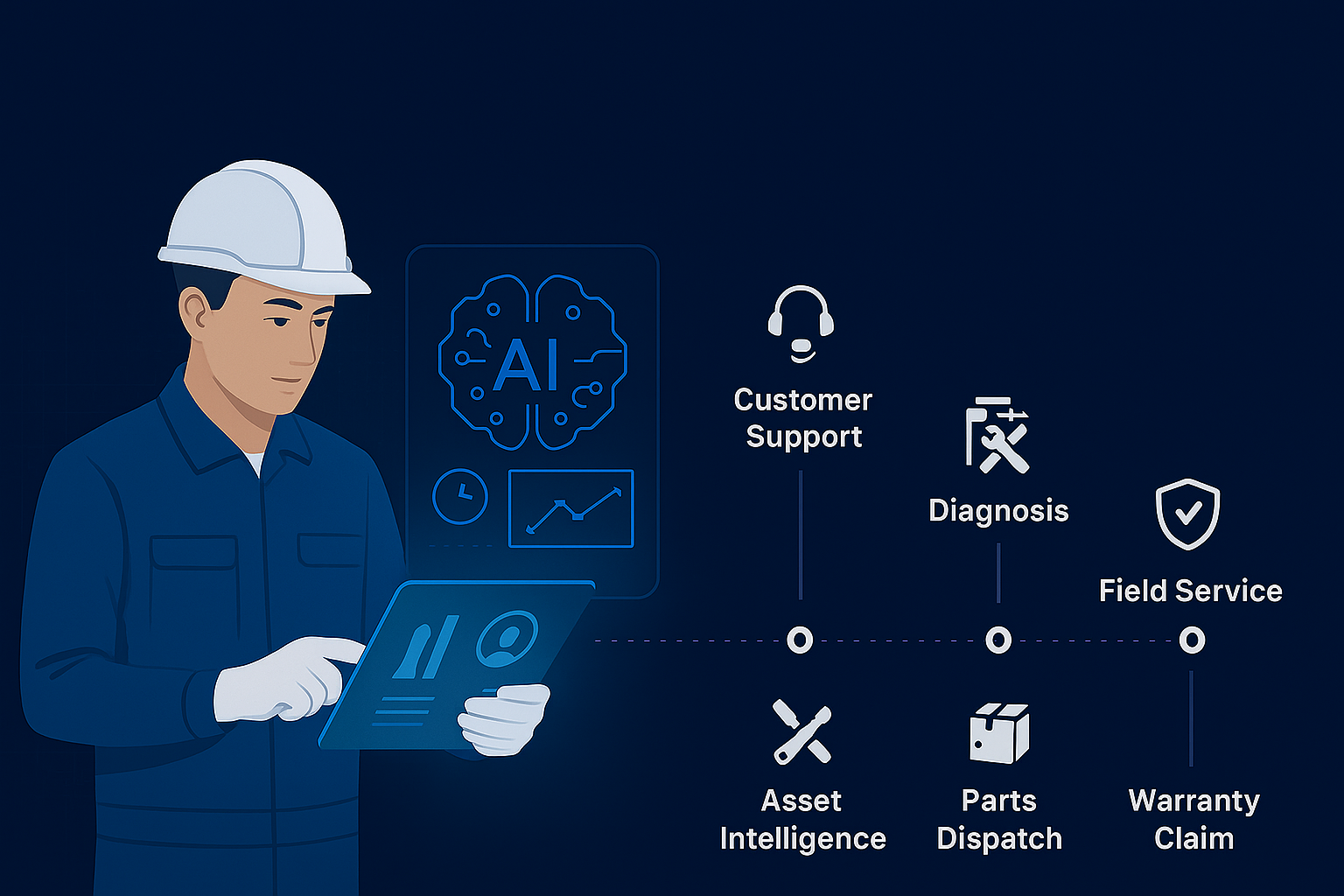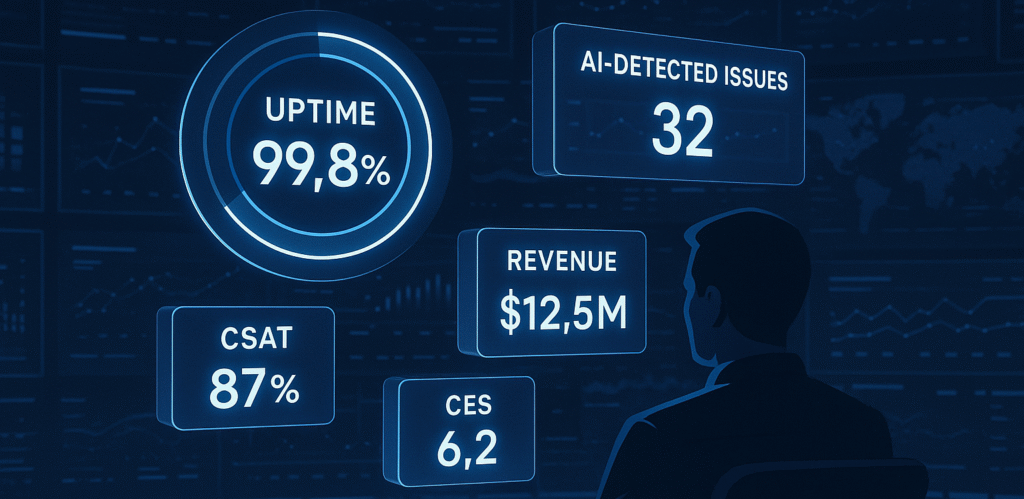

Manufacturers have spent the last decade modernizing two distinct worlds. Information Technology (IT) has moved ERP, CRM, and service platforms to the cloud to improve governance and customer management. At the same time, Operational Technology (OT) has advanced machine performance through sensors, controllers, and industrial automation.
Yet a critical digital blind spot remains.
Many organizations run sophisticated enterprise systems that are technically unaware that a multi-million-dollar asset in the field is currently approaching failure. Dashboards show contracts and service KPIs, but the machine itself—the source of both risk and opportunity—often sits outside the enterprise data loop.
This gap exists because the “brain” (IT) and the “nervous system” (OT) are still disconnected. As service revenue becomes a primary growth lever, IT-OT integration in manufacturing is increasingly becoming the backbone of modern aftermarket service operations.
McKinsey research shows that aftermarket service margins can exceed 25% compared with roughly 10% for new equipment sales, making service one of the most profitable growth levers for industrial manufacturers.
The Great Cultural Divide Between IT and OT
Bridging IT and OT requires more than connecting systems. It requires acknowledging that these environments were built with fundamentally different priorities.
IT environments evolved around data integrity and governance. They protect financial records, enforce compliance rules, and maintain system reliability across business operations. Their success is measured by stability, security, and transactional accuracy.
Operational Technology evolved under a different mandate entirely: maintaining physical uptime. OT systems control machinery, monitor production conditions, and prevent failures that could halt operations or compromise safety.
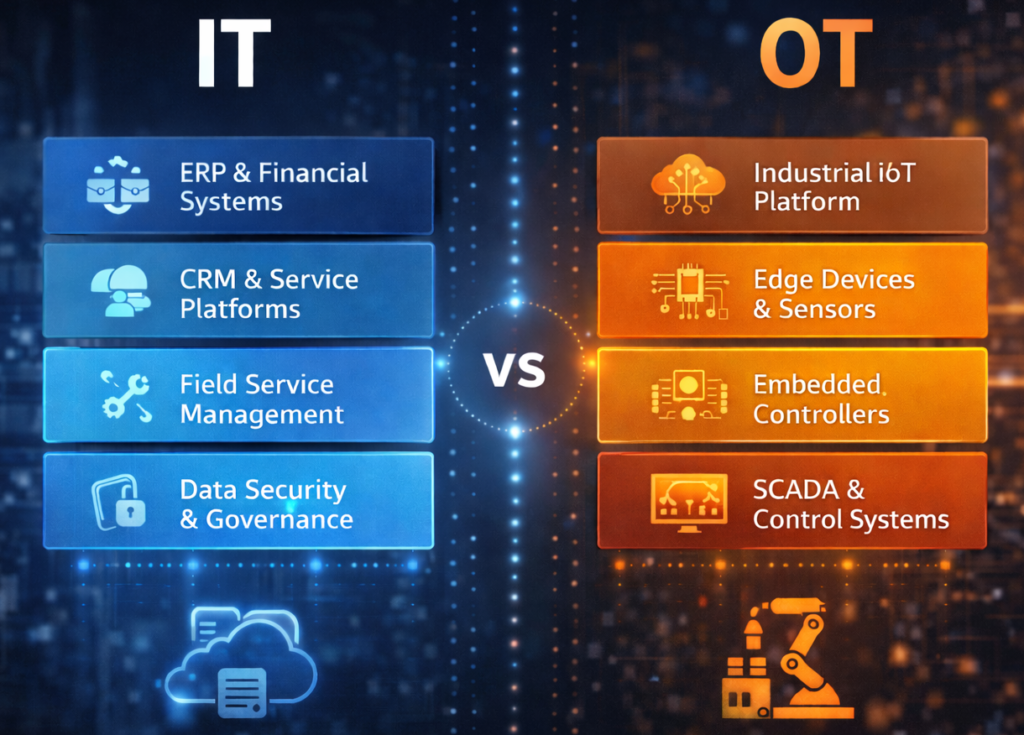
The contrast becomes clearer when their priorities are placed side by side.
The IT Priority: Confidentiality & Integrity
Driven by the CIO, IT focuses on protecting records, enforcing governance, and ensuring secure system transactions.
The OT Priority: Availability & Safety
Driven by operations or engineering leadership, OT focuses on continuous uptime and safe equipment operation.
In OT environments, a software failure is not simply a bug, it can stop production or create operational risk.
These differing priorities create what can be described as convergence debt: the hidden operational tax organizations pay every time a human must manually bridge the gap between a machine’s error code and a service work order.
When data stays siloed, service remains reactive.
The Service Execution Matrix: Four Value Levers of IT-OT Integration
Understanding the structural divide is important. But for service leaders, the more practical question is:
Where exactly does IT-OT integration create business value?
In aftermarket operations, integration unlocks four distinct value levers. These can be viewed across two dimensions: operational complexity and revenue impact.
Each quadrant represents a different way that machine signals can influence service economics.
1. Condition-Based Contracts (Predictable Risk)
Service contracts are often priced using engineering assumptions and historical averages. In reality, asset usage varies dramatically across customers and environments. Equipment operating in harsh conditions or at high utilization can experience significantly faster degradation.
By connecting OT telemetry with IT contract systems, manufacturers gain visibility into real asset health and usage patterns. Contracts can then be priced or adjusted based on actual wear rather than generalized assumptions.
The result is improved margin protection and more predictable service risk exposure.
2. Outcome-Based Models (Total Uptime)
The transition from selling equipment to selling outcomes such as availability, throughput, or uptime, depends on continuous operational visibility.
Models like “Power by the Hour” require a reliable feedback loop between the machine and the billing system. OT telemetry provides the operational heartbeat, while IT systems convert that data into invoices, service entitlements, and SLA tracking.
Without that connection, outcome-based service models remain difficult to scale. With it, usage-based pricing becomes both measurable and automatable.
3. Intelligent Parts Logistics (Physics-to-Purchase Order)
Many service organizations still manage spare parts planning using historical averages. Yet the machine itself often signals degradation well before failure occurs.
When OT alerts are connected to ERP systems, these signals can automatically trigger operational actions:
- inventory checks
- replenishment requests
- automated shipping workflows
For example, a thermal sensor reaching a defined threshold can initiate a spare-part shipment before a breakdown occurs. The result is reduced emergency freight, improved parts availability, and fewer costly downtime events.
Operational physics begins to drive supply chain decisions.
4. Remote Technical Copilot (Live Telemetry)
Field technicians frequently arrive on site with limited diagnostic context. Much of the service visit is spent determining what the problem actually is.
Integrating OT telemetry into service tickets changes that dynamic. When technicians can see the last hour of machine behavior, they arrive with clearer diagnostic insight and the correct spare parts.
This significantly improves First-Time Fix Rates (FTFR) and reduces repeat service visits.
More importantly, it shifts service work from reactive troubleshooting toward informed intervention.
The business impact of IT-OT integration in aftermarket operations can be understood through four primary value levers.
| Low Operational Complexity | High Operational Complexity | |
|---|---|---|
| High Revenue Impact | Condition-Based Contracts | Outcome-Based Service Models |
| Efficiency & Margin Impact | Intelligent Parts Logistics | Remote Technical Copilot |
The Four Levels of IT-OT Integration Maturity
While the value of integration is clear, most organizations sit at different stages of the journey.
Understanding this maturity progression helps explain why many predictive maintenance initiatives struggle to scale.
Level 1: Air-Gapped (Reactive)
Machines operate independently from enterprise systems. Operational data is collected manually or intermittently. Service remains fully reactive.
Level 2: Connected but Siloed (Informative)
Machine data flows to monitoring dashboards, but it does not trigger enterprise workflows. Engineers can see issues, but responses remain manual.
Many organizations stop here. Visibility improves, but automation and commercial integration remain limited.
Level 3: Integrated Levers (Proactive)
Operational events trigger enterprise actions. A critical machine alarm automatically generates a draft service case or maintenance request.
Service becomes proactive rather than reactive.
Level 4: Ecosystem Synchronization (Adaptive)
Real-time feedback loops connect assets, service operations, and supply chains. Contracts, parts logistics, and field service decisions adapt dynamically to asset performance.
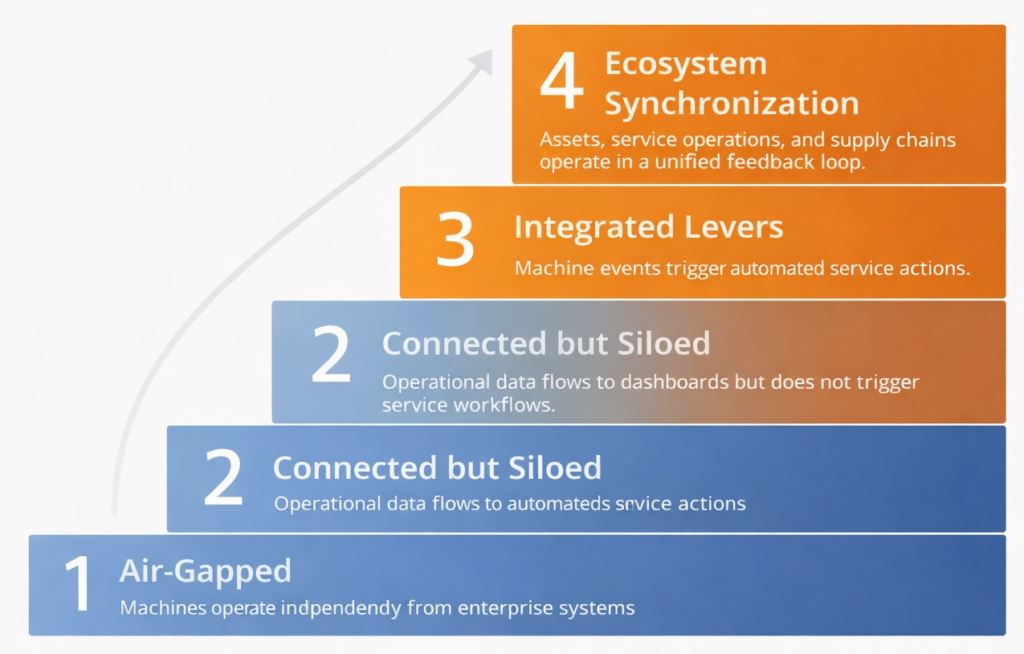
At this stage, service evolves from a support function into a data-driven revenue engine.
Why OT Data is the Foundation for AI in Service
Artificial intelligence is frequently presented as the next breakthrough in aftersales operations. Predictive maintenance algorithms promise early failure detection, optimized maintenance schedules, and reduced downtime.
Yet AI is only as effective as the data infrastructure beneath it.
Without reliable operational signals, predictive models cannot identify meaningful patterns. Without enterprise workflow integration, predictions cannot trigger actions.
Scalable AI therefore depends on three foundational elements:
- Structured OT telemetry with clean, time-stamped signals
- Enterprise workflows capable of automatically creating work orders or purchase requests
- Clear asset hierarchies that link components, machines, and service contracts
When these foundations are missing, AI initiatives often stall in “pilot purgatory.” Predictions may be technically accurate, but they fail to drive operational outcomes.
The 80/20 Roadmap for IT-OT Integration
A common mistake in digital transformation programs is attempting to connect every asset simultaneously. This approach creates complexity without immediate business impact.
A more practical roadmap follows an 80/20 strategy.
Focus on the critical few assets.
Identify the 20% of the installed base responsible for the majority of service margin or emergency downtime.
Use gateway technologies.
Legacy machines do not always need replacement. Edge devices can translate existing industrial protocols into enterprise-friendly data streams.
Move only decision-relevant data.
Not every machine signal must reach the cloud. If a data point does not influence maintenance decisions, it can remain processed at the edge.
This targeted approach accelerates value while avoiding unnecessary architectural complexity.
From Technology to Governance: The IT-OT Peace Treaty
Despite the technical challenges involved, the primary barrier to IT-OT convergence is rarely technology alone.
It is organizational alignment.
IT teams optimize for system governance.
OT teams optimize for operational reliability.
Service operations sit between these domains but often lack authority over either. Successful integration therefore requires shared governance, where IT architects, OT engineers, and service leaders align around common outcomes.
A useful shared KPI is Total Cost of Service, a metric that reflects both operational efficiency and commercial performance.
Service leaders are often the natural owners of this convergence. They understand both the operational realities of equipment and the economic consequences of downtime.
Conclusion: Turning Machine Signals Into Service Growth
In modern manufacturing, competitive advantage increasingly depends on what happens after the sale.
Machines are no longer just products. They are ongoing sources of operational intelligence. Organizations that capture and operationalize that intelligence gain the ability to anticipate failures, optimize service delivery, and develop new revenue models.
Strategy provides the roadmap.
But a connected IT-OT architecture provides the engine.
Manufacturers that successfully negotiate the “peace treaty” between enterprise systems and operational technology will transform service operations from a reactive support function into a sustainable growth engine.
The future of aftermarket performance lies not only in the machines themselves, but in how intelligently those machines are connected.