
Manufacturers rarely lack a service revenue strategy. Contract attach targets exist. Parts pricing guardrails are documented. Field teams are trained on upsell talking points. And yet quarter after quarter, the same revenue stays on the table.
The reason isn’t strategy. It’s that every revenue lever in a service organization passes through a handoff between functions with conflicting incentives, and that’s where the money leaks. Contract attach falters when sales owns the deal but service owns the cost. Parts margin erodes when discounting authority sits locally while margin accountability sits centrally. Field upsell stalls when technicians are asked to sell without being incentivized to. Warranty-to-contract conversion is missed when no one owns the moment coverage lapses. And modification revenue gets treated as an afterthought instead of a distinct sales motion.
This article breaks down where each of these five levers breaks in practice, and what closing that gap actually requires. For the bigger picture on what determines which sources you can actually sell, and whether your business model even lets you reach them before capture ever comes into play, see Service Revenue Growth in Manufacturing: The Three Layers That Determine It.
What is Service Revenue Execution?
It is the operational discipline of aligning ownership, incentives, and data to monetize the installed base. Unlike strategy, which defines “where” to play, execution focuses on specific revenue levers such as contract attach, parts pricing, and field upsells, to ensure growth is realized, not just planned.
What Revenue Leakage Actually Looks Like
Most service leaders notice the symptoms long before anyone traces them to a cause. Contract attach plateaus a few points below target, quarter after quarter, despite a renewal push that looks fine on paper. Warranty costs drift upward not because of a spike in failures, but because exceptions and goodwill credits have quietly become the path of least resistance for anyone trying to avoid an escalation. Parts margins erode a percentage point at a time, through local discounts that each look defensible in isolation and only show up as a problem once finance rolls up the quarter. Field teams keep operating reactively, fixing what’s in front of them and moving on, because nobody has ever made it worth their time to do otherwise. And modification or upgrade opportunities get quoted late, discounted to close fast, or missed altogether, because there’s no process built for work that doesn’t fit neatly into either a routine service call or a capital sale.
None of this looks like a strategy failure from the inside. It looks like business as usual, which is exactly the problem. Each symptom marks a spot where a lever exists on paper, but nobody is fully accountable for pulling it.
The Five Levers, and Where Each One Breaks
| Lever | Where It Breaks | What Fixes It |
|---|---|---|
| Contracts | Sales owns the deal; service owns the cost | A single lifecycle owner with P&L accountability across the contract’s life |
| Warranty-to-Contract Conversion | Coverage lapses with no defined handoff owner | Automated conversion outreach triggered at lapse, owned end-to-end |
| Parts Pricing | Local discounting to keep the customer happy | Centralized margin guardrails with defined local flexibility |
| Field Upsell | Technicians identify needs but aren’t incentivized to act commercially | Technicians flag the opportunity; inside sales owns the close |
| Modifications & Upgrades | Treated as ad hoc field upsell instead of a distinct lifecycle motion | Routed as its own quoting and ownership path, scoped like a small project |
Contracts: Where the P&L Splits in Two
Contract attach and renewal usually fail at a specific seam: sales is compensated for closing the initial deal, and service is compensated for delivering against it profitably. Nobody owns the contract’s full lifecycle economics. A renewal that should be priced up based on usage data instead gets rolled over flat because the account owner has moved on to the next close, and service has no pricing authority to begin with.
The fix isn’t a bigger renewal push. It’s naming a single lifecycle owner, often in a hybrid service-sales role, who carries P&L accountability for the contract from signature through renewal, not just the initial sale.
Warranty-to-Contract Conversion: The Moment Nobody Owns
This is a different problem from warranty governance or goodwill discipline, those are cost-avoidance questions, covered in Warranty Management in Manufacturing. This is about revenue: the exact moment a customer’s warranty coverage ends is the highest-intent moment to sell them a service contract, and in most organizations, nobody owns triggering that conversation. It falls between whoever administers warranty claims and whoever sells service contracts, and by the time either function notices the coverage lapsed, the customer has often already found another provider or simply gone uncovered.
The highest-intent moment to sell a service contract is the exact moment a customer’s warranty runs out, and in most manufacturing organizations, no one owns triggering that conversation.
The fix is operational, not strategic: a defined trigger, ideally automated from the warranty system, that hands the account to a named owner the moment coverage is set to expire, with a tracked conversion outcome.
Parts Pricing: The Margin Lever That Fights Itself
Parts pricing usually looks disciplined on a policy document and undisciplined in the field. Regional teams have local discounting authority because a machine down at a key account creates real pressure to move fast. But margin visibility sits with finance, weeks removed from the decision. The result: a pattern of local discounts that individually look reasonable and collectively erode margin.
The fix is not removing local flexibility but to put guardrails around it: a defined discount band local teams can act within, with anything beyond it requiring visible, fast escalation rather than silent approval.
Field Upsell: Selling Without a Sales Incentive
Technicians are frequently asked to spot commercial opportunities such as a worn component, an asset nearing end of life, a customer clearly over capacity, without being compensated as if they’d made a sale, and often without a clean path to hand that lead to someone who is. The predictable result is that technicians treat commercial awareness as extra, unrewarded work, and stop doing it.
This lever closes when the roles are split cleanly: technicians are responsible for flagging the opportunity as part of the job they already do, and a defined inside sales or account function owns turning that flag into a closed deal, with technician identification tracked and credited, even if they’re not the ones closing it.
Modifications & Upgrades: Not an Upsell, a Different Motion Entirely
This lever behaves differently from the other four, and it’s worth being explicit about why: the first four are incentive-alignment problems where the lever exists, but the people who could pull it aren’t motivated or empowered to. Modifications and retrofits are more often a process gap. These are project-shaped opportunities, example a customer needs a control system upgrade, a safety retrofit, a capacity modification, but they get funneled through the same intake as a routine field upsell, quoted reactively, and often discounted because there’s no distinct scoping process built for work of this size and complexity.
The fix here is recognizing that lifecycle modification work needs its own quoting path, its own ownership, and its own sales cycle, closer to how a capital project gets sold than how a field lead gets closed.
Why These Leaks Persist
Revenue leakage isn’t a result of people being lazy. It’s a result of people behaving rationally inside a system that rewards the wrong thing.
Consider a service manager measured on uptime but not on margin. Faced with a machine down at a key account, giving away a part for free is the fastest way to hit the metric they’re actually accountable for. That isn’t a mistake. The system working exactly as designed, just not as intended.
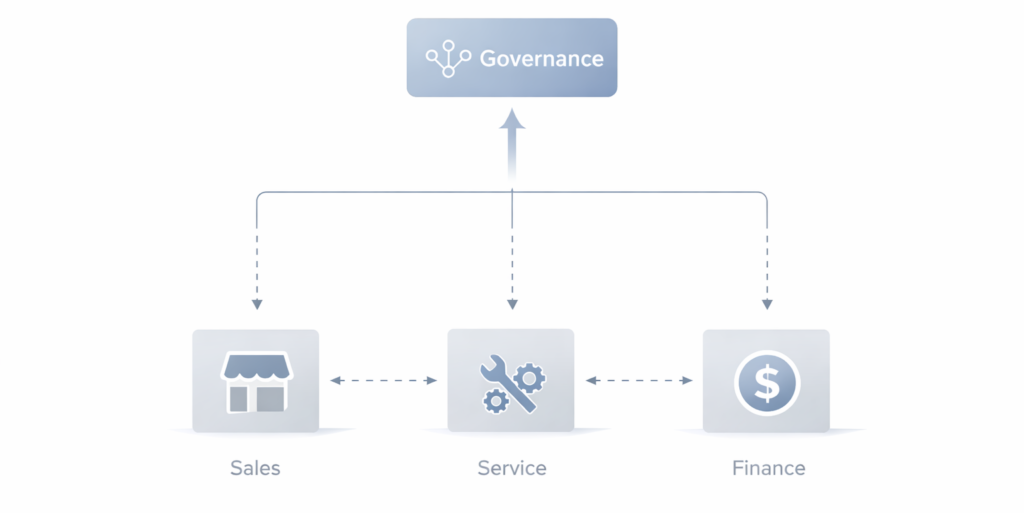
Most manufacturers operate in a hybrid structure: centralized policy, distributed execution, shared KPIs across functions that don’t share incentives. Revenue leaks precisely at the handoffs between those functions, at the moment a contract moves from sales to service, the moment a discount decision moves from field to finance, the moment warranty coverage moves from administration to sales. Unless decision rights and accountability are explicitly assigned at each of these handoffs, the leak persists regardless of how well-designed the strategy above it is.
What This Looks Like When It Works
A global HVAC manufacturer used its digital service platform to pivot toward a specific, urgent customer need, indoor air quality compliance, rather than sticking to a pre-planned efficiency roadmap. By enabling customers and technicians to digitally request, quote, and manage retrofit and compliance work, the organization moved from being a generic equipment provider to a service partner customers came to first, accelerating quote-to-order cycles in the process. Full story: HVAC Field Service Strategy.
A material handling equipment manufacturer deployed cognitive self-service tools to reduce technician decision latency in the field, not a broad digitalization push, a targeted fix to one specific bottleneck. The result was roughly a 15% uptime improvement and measurable cost savings for dealer partners, driven by faster, more confident technician decisions rather than any change to commercial process. Full story: Cognitive Technician Self-Service in Field Service.
In both cases, the win came from targeting one specific execution gap precisely, not from a broader transformation initiative.
Where to Start
Pick the lever contributing the most revenue today from contracts, parts, warranty conversion, to modifications and trace it end to end. Where does ownership become unclear? Where do decisions stall or get escalated unnecessarily? Where do the incentives of the people involved actually conflict with the revenue outcome you want?
Then ask the harder question: who is accountable for the outcome, not just the activity, at each of those handoffs? Until that’s unambiguous, no amount of strategic refinement will close the gap.
Want a fuller picture of where your organization stands? The Service-Led Growth Readiness Checklist walks through a structured self-assessment across people, process, and performance, a useful next step if you’re not sure which lever to start with. Download the Service-Led Growth Checklist and pressure-test your monetization readiness.
Ready to see where you stand?
Download the free Service-Led Growth Checklist to assess your organization’s readiness and identify the next best moves toward a lifecycle-driven business model.