
Field Service & Aftersales Insights

Perspectives on Service Growth, AI in Aftersales, Operation and Technology
This page brings together perspectives on field service, aftersales operations, and emerging technology in manufacturing and automotive service, grounded in real implementation experience.
The articles here explore what is changing, what is working, and where execution often breaks down. Topics range from KPIs and AI adoption to dealer operations, warranty management, and the day-to-day decisions that determine whether a transformation program succeeds or stalls.
Pick a topic below to explore further or browse the latest insights.
Explore Field Service Topics





Latest Insights
KPI of the Month #7: SLA Compliance Rate
SLA Compliance Rate can sit above 95% while customers still complain about slow service. This is because most organizations measure the clock at response, not resolution. This piece breaks down why the ambiguity persists, how it’s priced into vendor tiers, and how to report the metric so it reflects what customers actually experience.

Service Revenue Growth in Manufacturing: The Three Layers That Determine It
Service revenue growth isn’t one strategy question. It’s three questions, usually collapsed into one. What can you actually sell, does your business model let you reach it, and once it’s reachable, how do you capture it? This framework maps all three layers and shows why growth stalls when they fall out of sync.

Agentforce Field Service Review: Strong UX, but the Offline Gap Still Costs OEMs
Agentforce Field Service (formerly Salesforce Field Service) delivers strong core FSM capability (scheduling, mobile UX, native CRM integration, asset hierarchies) out of the box, ahead of most competitors. But its offline gap is real and documented, serious enough that a mature Salesforce shop still went third-party. Know before you buy.
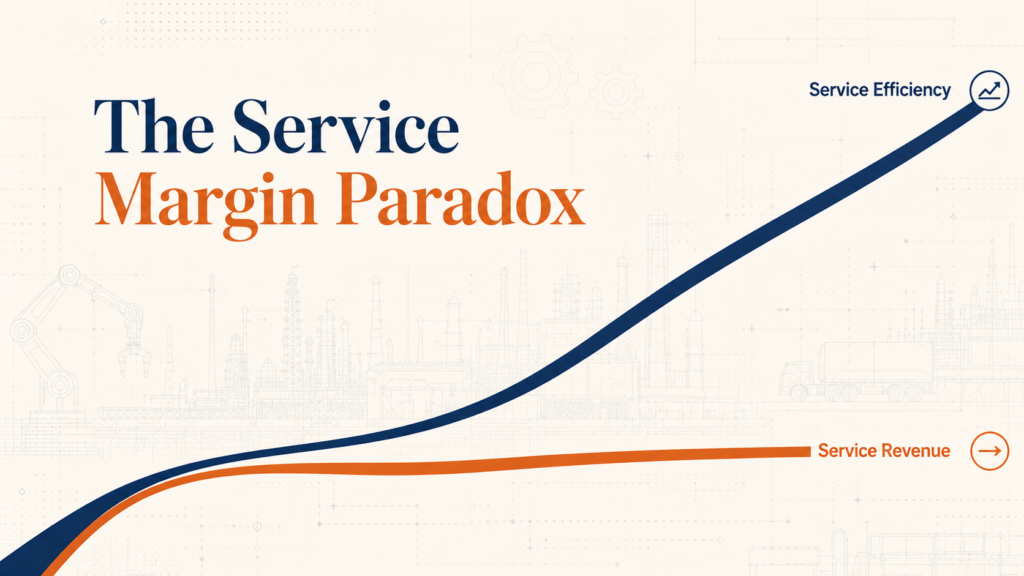
Your Service KPIs Are Improving. Your Revenue Isn’t. Here’s Why.
Improving FTFR and MTTR often coincides with flat or declining service revenue is not a KPI problem. This article breaks down why efficiency erodes revenue differently across strategic, hybrid, and break-fix accounts, offers a four-point diagnostic, and explains why the real fix is repricing the contract, not reversing the efficiency.

The Project-to-Service Handoff Gap That’s Quietly Draining OEM Margins
In project-based manufacturing, service inherits assets without their history such as warranty terms, commissioning data, configuration, because no one owns both sides of the handoff. Mature organizations send technicians to physically audit sites, but that only answers “what’s here,” triggering a tedious admin scramble to piece the rest together. The real fix uses the ERP…

AI in Aftersales: A Maturity Framework for Practitioners
Most aftersales AI investments fail from bad sequencing, not bad technology. This guide maps the real maturity path from automation, agentic AI, to autonomous operations, showing where organizations actually stand today, what to invest in next, and why warranty claim adjudication is the clearest proof point for the whole framework.

Entitlement Management: The Moment the Contract Meets Reality
Manufacturers have gotten sophisticated at selling service contracts, yet when a customer calls, dispatchers still juggle six systems to answer one question: is this covered? The contract exists. The entitlement decision is still manual. Here’s why that gap persists, what it costs, and how to actually fix it.

KPI of the Month #6: Parts Fill Rate – The Hidden Driver of Service Performance
Parts Fill Rate measures the percentage of parts requests fulfilled immediately from available inventory. For manufacturing and automotive service leaders, it is a critical KPI influencing First Time Fix Rate, Mean Time to Repair, customer satisfaction, and ultimately service profitability and operational resilience.