Manufacturers have spent years building the case for service-led growth. Contracts, subscriptions, and outcome-based agreements are now central to aftersales revenue strategy and not optional extras. The commercial logic is sound: recurring revenue, stronger customer retention, and a defensible margin stream that doesn’t depend on new equipment sales cycles.
The operational reality in most industrial organizations tells a different story.
Service Contracts have proliferated organically by region, by product line, by customer segment, and by whichever internal team had the commercial urgency to create a new type without retiring an old one. The result is a portfolio that nobody fully understands, customers struggle to navigate and makes upselling and cross-selling structurally difficult. As manufacturers push toward more sophisticated service models, this accumulated complexity becomes not just an operational problem but a strategic one.
Contracts were designed to give customers clarity and manufacturers recurring revenue. When you have too many of them, they deliver neither.
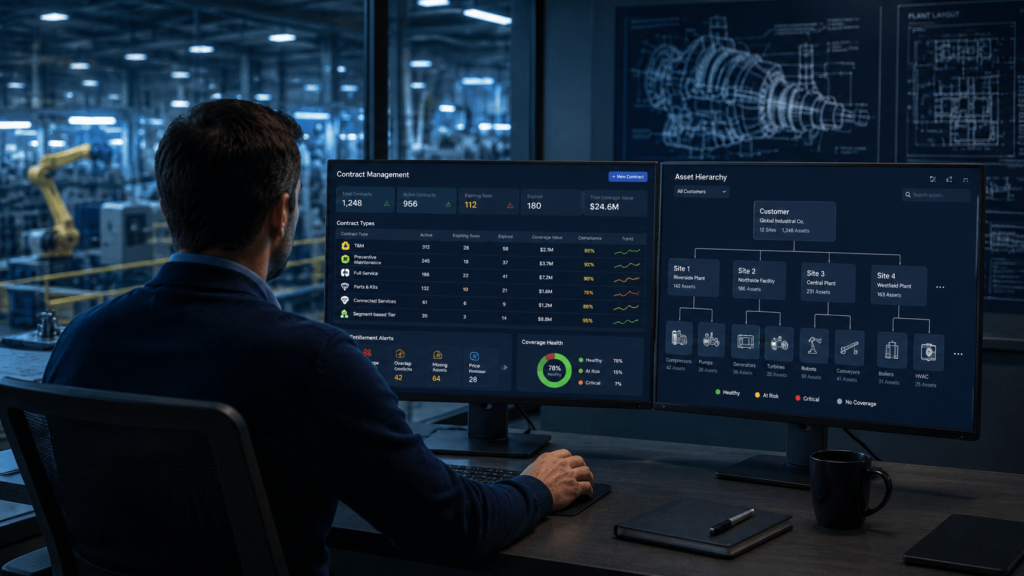
Service contracts sit at the center of modern aftersales operations, connecting revenue management, field service execution, warranty, spare parts, and long-term customer retention into a single operational model.
The Contract Landscape: More Types Than Anyone Can Manage
Most industrial manufacturers operate across a recognizable set of contract types each of which made commercial sense when it was created.
Time and Material contracts cover reactive service on a pay-per-use basis. Preventive Maintenance agreements add scheduled visits and inspections. Full-Service contracts extend coverage to parts, labour, and response time guarantees at system, site, or account level. Parts and kits contracts cover consumables and replacement components specifically. Connected contracts, a more recent addition, cover remote monitoring, alert management, and diagnostic services tied to IoT-enabled assets. And layered across all of these are segment-based tiers: basic, standard, and premium structures where a fixed entitlement bundle is offered by customer value tier, with add-on options available.
Coverage level adds another dimension of complexity. A contract can be defined at three levels – asset level, covering a specific piece of equipment; site level, covering all assets at a given location; and customer level, covering a customer’s entire portfolio across multiple sites. In theory these levels give customers flexibility. In practice, when contract types multiply across coverage levels without governance, the matrix of possible combinations becomes unmanageable, for the OEM trying to administer them and for the customer trying to understand what they actually have.
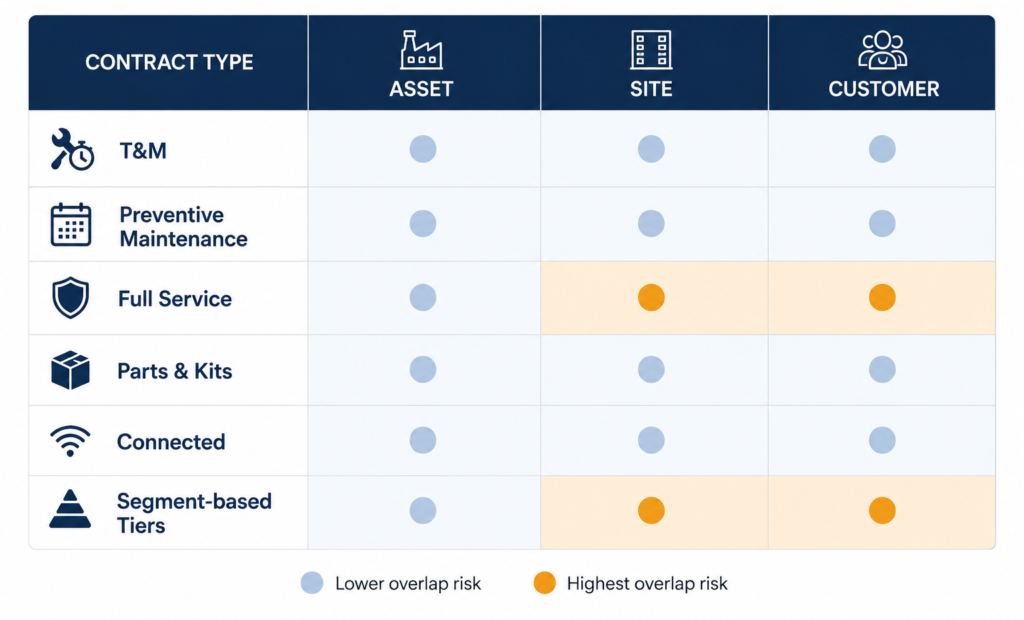
The problem isn’t that these types exist. The problem is that they accumulated without governance. Each team that needed a contract structure created one. Each region that had a local requirement defined its own variation. And nobody retired the contracts that were superseded, consolidated the entitlements that overlapped, or established who had authority over the master definition.
Where Service Contract Management Breaks Down
Proliferation Without Governance
A global HVAC manufacturer wanted to rationalize a contract portfolio that had grown across geographies and product lines over many years. The surface problem was visible immediately: too many contract types, inconsistent entitlement definitions across regions, and dealer confusion at the point of claim entry because similar entitlements carried different codes depending on region or product line.
The deeper problem only became clear once the full portfolio was mapped. Nobody had a complete picture of what it contained. Contracts created for a specific regional requirement had been replicated and modified elsewhere without central visibility. Entitlements that meant the same thing had multiple definitions, creating genuine uncertainty for dealers who had to select the correct code even when the underlying service being delivered was identical.
The customer-facing consequence was direct: customers in different regions with nominally the same contract received different entitlements without explanation. And dealers entering claims selected codes based on familiarity rather than accuracy, feeding directly into the entitlement leakage patterns that surface in warranty and claims management
When dealers aren’t sure which entitlement code to use, they pick the one they used last time. That’s not a training problem rather a contract design problem
Asset-Level Visibility
A large industrial manufacturer had recently implemented a tool to drive asset visibility for their global installed base, a significant investment in asset and contract management capability. The platform was sound. The data it had to work with was not.
At a typical customer site this manufacturer manages multiple hierarchical assets (sometimes over 5k assets in a customer site), each potentially covered under a different contract with its own entitlement set. Some systems share entitlements. Others have overlapping coverage from multiple contracts. And in many cases nobody (not the OEM service team, not the customer, and not the field technician arriving on site) could quickly establish what a specific asset was entitled to at that moment.
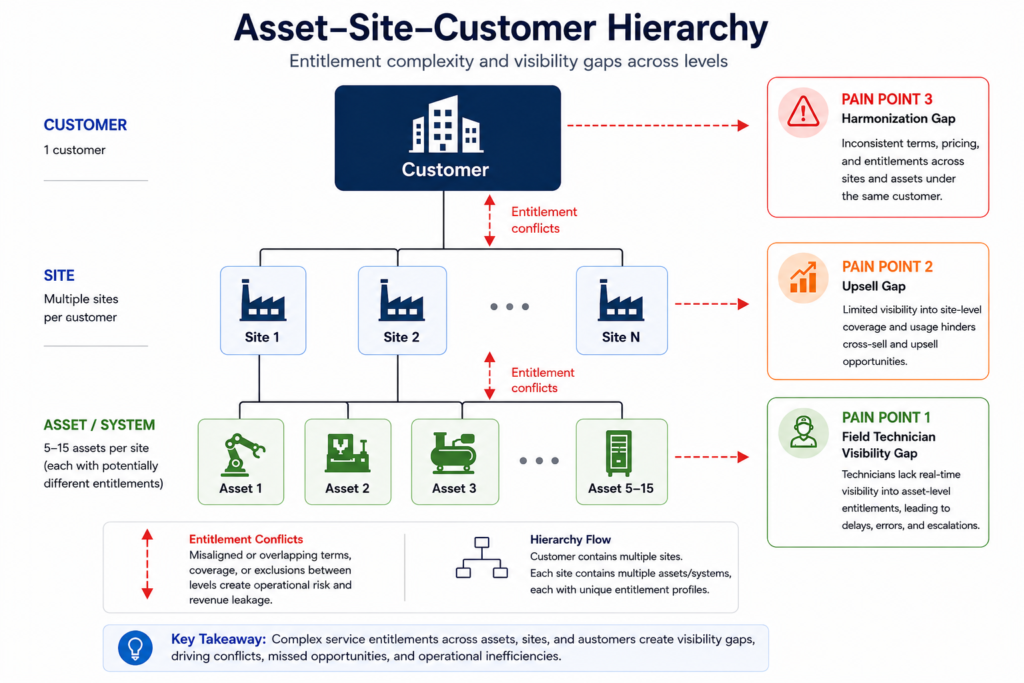
The commercial consequence is significant. Upselling and cross-selling require knowing what the customer already has. Without asset-level entitlement visibility, the sales conversation defaults to what the account manager remembers, which is incomplete, or a manual lookup across multiple records, which takes too long to be practical. New contract sales carry overlap risk: nobody is confident a proposed contract doesn’t partially duplicate existing coverage.
Internal Team Conflict Over Contract Definition
This failure mode is organizational rather than technical, and often the hardest to resolve because it doesn’t appear in any system report.
When multiple teams (service operations, parts, connected services, regional commercial) each own a piece of the contract, they naturally prioritize their own entitlement structure. The connected services team wants to add a remote monitoring entitlement. A similar entitlement already exists under the service operations framework. The question of which to keep, which definition takes precedence, and who has authority to decide goes unresolved, so both persist.
This plays out regionally too. North America defines a contract structure that doesn’t map cleanly to European regulatory or commercial requirements. The asset management team has one definition of a system. The parts team has another. The contract portfolio ends up reflecting internal organizational structure rather than customer needs, and no platform implementation resolves that without deliberate governance work first.
The downstream result of all three failure modes is the same: the customer portal can’t accurately show what a customer is entitled to for a specific asset, and the field technician arriving on site can’t confirm coverage without a manual lookup across systems. The portal isn’t the problem. The contract design behind it is.
How to Design Service Contracts That Scale
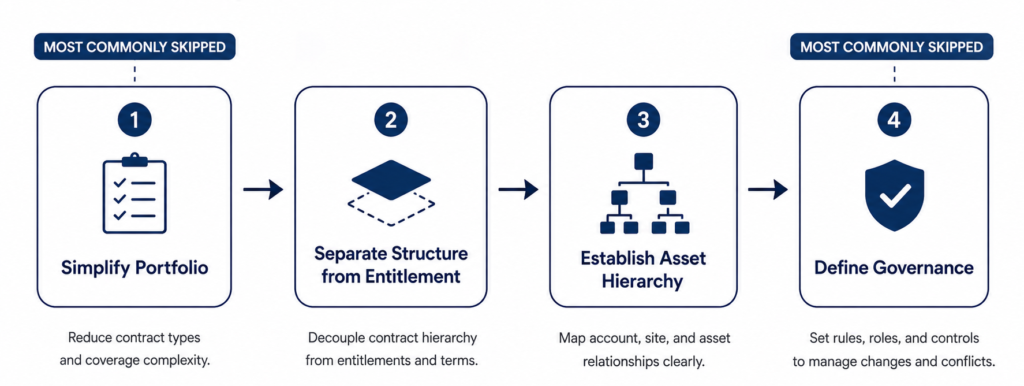
Four principles emerge from both engagements discussed above. Though unglamorous in execution, their outcome is transformative.
- Simplify before you digitize. The HVAC manufacturer’s most important decision wasn’t which platform to implement. It was reducing their contract portfolio to three standard structures before any system work began. Core entitlements were fixed within each structure. Customers could select additional entitlements from a governed menu. This single decision made everything downstream manageable. Organizations that migrate existing complexity into a new platform don’t get a cleaner system, they get faster complexity.
- Separate contract structure from entitlement definition. A contract structure defines the framework, pricing tier, and coverage level. An entitlement defines specifically what the customer receives, a preventive maintenance visit, a four-hour response time, a remote monitoring alert. Conflating the two is the most common design error. Entitlements should be defined once, maintained centrally, and referenced by multiple contract structures as needed, not redefined each time a new contract type is created. The HVAC entitlement cleanup was as significant a workstream as the contract rationalization itself.
- Establish asset hierarchy before contract implementation. The Asset Management case demonstrates this directly. The platform had the capability to provide asset-level entitlement visibility. The underlying asset data, how systems relate to sites, how sites relate to accounts, how parent and child assets are structured, was too fragmented to use it. Asset hierarchy is a prerequisite for contract management, not a parallel workstream. Implementing contracts before resolving asset hierarchy produces the same visibility gaps regardless of platform capability.
- Define governance before defining structure. If multiple teams have independent authority to create entitlements, a new platform gives them a faster way to conflict with each other. Contract governance, who owns the master entitlement library, who can create new contract types, how regional variations are approved against a global framework, must be agreed before design work begins. In the HVAC engagement, resolving internal ownership was as time-consuming as the technical implementation. It was also what made the technical implementation stick.
Why Getting This Right Matters More as the Model Evolves
As manufacturers move toward outcome-based and subscription models such as equipment-as-a-service, uptime guarantees, performance contracts, the contract becomes the product itself, not a wrapper around one. In that environment, contract design quality, entitlement clarity, and asset-level visibility are the commercial foundation, not operational improvements.
Organizations that haven’t resolved the design and governance challenges described here will find servitization significantly harder than the commercial ambition suggests. You cannot guarantee uptime for an asset you cannot track entitlements against. And you cannot build customer confidence in an outcome-based model when the customer portal can’t reliably tell them what they’re covered for today.
Related reading:
- Connected field service and agentic AI explores how modern servitization models depend on the same connected asset and operational data foundation discussed in this article.
- AI Readiness Assessment explains why data quality, system structure, and governance readiness are critical for scalable contract and entitlement management.
Final Thoughts
Service contracts became complex because manufacturers responded to every customer need, every regional requirement, and every internal team priority by creating something new without retiring what it superseded. That responsiveness made sense in the moment. The accumulated result makes sense to nobody.
The path forward isn’t better software. It’s simplification, separation of structure from entitlement, asset hierarchy as a foundation, and governance as a prerequisite. Organizations that do this work build a contract portfolio that supports the customer experience they want to deliver and the revenue model they’re moving toward.
The ones that don’t will keep arriving at the same problem: a field technician who can’t confirm coverage on site, a sales team that can’t confidently sell a new contract without risking overlap, and a customer portal that raises more questions than it answers.
Contract complexity is a strategic problem dressed as an operational one. The fix starts with design, not software.