

The platforms (such as Salesforce FSL, IFS, SAP FSM, ServiceMax, etc.) available for field service scheduling today are genuinely capable. These platforms can handle skill-based technician matching, SLA prioritization, real-time parts availability feeds, Gantt chart dispatch consoles, and dynamic rescheduling when variables change. For the majority of field service work such as reactive maintenance calls, single-technician standard jobs, high-volume routine visits, these platforms automate most scheduling decisions effectively when the data feeding them is clean.
Most organizations managing this type of work have largely solved the dispatch problem. The remaining challenge is data quality, maintaining accurate technician profiles, reliable parts availability records, and realistic job duration estimates. The platform does the matching. The dispatcher manages exceptions. At scale, this model works.
But not all field service is this type of work. And the organizations that apply the same scheduling model to complex multi-technician jobs discover quickly that the dispatch console was never the right starting point for those jobs.
A mature FSM platform handles standard dispatch well. What it cannot do is compensate for a planning process that wasn’t designed for the jobs being put through it
The platform does the matching. The dispatcher manages exceptions. At scale, this model works, and the impact shows directly in the metrics that matter most, particularly First Time Fix Rate and Mean Time to Repair, which scheduling quality drives more than almost any other operational variable.
Two Scheduling Problems That Require Different Approaches
The distinction that most FSM implementations never make explicitly is between two fundamentally different types of field service work and the scheduling model each requires.
Model 1: Standard single-technician dispatch
A work order arrives with a defined fault type, required skill, customer location, SLA priority, and parts requirement. The dispatcher matches it to the best available technician. At high volume, large field service operations managing tens of thousands of truck rolls monthly, this is primarily an optimization problem involving route efficiency, skill matching, and SLA sequencing. When the data feeding the platform is accurate, automated dispatch handles the vast majority of assignments without human intervention. Dispatchers shift from building schedules manually to managing the 10–20% of situations that require human judgment for example in cases with priority customers, unusual equipment needs, or jobs that run significantly over duration.
This model is well understood and well served by current FSM platforms. The challenge is data quality, not scheduling logic.
For organizations still in the process of selecting an FSM platform, getting this foundation right starts with choosing a solution that matches your actual scheduling requirements, not just the most impressive demo. Every major vendor promises end-to-end capability, but the evaluation criteria that matter differ significantly depending on your service type, job volume, and complexity profile. The FSM Vendor Assessment Framework provides a structured, weighted scoring model for comparing vendors against the dimensions that determine real-world fit covering scheduling capability, integration requirements, scalability, and implementation reality alongside the features vendors lead with in demos.
Evaluating FSM platforms?
The FSM Vendor Assessment Framework is a practical evaluation matrix used by service leaders and consultants to compare vendors objectively with weighted scoring, visual output, and decision rationale capture built in. Download the Framework →
Model 2: Complex multi-technician jobs
A commissioning event for industrial equipment. A planned maintenance outage on a critical asset. A large commercial HVAC installation across multiple building zones. These are not single work orders assigned to one technician. They require a crew working through a defined sequence of tasks, coordinated across multiple skill sets, over a period that may span multiple days.
Different tasks within the same job require different certifications. Some tasks cannot begin until others are complete. Parts need to be pre-positioned before the job starts, not ordered and assumed to arrive. Customer access windows are constrained by operational schedules the service team doesn’t control. A senior technical coordinator or planning team needs to have understood and structured all of this before a single technician is assigned.
The FSM is the right tool for managing these jobs once they are properly structured. The problem is structuring them (decomposing the job into tasks, sequencing those tasks, confirming parts and skills for each) happens before the FSM is involved, often in email and spreadsheets, and often incompletely. When an unstructured complex job enters the dispatch console, it creates manual workarounds at exactly the point where the platform should be doing the most work.
| Model 1: Standard Dispatch | Model 2:Complex Job Scheduling | |
|---|---|---|
| Job Type | Single technician, defined fault, standard parts | Multi-technician, complex asset, variable requirements |
| Starting Point | Work order received with full details | Issue identified but decomposition required first |
| Scheduling Trigger | FSM auto-matches on receipt of WO/ ticket | Planning layer completes before FSM is involved |
| Parts | Available or ordered at assignment | Must be confirmed on site before job enters queue |
| Human Involvement | Exception management only | Planning, sequencing, field input required |
| FSM Role | Primary scheduling engine | Execution management after planning is complete |
| Primary Failure Mode | Data quality feeding the FSM | Planning process upstream of the FSM |
Where Complex Scheduling Breaks Down
The failure modes in Model 2 scheduling are distinct from Model 1, and each one occurs upstream of the dispatch console, which is why better dispatch tools don’t resolve them.
Jobs Enter the Queue Before They Are Ready to Be Scheduled
This is the most common and most costly failure mode in complex field service, and it is rarely described in this way because it happens before the FSM is involved.
A complex job that arrives at the dispatch console without a defined task sequence, confirmed skill requirements, and confirmed parts availability is not ready to be scheduled. It is ready to be planned. Those are different activities requiring different inputs and different ownership.
When this happens, the dispatcher does one of two things: attempts to schedule against incomplete information, creating a plan that will break down at execution, or routes the job out of the FSM entirely and manages it manually in spreadsheets. Either outcome defeats the purpose of the platform investment. The FSM records what happens rather than driving what happens, for precisely the jobs where intelligent scheduling would deliver the most value.
Parts Timing Treated as a Logistics Assumption Rather Than a Scheduling Gate
A complex job is scheduled against an expected parts delivery date. The crew is booked. The customer access window is confirmed. The parts arrive late.
For a standard single-technician job this is a rescheduled visit, disruptive but contained. For a complex multi-technician job, it is a cascade: a crew that cannot start, a customer access window that cannot be extended, a rescheduling exercise that takes days and generates multiple additional truck rolls that were not in the original plan.
The distinction between parts ordered and parts confirmed on-site before job start is rarely reflected in FSM scheduling logic. It is almost always reflected in rescheduling cost. Treating confirmed parts availability as a hard gate before a complex job enters the dispatch queue, rather than an assumed input, eliminates one of the most predictable sources of scheduling failure in complex field service.
The Plan Doesn’t Reflect What the Field Team Needs to Execute
Work packages for complex jobs are typically created by a planning team or service manager who will not be executing the work. The field team receives the plan and identifies constraints the planner doesn’t have visibility of all the aspects such as a site access restriction, a component configuration requiring a different approach, or a task sequence that doesn’t reflect the physical reality of the asset.
The field team adapts. The adaptation isn’t reflected in the FSM. The system of record and operational reality diverge from the first day of execution. When the job is reviewed for invoicing, warranty, or future planning purposes, the FSM shows a plan that doesn’t reflect what actually happened.
The root cause isn’t a scheduling failure. It’s a planning process that excludes the people who will execute. A lightweight field review step before a complex work package is finalized like a senior technician input on access constraints, sequence feasibility, and resource requirements, closes most of this gap without significantly extending the planning cycle.
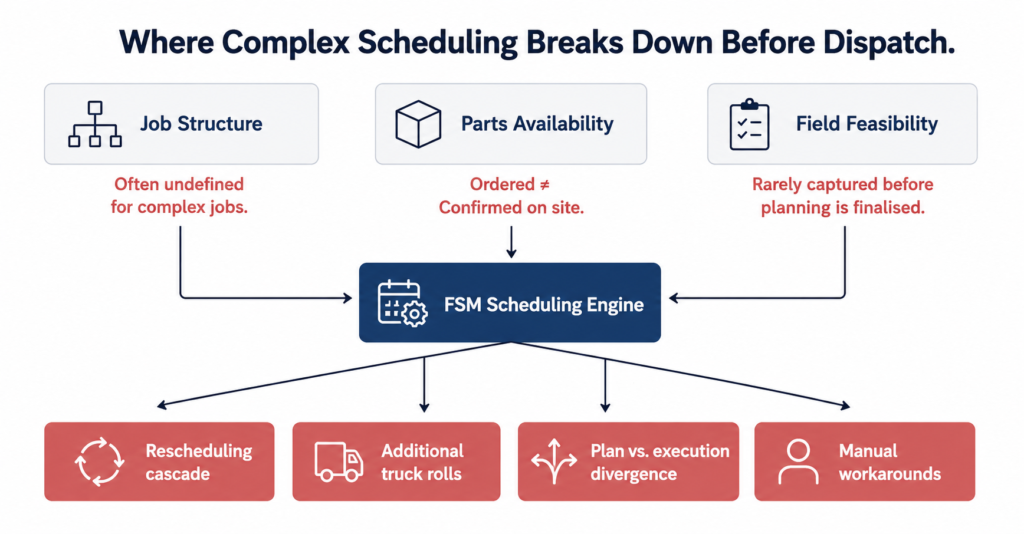
Complex job that enters the dispatch queue without a defined task sequence and confirmed parts isn’t a scheduling problem yet. It will become one, and then a customer problem.
What the Planning Layer Actually Requires
The organizations that consistently schedule complex jobs effectively have built a deliberate planning layer between job identification and FSM entry. What that layer looks like varies by organization size and job complexity. In larger organizations it is a dedicated planning function, in smaller ones it is usually a senior service manager or technical coordinator role. What matters is that the function exists, has clear ownership, and produces a structured output before any job reaches the dispatch queue.
Four things the planning layer needs to resolve before a complex job is schedulable:
- Task decomposition and sequencing. The job needs to be broken into discrete tasks with defined dependencies with information such as which tasks must be complete before others can start, which can run in parallel, and what the critical path is. This cannot be done effectively inside the dispatch console. It requires domain knowledge of the asset type, the fault category, and the site constraints.
- Skill and certification confirmation per task. Each task in the work package needs a confirmed skill and certification requirement, not a general crew skill level, but specific qualifications for specific tasks. A crew that collectively has the right skills, but where no individual has the certification for a specific task fails at that task regardless of how well the rest of the job was planned.
- Parts confirmation as a scheduling gate. No complex job should enter the dispatch queue until parts availability is confirmed at the relevant depot or confirmed delivery before job start date is secured. This requires integration between the parts ordering system and the FSM scheduling logic, a configuration investment that most implementations haven’t made but that consistently pays back faster than most scheduling technology investments. The parts and kits contracts mode discussed in the context of OEM aftersales applies equally here, locking in parts availability before the scheduling commitment is made rather than assuming the supply chain will align.
- Customer access window confirmation, not assumption. For complex jobs, customer availability needs to be confirmed against the specific task sequence and duration, not just a general availability window. A customer who confirms availability for two days may not have accounted for the access restrictions that apply to specific zones on day two. Confirming access at task level rather than job level eliminates one of the most common causes of mid-job schedule disruption.
Where AI Fits Into Complex Scheduling
AI adds genuine value in two specific places in complex field service scheduling, and neither of them is the planning layer itself.
Dynamic re-optimization: when a variable changes mid-execution such as a task overruns, a technician becomes unavailable, or a parts delivery is delayed, AI can re-run scheduling logic across the remaining tasks and dependent jobs in real time, surfacing the re-plan that minimises SLA impact and additional truck roll cost. This is genuinely useful and increasingly available in mature FSM platforms. But it requires the job to have been structured correctly in the first place. AI re-optimises against the task sequence and resource assignments that were defined in planning. If those were incomplete or incorrect, the re-optimisation is precise but wrong.
Predictive job duration: AI models trained on historical completion data produce duration estimates that reflect actual execution patterns rather than default values configured at go-live. For complex jobs where duration variance is high and the cost of a job overrunning is significant, this is a meaningful improvement. It also feeds better customer expectation-setting before the job starts.
What AI cannot do is replace the planning layer. The data and process prerequisites described above are not things AI compensates for, they are the foundation that makes AI scheduling investment worthwhile. The AI Readiness Assessment logic applies directly here: before investing in AI-driven scheduling optimization for complex jobs, it is worth confirming whether the job structure, parts confirmation, and skill data that optimization depends on are actually in place.
Final Thoughts
The field service scheduling platforms available today handle standard single-technician dispatch well, and for the majority of field service volume, that problem is largely solved. The scheduling challenge that remains in most industrial service organizations isn’t a tool problem. It’s a planning problem that sits upstream of the tool and that no amount of dispatch optimization resolves.
Complex multi-technician jobs require a planning layer that defines task sequences, confirms skill requirements, gates on parts availability, and incorporates field input before a single assignment is made in the FSM. Organisations that have built that layer find their platform investment delivering the outcomes it promised. Organisations that route complex jobs directly to the dispatch console find the platform managing the symptoms of a planning failure rather than preventing it.
The dispatch console is where scheduling execution happens. Planning is what makes that execution possible. Getting the sequence right with planning first and dispatch second is the decision that determines whether the FSM investment pays off for the jobs that matter most.
If your organization is still in the platform evaluation stage, the FSM Vendor Assessment Framework covers the vendor selection criteria that matter most for complex scheduling requirements specifically.
Managing complex field service scheduling in your organization?
Share your experience via the contact form. Practitioner inputs shape the content on this site.