Mihir Joshi

Field service KPIs showing how operational service data flows from technicians and assets into strategic business decisions in manufacturing and automotive organizations

Field Service KPIs for Manufacturing & Automotive: Metrics That Actually Drive Performance

Field service organizations track dozens of KPIs, yet still struggle to improve uptime, customer trust, and service profitability. This article explains how manufacturing and automotive companies should design, structure, and govern field service KPIs as a connected system that drives decisions, manages trade-offs, and scales with service maturity.

Field Service KPIs for Manufacturing & Automotive: Metrics That Actually Drive Performance Read More »

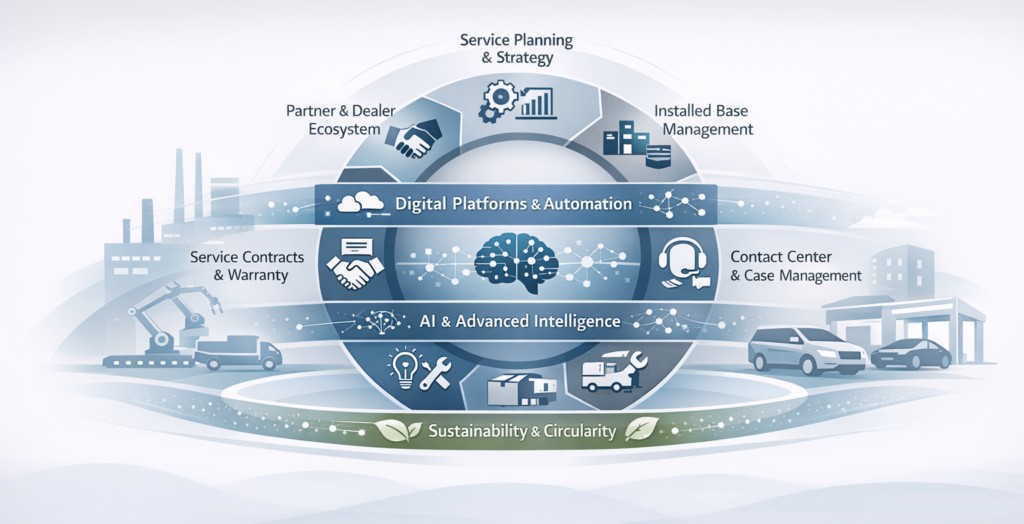
Manufacturing and automotive after-sales service ecosystem covering planning, execution, contracts, partners, and digital enablement

Manufacturing & Automotive After-Sales Service: Strategy, KPIs & Digital Transformation

After-sales service is now a strategic growth lever for manufacturing and automotive organizations. This article presents an end-to-end view of after-sales service, covering operating models, KPIs, execution challenges, and the practical role of digital and AI, grounded in real-world service transformation experience.

Manufacturing & Automotive After-Sales Service: Strategy, KPIs & Digital Transformation Read More »

Proactive Resolution Rate (PRR) KPI showing proactive issue resolution in manufacturing and automotive after-sales service

KPI of the Month #3: Proactive Resolution Rate (PRR)

Proactive Resolution Rate (PRR) is an emerging KPI that measures how effectively manufacturing and automotive service organizations prevent failures before customer impact. As AI, predictive analytics, and condition monitoring scale, PRR connects proactive insights to real outcomes, shifting service excellence from fixing failures faster to preventing them altogether.

KPI of the Month #3: Proactive Resolution Rate (PRR) Read More »

Cognitive self-service replaces manual searches and fragmented systems, reducing MTTR and improving first-time fix rates in field service operations.

Case Study: Improving Field Service Uptime Through Cognitive Technician Self-Service

Dealer technicians often lose valuable time searching for information instead of fixing equipment. This case study shows how a material handling equipment manufacturer improved uptime by 15% by reducing cognitive load at the point of service, using a search-driven technician self-service approach rather than overengineering AI.

Case Study: Improving Field Service Uptime Through Cognitive Technician Self-Service Read More »

Service and after-sales transformation momentum fading over time in manufacturing organizations

Why Most Service Transformation Programs Stall After Year 2

Most service transformation programs don’t fail, they quietly stall. Early momentum, strong leadership attention, and rapid implementation create the illusion of success. But as priorities shift, budgets tighten, and ownership blurs, outcomes plateau. This article explores why service transformations lose momentum after year two, and what leaders must do differently.

Why Most Service Transformation Programs Stall After Year 2 Read More »

software service the new mandate in aftersales field service agenticai manufacturing

Service Leadership in the AI Age: From Cost Containment to Force Multiplication

In the AI age, service leadership is being redefined by a paradoxical mandate: lower costs, shrinking workforces, and rising customer expectations. Move beyond the hype of “predictive” service to master Data Orchestration and Force Multiplication. Discover the strategic framework to transform your service department from a cost center into a high-performance value engine.

Service Leadership in the AI Age: From Cost Containment to Force Multiplication Read More »

Software-defined vehicle with digital health, uptime, and performance indicators showing continuous value creation through OTA updates

The 2026 Service Blueprint: From Predictive AI to Agentic Operations

2026 marks the end of AI experimentation and the rise of Agentic Execution. As assets become software-defined and margins shift to uptime, service leaders must master Industrial FinOps and ‘teleporting expertise’ to protect Customer Lifetime Value. Discover the five pillars of the 2026 service blueprint.

The 2026 Service Blueprint: From Predictive AI to Agentic Operations Read More »

2025 aftersales & field service review

2025 Aftersales & Field Service Review: From Ambition to Operational Reality

2025 was a reality-check year for aftersales and field service. Demand stayed resilient, but workforce shortages, asset complexity, AI scaling limits, and regulatory pressure reshaped execution. Leading organizations shifted from experimentation to fundamentals, anchoring AI to KPIs, prioritizing productivity over headcount, and treating service as an end-to-end system under real economic constraints across manufacturing and automotive.

2025 Aftersales & Field Service Review: From Ambition to Operational Reality Read More »

Mean Time to Repair (MTTR) KPI showing average time to restore assets in field service and manufacturing operations

KPI of the Month #2: Mean Time to Repair

Mean Time to Repair (MTTR) measures how quickly service organizations restore failed assets to operation. In manufacturing and automotive after-sales, MTTR reflects diagnostic readiness, parts availability, process discipline, and system integration. Used correctly, it highlights structural bottlenecks; used in isolation, it can drive superficial optimization and missed root causes.

KPI of the Month #2: Mean Time to Repair Read More »

Scroll to Top