
Mihir Joshi

2025 aftersales & field service review

2025 Aftersales & Field Service Review: From Ambition to Operational Reality

2025 was a reality-check year for aftersales and field service. Demand stayed resilient, but workforce shortages, asset complexity, AI scaling limits, and regulatory pressure reshaped execution. Leading organizations shifted from experimentation to fundamentals, anchoring AI to KPIs, prioritizing productivity over headcount, and treating service as an end-to-end system under real economic constraints across manufacturing and automotive.

2025 Aftersales & Field Service Review: From Ambition to Operational Reality Read More »
Mean Time to Repair (MTTR) KPI showing average time to restore assets in field service and manufacturing operations

KPI of the Month #2: Mean Time to Repair

Mean Time to Repair (MTTR) measures how quickly service organizations restore failed assets to operation. In manufacturing and automotive after-sales, MTTR reflects diagnostic readiness, parts availability, process discipline, and system integration. Used correctly, it highlights structural bottlenecks; used in isolation, it can drive superficial optimization and missed root causes.

KPI of the Month #2: Mean Time to Repair Read More »

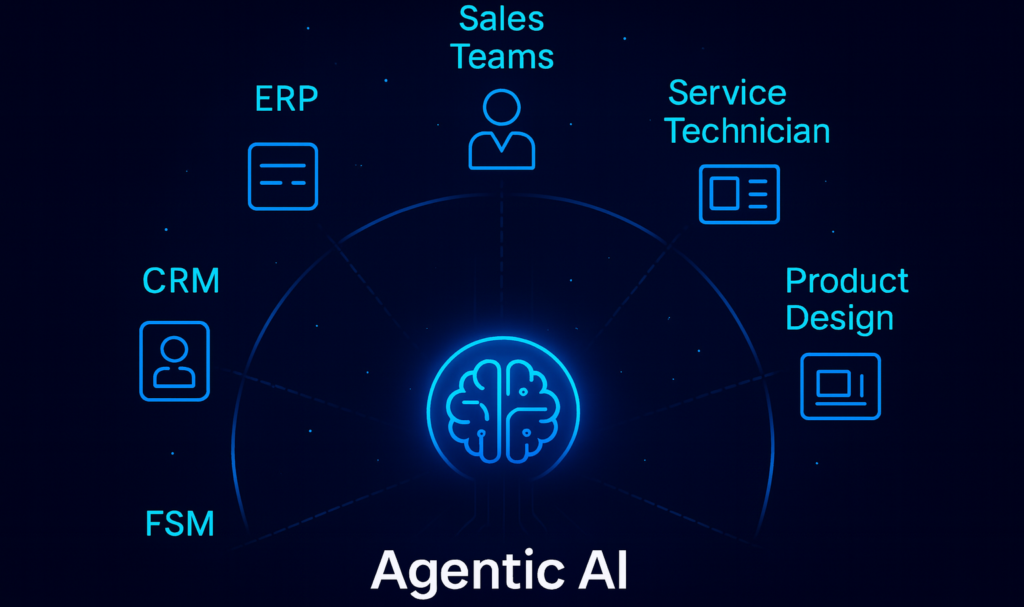
Agentic AI in manufacturing and automotive after-sales service, showing how AI agents coordinate CRM, ERP, FSM, IoT, warranty, and CPQ systems to close execution gaps that automation cannot solve.

Agentic AI in After-Sales: The Missing Execution Layer That Automation Couldn’t Fix

Discover how agentic AI in after-sales and field service is closing execution gaps that traditional automation cannot fix. Learn how agentic systems orchestrate workflows across CRM, FSM, ERP, and service teams, improve technician productivity, enhance customer experience, and enable closed-loop feedback into product design.

Agentic AI in After-Sales: The Missing Execution Layer That Automation Couldn’t Fix Read More »

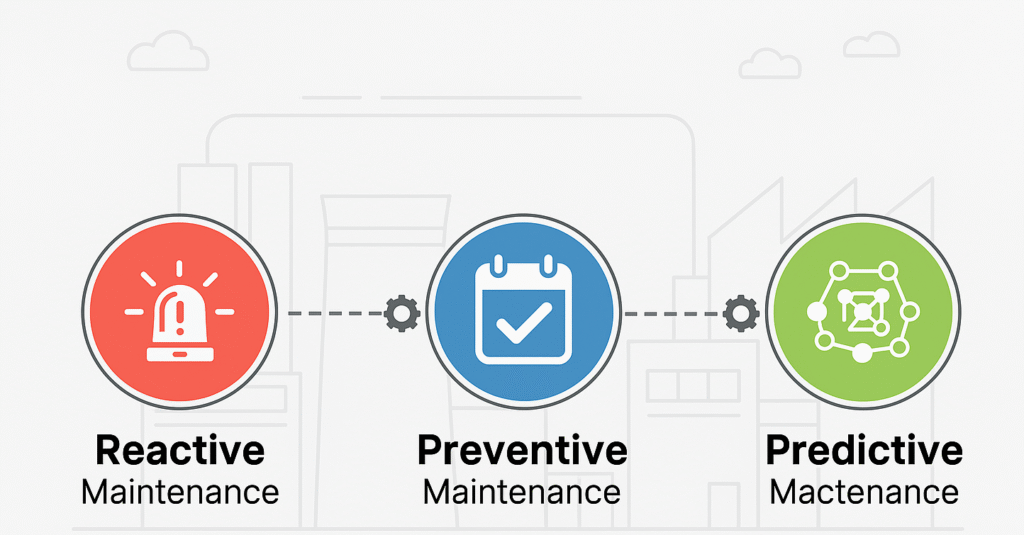
Predictive versus preventive maintenance in manufacturing, illustrating the shift from scheduled maintenance to data-driven, IoT-enabled prediction to improve uptime, reliability, and cost efficiency.

Predictive vs Preventive Maintenance: Key Differences Explained

Understand the real difference between predictive and preventive maintenance, and why it’s not just about technology. Learn how manufacturers can master preventive maintenance first, assess readiness, and layer predictive intelligence to drive service-led growth. Explore common pitfalls, readiness checklists, and practical guidance for bridging the gap from reactive repairs to proactive, data-driven reliability.

Predictive vs Preventive Maintenance: Key Differences Explained Read More »

Industrial and Automotive after-sales service contrast between genuine customer care and revenue-driven upselling, highlighting the growing gap between service and serving in the modern dealership experience.

Service vs. Serving

As after-sales becomes a major profit driver, many OEMs are prioritizing revenue over relationships. This article explores how monetizing service, through inflated parts pricing, opaque terms, and sales-driven KPIs, is eroding customer trust and loyalty across the automotive sector. Learn how transparency, contextual upselling, and a Service-Led Growth mindset can rebuild relevance before disruption arrives.

Service vs. Serving Read More »

First Time Fix Rate in field service, illustrating how technicians resolving issues on the first visit improves cost, efficiency, and customer experience for manufacturing, automotive, and industrial service organizations.

KPI of the Month #1: First Time Fix Rate

The First Time Fix Rate (FTFR) is one of the most important field service KPIs, revealing how effectively technicians resolve issues on the first visit. This article explains what FTFR really measures, why it matters for cost, efficiency, and customer experience, and how people, process, and technology improvements can drive sustainable performance gains across manufacturing, automotive, and industrial service organizations.

KPI of the Month #1: First Time Fix Rate Read More »

Platform-of-platforms architecture for service organizations, showing how CRM, ERP, field service software, IoT platforms, and CPQ systems connect to unify data, workflows, and quote-to-cash processes.

Platform of Platforms: Why Individual Tools Are No Longer Enough

Discover how a “Platform of Platforms” approach transforms field service management. Learn why integrating planning, execution, quoting, and analytics under one connected architecture is key to service-led growth. Explore enablers, business benefits, and real-world use cases that show how unified platforms drive efficiency, revenue, and customer experience.

Platform of Platforms: Why Individual Tools Are No Longer Enough Read More »

Service-led growth in manufacturing, showing how after-sales service, uptime, digital workflows, and customer-centric value models drive revenue and long-term profitability for industrial companies.

Unlocking Service-Led Growth in Manufacturing: From Mindset to Model to Market

Learn how leading manufacturers turn service into a growth engine. This guide explores the strategic models, economic case, and playbook behind Service-Led Growth, from lifecycle ownership to outcome-based value, plus a free checklist to assess your organization’s readiness.

Unlocking Service-Led Growth in Manufacturing: From Mindset to Model to Market Read More »

Scroll to Top