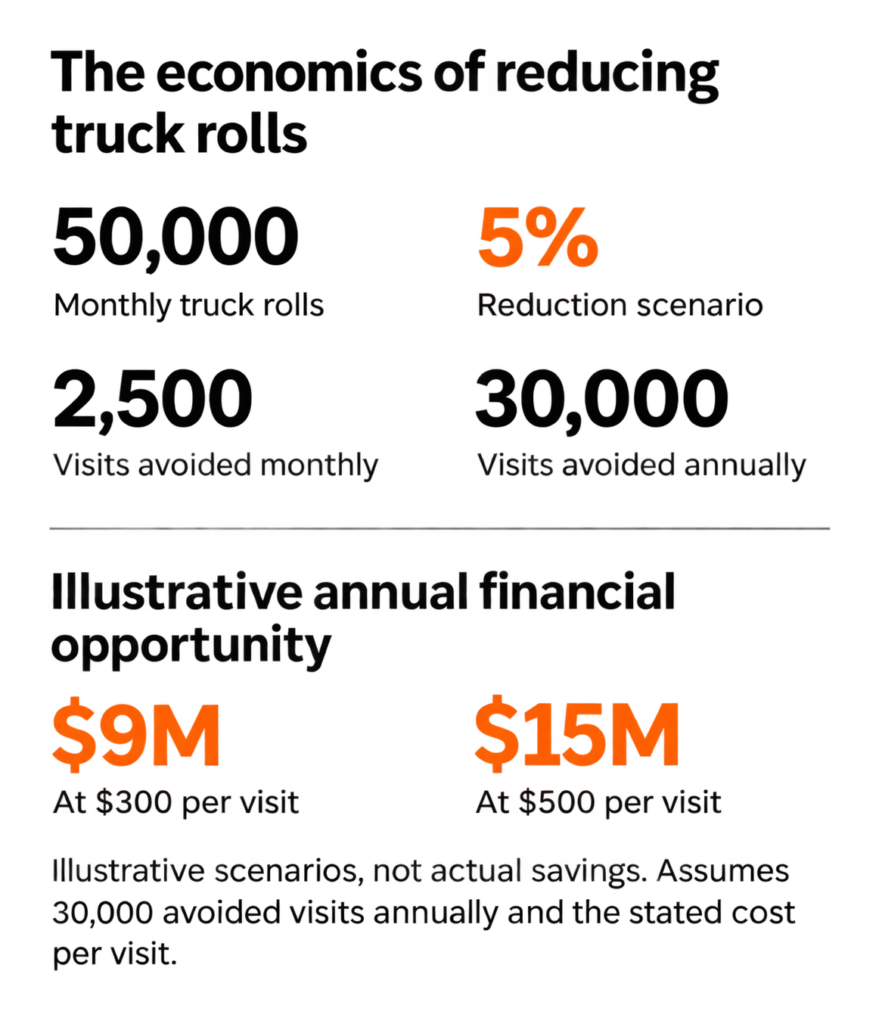
Consider a large equipment service organization that handles 50,000 truck rolls a month. If it avoided just 5% of them, that would be 2,500 fewer technician visits a month, or 30,000 a year. The numbers are illustrative and don’t describe any specific company, but the arithmetic holds at almost any scale.
The harder question is why those visits happen at all. Some are unavoidable: a failed component, a safety issue, a repair that needs hands on the machine. Others happen because the service process has no step where anyone asks whether a technician is needed.
OEMs dispatch technicians to problems that could be resolved remotely because no step in the dispatch process asks whether a visit is necessary, and every role in the chain is measured on something a dispatch satisfies. Contact centers are measured on handle time, dispatchers on utilization and time to schedule, technicians on jobs per day. Remote resolution has no owner and no metric.
What An Avoidable Dispatch Costs
A dispatch costs more than fuel and a van. It carries technician travel and labor, scheduling and dispatch administration, and the capacity that technician could have spent on a job that did need them. The customer waits too, often with equipment down.
At an illustrative $300 per visit, 30,000 avoided visits represent $9 million in annual cost exposure. At $500 per visit, the figure is $15 million. These are exposure figures, not savings. The saving is real only where cost actually leaves the system, or where released technician capacity is redeployed to billable or backlog work. An OEM doesn’t need to eliminate a large share of visits for this to be worth pursuing.
Who Is Measured On What
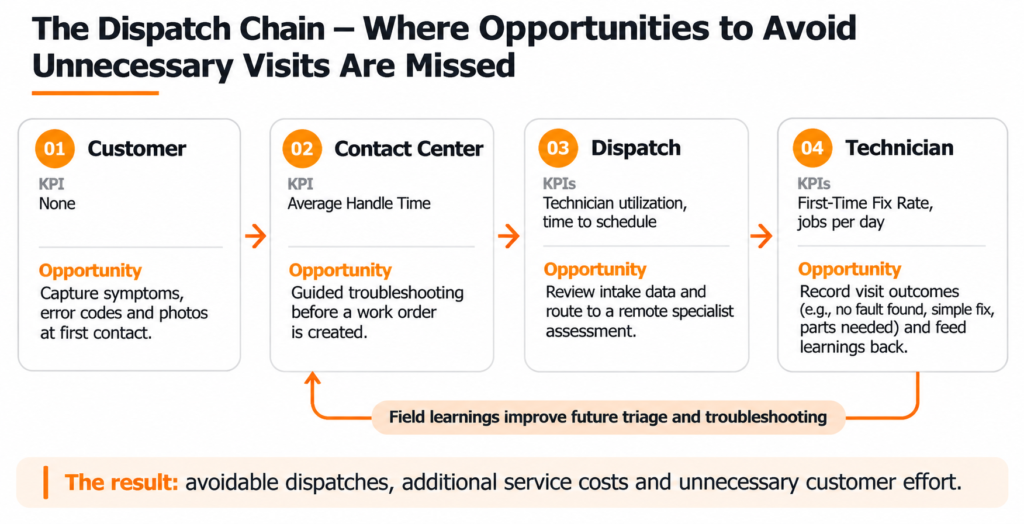
Follow a service request from the customer’s first call to the technician’s arrival and look at what each role is measured on. Almost every metric is satisfied by a dispatch. None is satisfied by a remote fix.
| Role | Typically Measured On | What That Rewards |
|---|---|---|
| Contact center | Average handle time | Closing the call with a work order |
| Dispatch | Technician utilization, time to schedule | Filling the calendar, whether or not the visit is needed |
| Technicians and field managers | First-time fix rate, jobs per day | Visits. A remote fix doesn’t appear in these metrics |
| Connected-services team | Monitoring coverage, asset health insight | Seeing the alert, with no obligation to change what field does with it |
| SLA and contract terms | Response time, often stopped at dispatch | Dispatching early as the safe choice |
| Dealers and partners (where they earn on labor) | Labor and parts revenue from visits | A remote fix removes their revenue |
Each role is doing what it is measured to do. The sum of those behaviors is a process that moves work efficiently without ever testing whether the work is needed. It shows up in three places.
Where The Incentives Show Up In The Process
Triage: intake that captures too little
A request that says “machine not operational” gives the contact center almost nothing to work with. Was there an error code? Did the machine stop during operation? Was there recent maintenance, or a similar failure before? Is the whole machine affected or one function? Without those answers the safe path is a work order.
Contact centers measured on average handle time have no reason to spend extra minutes collecting them. Fixing this takes a structured intake built around equipment type, reported symptom and failure category, designed around what technicians need to diagnose common problems. It doesn’t require sophisticated technology.
Non-connected assets: remote support starts with information
A large share of the installed base across manufacturing industries doesn’t send operational data to the OEM. Legacy equipment and older product generations remain common. That doesn’t mean every problem on those assets needs a visit.
The customer can supply the model, serial number and configuration, read out or capture the error code, share a short video, and describe what happened before the failure. A contact center agent or technical specialist can check the service history for similar failures and guide basic checks. Take a machine that stopped because of an incorrect configuration setting. If the customer can safely reach the controls and a specialist can talk them through the correction, the visit never needed to happen.
There are limits. Mechanical failures, electrical faults and safety-critical conditions need physical inspection, and customers should never be asked to perform checks beyond their training or authorization. Remote support on these assets begins with a better conversation with the customer.
Connected assets: intelligence that doesn’t reach the decision
In one process manufacturing environment I worked with, the organization had an advanced connected-asset monitoring capability. A dedicated team watched the connected equipment and had access to asset health information and diagnostic insights. The contact center could see it too.
The information didn’t flow into field service. The connected-services team and field service had separate responsibilities and separate workflows. When a work order reached field service, the technician often didn’t receive the same diagnostic context, and had to investigate the problem again, sometimes repeating work already done remotely. The asset visibility was excellent. The service operating model didn’t use it.
These disconnects are often difficult to resolve because OEMs continue to operate with legacy platforms that support critical processes but are not always designed for seamless integration with newer service capabilities.
The test for any OEM is whether the people making decisions can see what the monitoring team sees. Does an alert create or update a service request where appropriate? Can the contact center view diagnostic information at intake? Does the technician receive the alert history and the troubleshooting findings? Are remote diagnosis outcomes recorded against the service request? Can the organization tell an alert that needs monitoring from one that needs intervention? Connected assets only reduce truck rolls when the answers reach whoever decides to dispatch.
Where to start
Most OEMs reach for tooling first, and the measures and ownership underneath it stay unchanged.
1. Name an owner for the dispatch decision
Put a gate between the service request and the work order, and make someone accountable for asking whether a visit is needed. In practice this is a role in the contact center or a remote support team with the authority, knowledge and tools to resolve appropriate issues without escalating. Because coverage determines what can be offered remotely and who pays, entitlement management needs to answer the “is this covered?” question at intake, not after the visit.
2. Measure what you want to happen
Add remote resolution rate and avoidable dispatch rate beside the traditional KPIs. First-time fix rate only exists for visits, so it needs a companion measure that credits problems solved without one. Pair remote resolution with repeat contact and repeat visit rates, otherwise tickets get closed remotely and come back. A proactive resolution rate shows how far the organization acts before the customer feels the problem, and remote resolution is part of that picture.
However, improving operational efficiency does not automatically translate into better service economics. This is part of the service margin paradox: why efficiency gains don’t always translate into revenue growth.
Avoidable dispatch rate is the share of field visits where remote guidance, better intake information or existing diagnostic data would have resolved the issue or changed the dispatch decision. Few OEMs measure it, which is why it is rarely managed.
3. Audit past visits before changing anything
Take a sample of completed field visits and sort each into one of four groups: no fault found, resolvable by the customer with guidance, a different outcome had better information been available before dispatch, and genuinely requiring physical intervention. Look for patterns by equipment type and failure category. The result is a baseline, and it shows which issues to route first to customer guidance, contact center troubleshooting or specialist remote support.
4. Bring in tooling last
Guided diagnostics, knowledge retrieval and approaches like cognitive technician self-service can extend what remote and field teams resolve. They depend on the owner, the measures and the data from the first three steps, and they underperform without them.
Tradeoffs And Limits
Remote-first service has real costs, and some of the incentives above are written into contracts. If an SLA response clock stops at dispatch, a remote attempt that fails burns time against the commitment, so contract terms may need to recognize remote response. Where dealers earn on labor, a remote fix removes their revenue, and OEMs need to agree how remote work is compensated or the channel will resist.
A failed remote attempt also delays the customer and can end in the same visit with more frustration, which is why the repeat visit rate belongs next to the remote resolution rate. Safety-critical conditions always need inspection. And an avoided visit only saves money if the cost leaves the system or the capacity is redeployed.
Intake Data Also Matters For AI
The information collected at intake and during troubleshooting is the raw material for AI in service. When customer-reported symptoms, equipment model and configuration, error codes, troubleshooting steps performed, root cause and resolution are captured consistently and linked to the asset, they become a knowledge base. AI can then retrieve relevant procedures, find similar historical cases, recommend diagnostic steps and help technicians prepare for a visit with equipment history and previous repairs in hand.
Industry sources point the same way. Aquant’s 2026 Field Service Benchmark identifies roughly one in five truck rolls as potentially avoidable through remote resolution, and McKinsey’s May 2026 analysis describes an industrial AI troubleshooting application with nearly 90% diagnostic accuracy and more than half of fixes completed remotely. Both depend on service data being captured and connected in the first place. If you’re unsure whether your service data is ready for that, the AI readiness assessment scores your organization across seven dimensions.
Pull a sample of last quarter’s completed visits and sort them. The split between visits that needed a technician and visits that only needed better information is the number that makes the case internally.
The Goal Is Better Resolution, Not Fewer Visits
Reducing truck rolls is not about keeping technicians off-site. Some problems need physical intervention, and remote troubleshooting should never compromise safety or delay a necessary repair. The objective is to make sure every dispatch is justified by the problem, not simply by the way the service process is organized.
That requires more than connected equipment or better diagnostic tools. It requires an operating model where the right information reaches the right people, remote resolution has clear ownership, and performance measures reward outcomes rather than activity.
Start with the visits that have already happened. Understand which ones genuinely needed a technician and which might have been avoided with better information, guidance or coordination. That is where the opportunity to change the dispatch process begins.
Is your service operation optimized for dispatch, or for resolution?
Share your experience via the contact form. Practitioner inputs shape the content on this site.