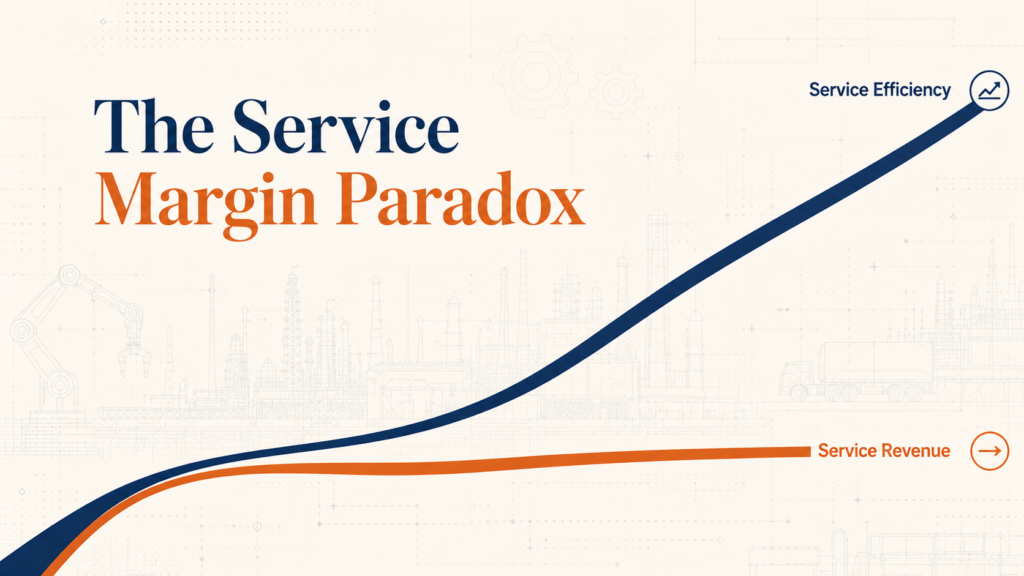
Your First Time Fix Rate is up 12 points this year. Mean Time to Repair is down 20%. Dispatch cost per job has never been lower. By every operational measure, your service organization is performing better than it has in years.
Then finance asks why service revenue is flat, or down 8%.
The instinct is to defend the numbers. Pull up the dashboard, point at the green metrics, explain how much harder the team is working and how much better they’re performing. That instinct is understandable, and it’s also the wrong move. The KPIs aren’t lying. Revenue isn’t lying either. Both can be true at the same time, and once you see the mechanism, it stops looking like a contradiction.
This isn’t unique to one industry. Any equipment-heavy service organization such as industrial manufacturing, automotive, HVAC, medical devices run into some version of this as operations mature.
Efficiency didn’t break your revenue. Your billing model was never built to survive it.
Why Better Service KPIs Don’t Always Mean More Revenue
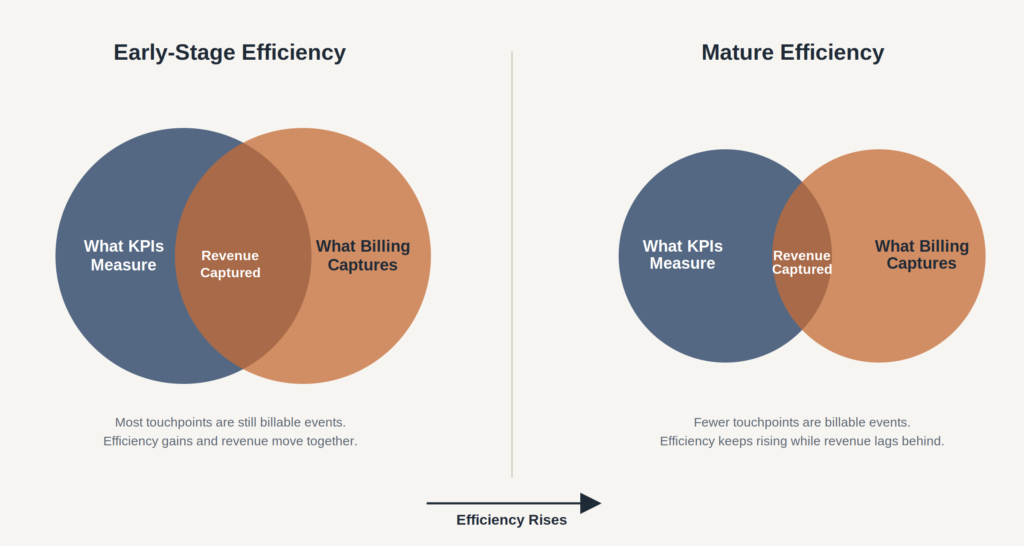
Here’s the mechanism in one line: your KPIs measure fewer visits, faster resolution, and fewer touchpoints, but under a lot of service billing models, those touchpoints were the revenue.
Here’s what that means in practice. In a transactional or break-fix model, you don’t get paid for “service” as a concept, rather you get paid for each discrete, billable event: the visit itself, the labor hour, the part replaced, the follow-up call. Every one of those events is a line item on an invoice. So, when First Time Fix Rate climbs, you’re not just closing tickets faster, you’re eliminating the second visit, the extra labor hour, and the follow-up part order that used to come with it. The KPI is measuring exactly the events your invoice used to depend on. Improve the KPI enough, and you’ve engineered those billable events out of existence, one ticket at a time.
Maturity doesn’t cause the decline. It exposes a pricing model that was never designed to capture the value that maturity creates. A service organization can get measurably better at its job and get paid measurably less for it, because the thing it’s improving and the thing it’s billing for turned out to be the same line item.
This is a deeper version of a misalignment problem worth naming on its own: improving one operational lever can quietly undermine another, and revenue is often the lever nobody’s watching. Manufacturing & Automotive After-Sales Service: Strategy, KPIs & Digital Transformation digs into how these KPI trade-offs play out more broadly across a service organization.
Which of Your Service Contracts Are Losing Revenue to Efficiency
The paradox doesn’t hit every customer account the same way. It depends entirely on how that account is billed and most aftersales books run three distinct tiers.
Strategic and Key Accounts (Outcome or Fixed-Fee Contracts)
These accounts run on predictive or preventive coverage, often with parts bundled and pricing tied to uptime or SLA terms rather than visit count. Here, the paradox is muted, but it doesn’t disappear. A predictive maintenance program that cuts reactive interventions by 30% within a flat-fee contract doesn’t lose revenue immediately. It loses something slower and more dangerous: renewal leverage. It’s the exact data point a customer’s procurement team will use to ask why they’re paying the same fee for fewer interventions.
Mid-Tier and Hybrid Accounts
This is the segment most leaders assume is “covered” by contract, and it’s usually the most exposed to silent erosion. These accounts run on a base maintenance fee plus billable extras: parts, out-of-scope labor, extended visits. Efficiency gains quietly shrink that billable-extras layer while the base fee still looks healthy on the P&L. Nobody notices until someone runs the account-level margin, not just the top-line contract value.
Long-Tail and Transactional Accounts (Break-Fix, Pay-Per-Visit)
Full, direct exposure. This is where the mechanism is easiest to see: a 10-point FTFR gain across 500 annual break-fix visits can mean 40 to 50 fewer billable callbacks in a single year. That is real revenue gone quietly yet with a KPI dashboard that looks better than ever.
| Segment | Where the Paradox Shows Up | What It Looks Like in the Numbers |
|---|---|---|
| Strategic / Key Accounts (Outcome or Fixed-Fee) | Renewal leverage, not immediate revenue loss | 30% fewer reactive interventions within a flat-fee contract. No revenue drop yet, but procurement notices at renewal |
| Mid-Tier / Hybrid Accounts | Silent erosion under a healthy-looking base fee | Billable-extras layer (parts, out-of-scope labor) shrinks while base fee revenue stays flat and masks the trend |
| Long-Tail / Transactional Accounts (Break-Fix, Pay-Per-Visit) | Direct, immediate revenue loss | 10-point FTFR gain across 500 annual visits ≈ 40–50 fewer billable callbacks per year |
The Four-Point Service Revenue Diagnostic
Before the fix, run your own numbers against these four checks. If two or more come back true, this isn’t a KPI problem but a pricing problem.
1. Fewer repeat visits
Ask: Has your repeat-visit or callback rate dropped in the same period FTFR rose?
Tell: If yes, and the account bills per visit, that’s a removed revenue event, not just a fixed inefficiency.
2. First-time-fix kills the parts tail
Ask: Has average parts revenue per work order dropped alongside FTFR gains? Check parts-attach rate specifically, since aggregate volume can mask the trend.
Tell: Fixing it right the first time often means fewer parts touched across the life of the job.
3. Predictive maintenance shrinks the reactive pool
Ask: What share of this years’ service revenue came from reactive work versus last year?
Tell: If reactive revenue is shrinking faster than contract revenue is growing to replace it, your billing model is falling behind the value your operations are creating.
4. SLA commitments absorbed the gain
Ask: Did your last two or three contract renewals tighten SLA terms such as faster response or higher uptime without a price increase?
Tell: If yes, the efficiency gain already left the building. It was contracted away as a customer benefit instead of captured as margin.
The Fix: Reprice the Model, Don’t Reverse the Efficiency
The answer is not to slow down. Slowing down FTFR or MTTR to protect revenue is the wrong lesson to take from this. It trades a pricing problem for a customer experience problem, and it won’t hold up under any real scrutiny.
The actual fix: stop billing for the activity you’re deliberately eliminating, and start billing for the outcome that activity used to produce.
In practice, that means segmenting the book before the next KPI review, not after:
- Break-fix accounts most exposed to direct erosion: Pilot outcome or uptime-based pricing on one or two contracts before attempting a portfolio-wide shift.
- Strategic accounts approaching renewal: Get ahead of the conversation. Reframe predictive maintenance value around risk avoidance and uptime, not visit count, before procurement raises it first.
- Hybrid accounts: Audit the billable-extras layer specifically. A healthy base fee can be hiding real margin erosion underneath it.
Why Uptime Is the KPI That Really Matters in Service makes the fuller case for pricing around outcomes rather than activity, if you want to take this further with a specific account.
Every Efficiency Win Is a Revenue Problem You’re Creating for Next Year, Unless You Reprice It
That’s the sentence worth sitting with. Every efficiency gain your team posts this year, under a billing model still priced for last year’s version of the business, becomes next year’s uncomfortable finance conversation.
The fix isn’t complicated, but it does require treating pricing as an operational lever, not a once-a-year contract renewal formality. Audit your top contracts by segment (strategic, hybrid, break-fix) before your next KPI review, not after finance asks the question for you.
Efficiency-first thinking without a pricing strategy attached is a maturity-stage trap, not a permanent state. The AI-in-Aftersales maturity framework maps out where this fits on the broader maturity curve.
Caught between hitting your efficiency targets and defending flat service revenue?
Share your experience via the contact form. Practitioner inputs shape the content on this site.