

Sales closes a multi-year deal. The project team spends a year or two installing and commissioning equipment on-site. Handover to Service happens, mostly with a signature, a punch list, maybe a PDF stapled to a project closure email. For most service organizations, the real moment of truth arrives 18 months later, when a service request comes in and nobody can answer the basic question: what did we actually install here?
Mature organizations have a fix for this, sort of a workaround. They deploy a field technician to walk the site and rebuild a fresh list of the installed base from scratch. But the site visit is only the start. What follows is a tedious admin exercise: pulling data from three or four disconnected sources including the original sales order, the project team’s commissioning notes, the warranty terms, the contract, and then manually piecing them together into something usable. The technician can tell you what’s physically there. Nobody can quickly tell you when it was installed, what warranty applies, or what was flagged during commissioning, because that information is scattered across systems and people who never talk to each other.
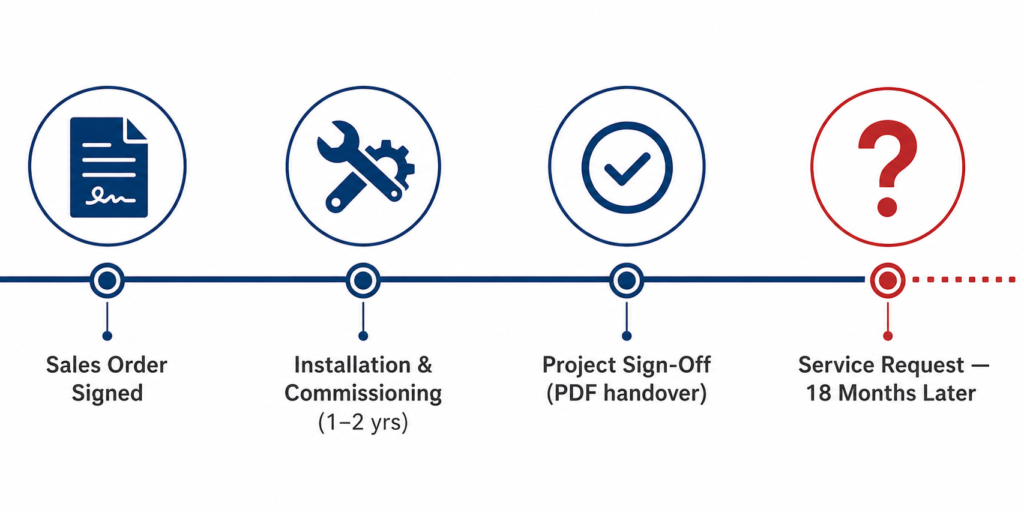
Asset Data Problem or Ownership Problem: What’s Really Failing at Handoff
Almost every service leader will say this is broken. Few will say it’s fixable, because the incentives on either side of the handoff don’t point the same direction. Project teams are measured on commissioning sign-off and schedule adherence, get the asset running, get the customer’s signature, close the project. Service enablement isn’t part of that scorecard. Service teams, meanwhile, inherit the asset, the warranty clock, and the SLA obligations, with no authority over how the handoff happened in the first place.
No shared KPI. No shared owner. No single function truly owns the lifecycle accuracy of that data with no consequence on either side when the data doesn’t transfer cleanly. It’s an incentive design problem more than a technology one, which is exactly why it tends to persist even in organizations that have invested heavily in systems.
Why Manufacturers Reach for Workarounds Instead of Fixing the Handoff
Faced with a gap that’s hard to close organizationally, service teams route around it: physical asset audits, IoT tagging retrofitted after the fact, standalone asset registries rebuilt from whatever field data can be scraped together, connected-asset platforms layered on top. These genuinely help. Better asset visibility and lifecycle control compound into real revenue, from contract attach rates to obsolescence management. But what they are actually solving for is to rediscover what the organization should already know, not why the data never flowed downstream in the first place.
Installed base data sits at the intersection of sales, service, warranty, contracts, supply chain, and dealer operations, and in most organizations no single function truly owns the lifecycle accuracy of that data. Customers often know more about what’s been modified, relocated, or decommissioned than the manufacturer does. That’s telling, because the gap isn’t an absence of technology since manufacturers already run CRM, ERP, field service management, IoT, and asset management systems. The gap is between what those systems were built to capture and what operational reality produces over time.
| Workaround | What it actually fixes | What it misses |
|---|---|---|
| Field technician site audit | Current physical inventory | Install date, warranty terms, commissioning history |
| IoT asset tagging | Ongoing location/status tracking | Retroactive data on already-installed assets |
| Standalone service-side registry | A working copy of “what’s here” | Single source of truth; drifts from ERP over time |
| Connected-asset platform | Visibility, lifecycle control | The upstream data-capture gap that caused the drift |
Fixing the Project-to-Service Handoff at the Source
The fix isn’t another site visit or another platform. It’s using the system that already holds most of the answer. The ERP already has the order and shipment data: what was sold, what shipped, when. The project team then installs and commissions those assets on-site, but the installation data such as exact location, configuration, parts changed, commissioning date, punch-list issues usually gets logged somewhere ad hoc: a spreadsheet, a project management tool, a folder that never talks back to the ERP.
The fix is to collate that data back into the same system of record: tag installed assets to their original sales order, build the equipment hierarchy (parent asset, sub-components), tag warranty windows against actual install date rather than ship date, and make this validation a mandatory gate the project team must clear before the project can be marked closed. What gets handed to service at that point isn’t a PDF, rather a structured, warranty-tagged asset record with one source of truth, and no admin scramble required to reconstruct it. A handover data contract isn’t a new system. It’s a governance gate on the one you already have.
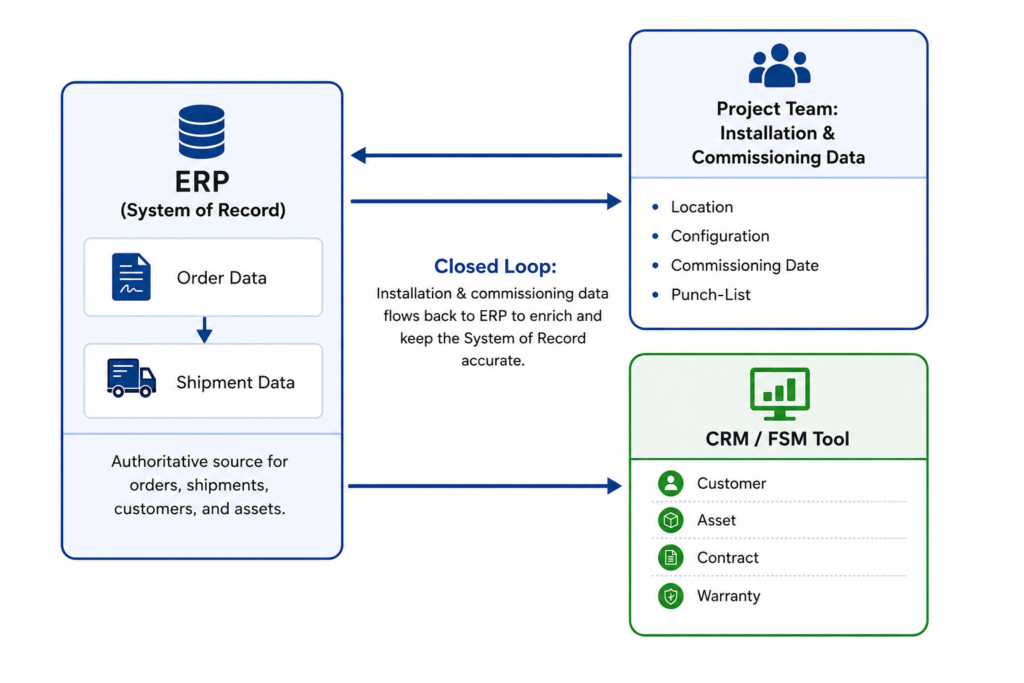
Why the Simple Fix Doesn’t Happen Anyway
If it’s this straightforward, why doesn’t it happen? Because it isn’t unsolvable, it’s unsponsored. Closing this gap requires someone senior enough to own both project delivery and service outcomes, with the authority to mandate a data gate that neither function will build voluntarily on its own. That role often doesn’t exist on the org chart. Project and service usually roll up to different leaders, sometimes different P&Ls, and nobody’s incentives depend on the handoff working.
Until that ownership question gets answered, manufacturers will keep absorbing the cost of the gap in site visits and admin hours, one workaround at a time, instead of closing it at the source.
Lost hours tracing asset history that should’ve transferred at handoff?
Share your experience via the contact form. Practitioner inputs shape the content on this site.