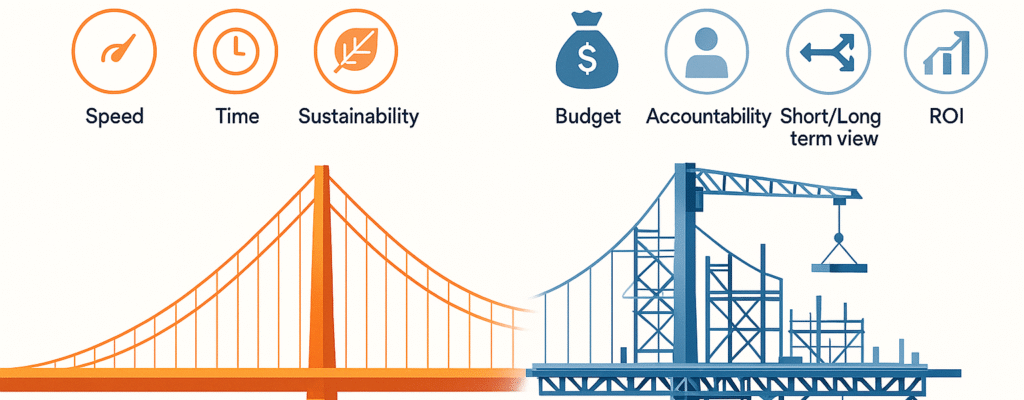
OEM spare parts have been the most reliable margin engine in aftersales for decades, and with good reason. Gross margins of 30–50% compared to 15–25% on new equipment sales, with parts and service contributing up to 40% of total OEM profits in automotive. Proprietary control, guaranteed compatibility, and brand trust created conditions where premium pricing was both justified and commercially defensible. For most of that period, the model was also stable, and customers stayed within OEM channels because the alternatives were limited, the quality gap was real, and switching required more effort than the saving justified.
That stability is now eroding. The independent aftermarket has grown steadily for years, but what was a gradual drift has become a measurable shift, and the data from the last 12 months suggests it is accelerating.
Parts pricing isn’t the problem. Parts pricing without a ceiling is.
The Numbers Every Aftersales Leader Should Be Reading
The numbers that have emerged from independent studies tell the same story from three different angles. The shift away from OEM parts is not a gradual drift. It is an accelerating trend with a clear directional signal across multiple independent data sources.
57% of consumers in Western markets now choose independent aftermarket parts over OEM, up 14 percentage points from 2024, according to Roland Berger’s Aftermarket Pulse 2025. That is not a marginal shift. That is a majority of the addressable market moving in one direction in a single year. US consumer preference for independent repair shops over OEM-authorized centers grew from 50% in 2023 to 56% in 2024, driven primarily by lower prices and shorter wait times (Roland Berger, 2024).
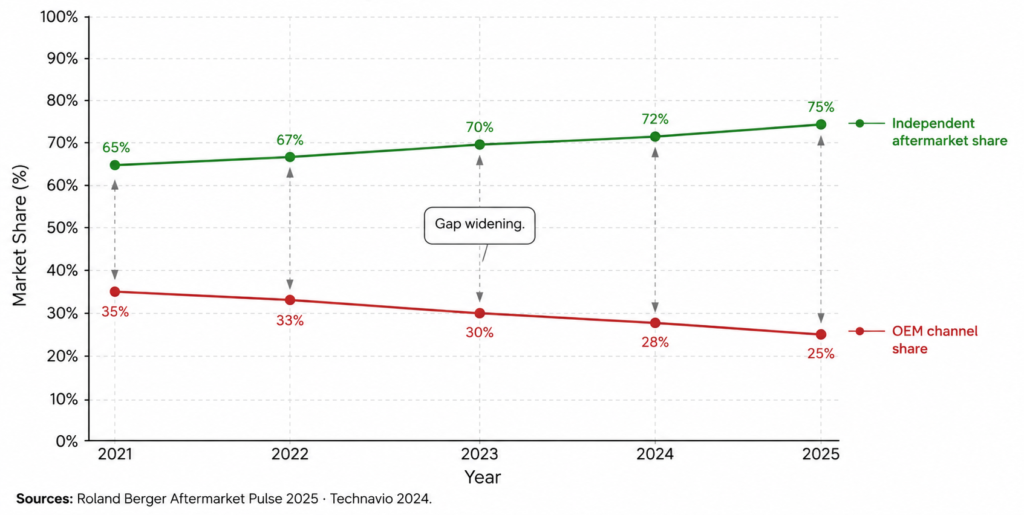
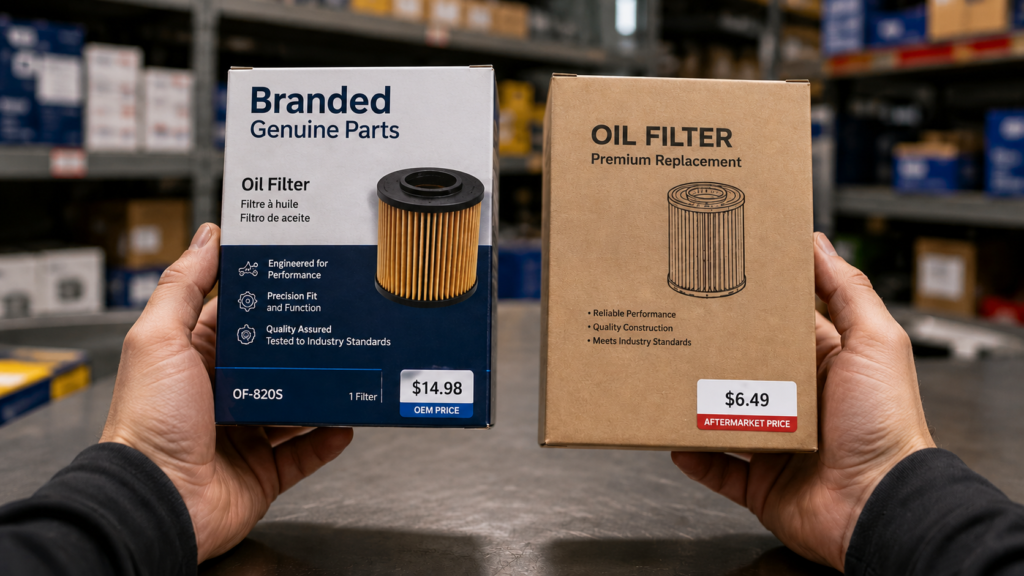
The independent aftermarket already accounts for approximately 75% of overall US automotive parts sales (Technavio, 2024). OEM parts are priced 30–50% above independent alternatives on average, a premium that was historically justified by quality assurance and brand trust and is now being systematically questioned by both customers and workshops.
The executives closest to the market already know what is coming. 65% of aftermarket executives see risk of margin compression ahead, up 22 percentage points from the prior year (McKinsey, 2024).
- 57% of Western consumers now choose IAM parts over OEM, up 14 points in one year (Roland Berger, 2025)
- 56% of US consumers prefer independent repair shops over OEM channels (Roland Berger, 2024)
- 75% of US automotive parts sales flow through independent channels (Technavio, 2024)
- OEM parts priced 30–50% above independent alternatives on average
- 65% of aftermarket executives see margin compression risk ahead, up 22 points year-on-year (McKinsey, 2024)
The aggregate service gross margin impact of this shift is still masked in most OEM financial reporting, because parts revenue decline is attributed to market conditions rather than pricing decisions. That attribution will become harder to sustain as the trend accelerates.
Why the Tipping Point Has Arrived It Differs Across the Portfolio
Not all parts defection happens at the same rate or for the same reason. Understanding the three distinct dynamics helps OEMs identify where the tipping point has already been crossed and where it is approaching.
- The post-warranty customer has no remaining reason to comply. During the warranty period, customers use OEM parts because the alternative risks voiding coverage. The moment warranty expires, price becomes the primary decision variable. 245 million vehicles in China alone are expected to be out of warranty by end of 2025 (Straits Research). OEMs lose the captive customer at precisely the moment the asset requires the most maintenance. If the pricing relationship during the warranty period has been purely extractive, there is no loyalty reservoir to draw on when it ends.
- Quality parity perception is eliminating the premium justification. Workshops and customers are gaining confidence that independent parts deliver comparable quality at a significantly lower price. Some aftermarket parts are made by the same component suppliers as OEM equivalents, sold under a different label. When that becomes widely known, and it increasingly is, the quality argument for the premium collapses. The remaining justification is brand trust alone, which is a legitimate commercial position but a structurally fragile one.
- Dealer sourcing behavior is the most damaging dynamic, and the least visible. When OEM parts pricing crosses the dealer’s own margin threshold, dealers begin sourcing from independent suppliers and presenting those parts as OEM-compatible. The OEM loses the revenue. The OEM keeps the reputational risk, if an independent part fails on a vehicle serviced at an authorized dealer, the customer blames the brand, not the dealer’s sourcing decision. This dynamic connects directly to the outward leakage patterns in warranty management where dealer sourcing decisions affect both parts revenue and claims integrity simultaneously.
When the dealer network starts sourcing around the OEM, the OEM loses the revenue and keeps the reputational risk.
Why OEMs Keep Pulling the Same Lever and What It Actually Costs
This is the part of the conversation that most commercial reviews skip.
Parts pricing is the path of least resistance for aftersales margin. It requires no new capability, no new commercial model, and no organizational change. Raise the price list, protect the margin, report the result. The downstream consequences such as customer defection, dealer workarounds, independent aftermarket share gain, appear in the numbers one to three years later, by which point the pricing decision that caused them is long forgotten.
Other service revenue avenues are harder to build. Contracts, connected services, capability-based offerings, and outcome models all require cross-functional alignment, new skills, longer payback periods, and a willingness to redefine what the aftersales business is actually selling. Under quarterly margin pressure, the parts price lever gets pulled again instead.
The compounding problem: every time it gets pulled past the tipping point, it accelerates the defection that makes the next pull less effective.
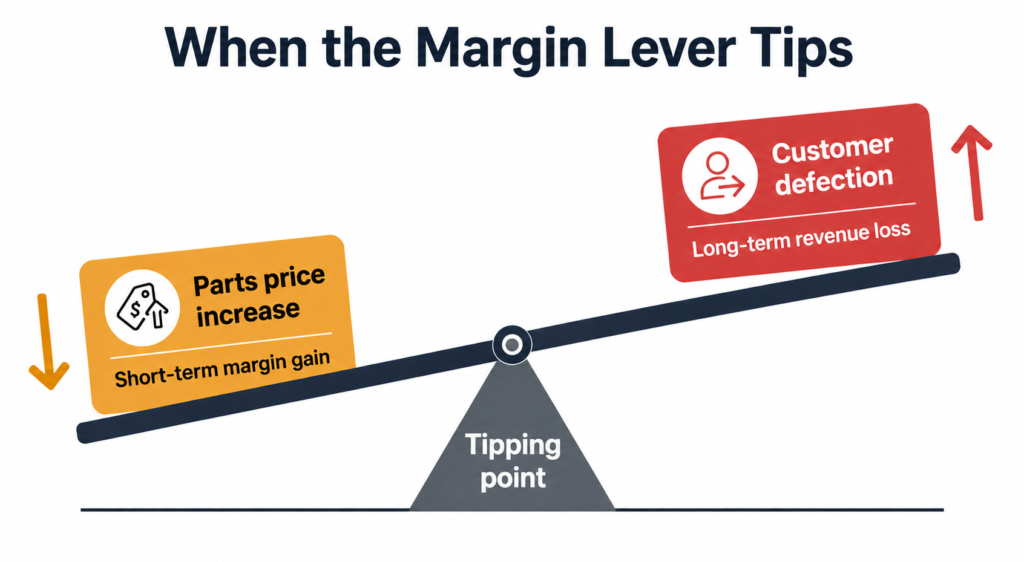
The revenue that disappears from the model is also rarely visible in the parts pricing decision itself. A customer who switches to independent parts typically moves their entire service relationship to an independent workshop thus taking labor revenue, contract revenue, and future parts revenue with them. The part margin is visible in the quarter it is earned. The downstream revenue loss appears gradually across subsequent periods, attributed to market conditions or competitive pressure rather than the pricing decision that preceded it. The installed base coverage rate is the metric that captures this downstream loss most accurately, and in most OEM organizations, it is trending in the wrong direction.
Parts pricing is the margin lever that requires the least organizational effort and creates the most organizational dependency. That combination is exactly why it gets overused.
What a Sustainable Aftermarket Revenue Model Actually Looks Like
Four approaches, none revolutionary in isolation, but together representing a fundamentally different commercial logic.
Price with precision across the portfolio, not uniformly. Not all parts carry the same independent competition or the same customer value. Safety-critical and technology-integrated components such as ADAS-linked parts, software-calibrated systems, EV battery management components, carry genuine OEM provenance value that independent alternatives cannot replicate.
Commodity wear parts such as filters, belts, generic consumables, face intense independent competition and low customer switching friction. Pricing both categories identically is commercially imprecise: it leaves margin on the table in safety-critical categories while accelerating defection in commodity ones. McKinsey analysis shows AI-based pricing has enhanced aftermarket margins by 2–6% of sales while maintaining competitive guardrails. The capability to price by competitive exposure now exists. The question is whether it is being used.
Parts and kits contracts to lock in revenue before the defection window opens. This is the industrial OEM’s most practical answer to post-warranty defection and one that automotive OEMs are increasingly adopting. A parts and kits contract locks in the customer’s parts spend at a predictable price for a defined period, typically one to three years, in exchange for a volume or coverage commitment. For the customer it provides price certainty and budget predictability. For the OEM it secures parts revenue before the post-warranty price comparison begins, maintains the service relationship, and keeps the customer inside the authorized network.
The design of these contracts matters significantly with entitlement clarity, pricing indexation, and renewal triggers all determining whether the contract retains customers or creates the complexity problems covered in the service contract management article. As a commercial mechanism, parts contracts are substantially more durable than transactional parts pricing alone.
Subscription models for parts and accessories. Emerging in industrial manufacturing and gaining traction in automotive. Rather than selling parts transactionally, OEMs offer subscription-based access to consumables, accessories, and planned maintenance parts at a fixed periodic fee that is predictable for the customer and recurring for the OEM. The model works best for high-consumption items where demand is reasonably foreseeable. It also creates a natural cross-sell pathway: a customer on a consumables subscription is significantly more receptive to a service contract conversation than one who only interacts with the OEM at the point of a transactional parts purchase.
Build genuine revenue avenues, not new ways to squeeze existing ones. The parts pricing dependency is partly a symptom of a broader failure: most OEM aftersales organizations have not built the alternative revenue streams that would reduce their reliance on parts margin.
Connected services like remote monitoring, predictive maintenance, software updates, performance analytics, generate recurring revenue from asset operational data rather than physical parts consumption. Capability-based offerings like training, certification, complex technical support, outcome guarantees, generate margin from knowledge and expertise that independent channels structurally cannot replicate. Nearly half of workshops in 2025 reported turning down ADAS-related repairs due to equipment costs and knowledge gaps (Roland Berger, 2025). OEMs that invest in equipping their authorized networks to handle technically complex repairs are building a parts and service premium in precisely the categories where it is most defensible and where independent competition is furthest behind.
The direction is clear: revenue from genuine value, technical capability, data intelligence, outcome assurance is more sustainable than revenue extracted from pricing power over a customer base that is becoming less captive every year.
The question isn’t whether OEM parts should command a premium. It’s whether the premium being charged today is building the customer relationship or quietly ending it.
Final Thoughts
The external studies tell the same story from three different angles: OEM parts pricing has crossed the tipping point in commodity categories, the shift is accelerating, and the executives closest to the market already know it.
The OEMs that sustain aftermarket margin through the next decade will be the ones that price with commercial precision across their parts portfolio, build contractual retention mechanisms before the post-warranty defection window opens, and invest in the connected and capability-based revenue streams that create defensible value rather than extracting from diminishing pricing power.
The parts pricing lever still works. It just no longer works alone.