Mihir Joshi

Dealers Changing Role in OEM Aftersales

The Dealer’s Changing Role in OEM Aftersales: Partner, Channel, or Liability?

OEMs are quietly undermining the dealer networks they still depend on for last-mile service delivery. This article examines four friction points reshaping the OEM-dealer relationship in automotive and industrial manufacturing, and what people, process, and technology changes are needed to build a sustainable model.

The Dealer’s Changing Role in OEM Aftersales: Partner, Channel, or Liability? Read More »

A service technician reviewing a warranty claims dashboard on a monitor in a manufacturing dealership environment

Warranty Management in Manufacturing: Why Outward Leakage Is Your Biggest Hidden Cost

Warranty management in manufacturing goes far beyond claims processing. Most organizations have digitized intake but still lose millions through dealer fraud, registration gaps, and ignored quality signals. This guide maps where warranty breaks down across the full lifecycle, and how AI in warranty management is helping close the gap.

Warranty Management in Manufacturing: Why Outward Leakage Is Your Biggest Hidden Cost Read More »

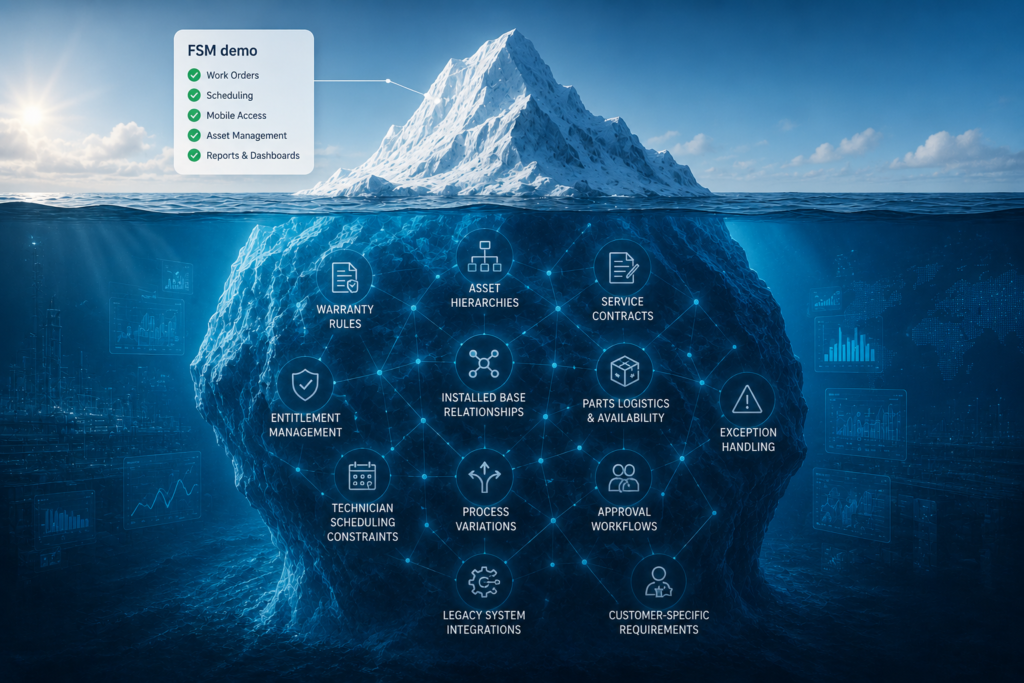
Iceberg diagram showing AI readiness gap with strategy above water and execution factors like data, process, and systems below

The AI Readiness Trap: Why AI Readiness Assessment Should Come Before Roadmap

Most organizations believe they’re ready for AI because the roadmap looks solid. But execution tells a different story. When ambition outpaces data, processes, and systems, initiatives stall. This gap between intent and capability is where AI efforts fail, and where the real work of readiness actually begins.

The AI Readiness Trap: Why AI Readiness Assessment Should Come Before Roadmap Read More »

AI prioritization framework showing progression from ideas to impact using business impact and data readiness model

Where Should You Start with AI in Aftersales? A Practical Prioritization Framework for Service Organizations

Most AI initiatives in aftersales fail not due to lack of ideas, but poor prioritization. This article introduces a practical framework to help service organizations decide where to start, based on business impact and data readiness, so they can sequence AI investments effectively and avoid costly, unscalable pilots.

Where Should You Start with AI in Aftersales? A Practical Prioritization Framework for Service Organizations Read More »

CRM junk folder showing ignored installed base service leads worth $10M in lost service revenue

The $10M Junk Folder: Why Installed Base Revenue is Lost

Installed base revenue often goes unrealized even when analytics uncover valuable service opportunities. In many organizations, these leads disappear inside CRM pipelines as sales teams prioritize larger deals. This article explores why service-generated opportunities get ignored, and how manufacturers can redesign the service-to-sales handoff to capture millions in lifecycle revenue.

The $10M Junk Folder: Why Installed Base Revenue is Lost Read More »

IT OT integration in manufacturing connecting machine data with aftermarket service operations

IT-OT Integration in Aftersales: Turning Machine Data into Service Revenue

Manufacturers invest heavily in ERP systems and industrial IoT, yet many still operate with a critical blind spot: enterprise systems disconnected from machine reality. This article explores how IT-OT integration in aftersales operations unlocks service revenue, improves field service efficiency, and enables outcome-based service models.

IT-OT Integration in Aftersales: Turning Machine Data into Service Revenue Read More »

team working while mirror reflects executive dashboard showing project status indicators

When the Dashboard Becomes the Project

Executive dashboards promise clarity, but poorly sequenced rollouts can shift teams from execution to optics. When red-green status indicators become visible to leadership before workflow discipline stabilizes, teams optimize for the dashboard instead of the work. This article explores how transformation leaders can design dashboard rollouts that improve governance without creating delivery friction.

When the Dashboard Becomes the Project Read More »

Digital industrial control panel connecting installed base assets to revenue levers and growth dashboard.

Service Revenue Execution: Why the Levers Matter More Than the Strategy

Service revenue growth in manufacturing doesn’t fail because of weak strategy, it stalls due to execution gaps. This article explains how aligning ownership, incentives, and revenue levers such as contracts, parts pricing, and warranty governance determines whether installed base potential becomes measurable, scalable growth.

Service Revenue Execution: Why the Levers Matter More Than the Strategy Read More »

Scroll to Top